Calculate losses
 in tendons
Introduction
CivilFEM takes into account the post-tensioned internal adherent reinforcement and the pretensioned reinforcement.
Prestressing with post-tensioned reinforcement is done alter the concrete is built. Reinforcement goes through ducts which are left inside concrete. When concrete has achieved its required strength, the prestressing process is done.
For pretensioned reinforcement, the tendons are prestressed before concrete is placed and are anchored to provisional restraining elements. When concrete has achieved its required strength, the reinforcement is freed from the restrains, and due to the adherence between the reinforcement and concrete, the prestressing action is transferred to the concrete.
Immediate losses
The immediate losses of prestress occur once the prestressing force is applied, after the concrete has been placed and cured, and when the tendons are anchored.
Its value for pre-tensioned members is the following:
Where:
P1: Losses due to steel relaxation before transfer and due to heating.
P2: Losses due to thermal steel expansion.
P4: Losses due to the slippage of strands in the anchorages.
P5: Losses due to elastic shortening of concrete member.
For post-tensioned members, its value is the following:
Where:
P3: Losses due to friction through the prestressing duct.
P4: Losses due to the slippage of strands in the anchorages.
P5: Losses due to elastic shortening of concrete member.
Losses due to steel relaxation before transfer and due to heating. (P1)
This loss is provided by the manufacturer. User can introduce this value in losses tables of each tendon.
Losses due to thermal steel expansion (P2)
Thermal steel expansion losses due to heating process are given by the following equation:
Where:
|
K
|
Thermal reduction factor. By default it is equal to 0.9 (Value proposed by CEB-FIB Code)
|
|
|
Thermal expansion coefficient of the tendon steel.
|
|
Ep
|
Elasticity module of the tendon steel.
|
|
Tc
|
Heating temperature at production process.
|
|
Ta
|
Environment temperature at production process.
|
Losses due to friction (P3)
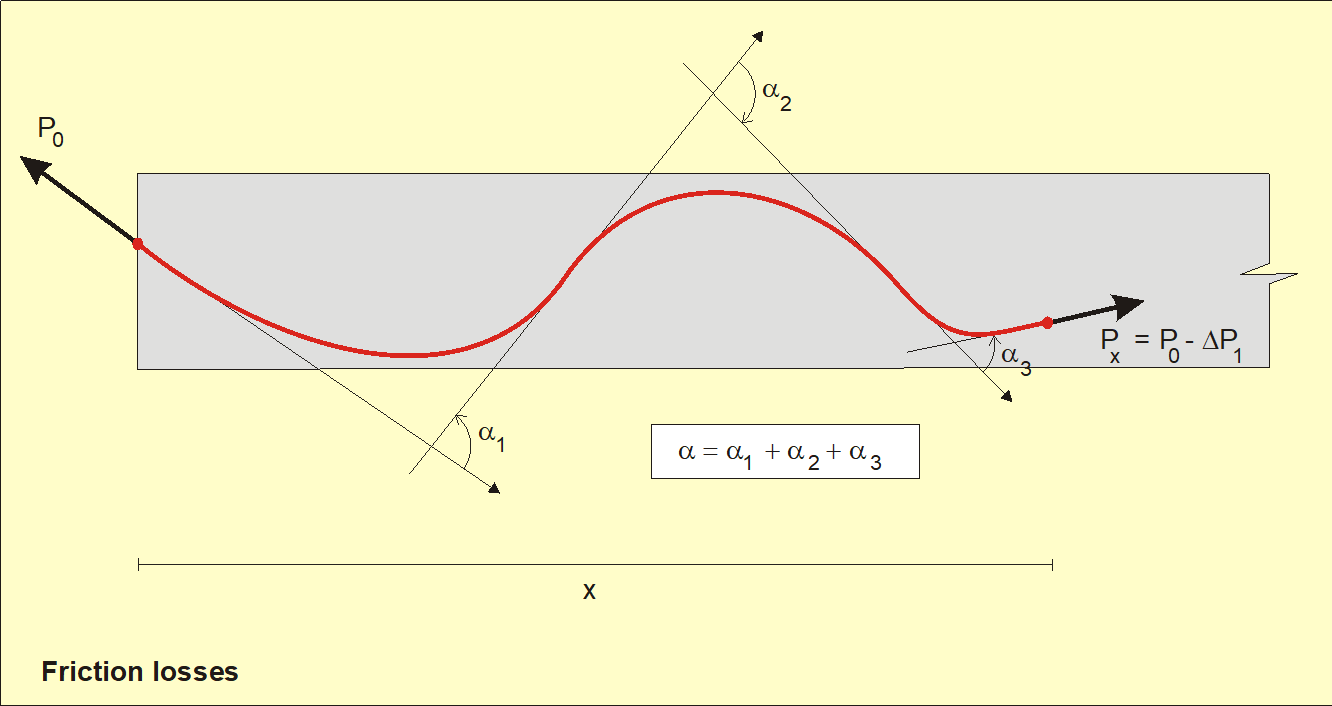
The prestressing friction losses between a given point, normally the anchorage device, and other point located at a distance x from the first one is given by the following equation:
Where:
|
P0
|
Initial tendon prestressing force.
|
|
μ
|
Friction coefficient between the tendons and their casing.
|
|
α
|
Sum of the angular displacements, measured in radians, over a distance x. The tendons layout can be a warping curve, evaluating in the space.
|
|
K
|
Unintentional angular displacement per unit length.
|
|
X
|
Real distance through the tendon between the considered section and the operative anchorage device.
|
The μ and K values are defined in the material properties associated to the tendon.
Losses due to slippage of strands in the anchorages (P4)
These losses take place when there is a drive-in of the tendons at the anchorage, during the operation of anchoring after tensing, and of the deformation of the anchorage.
The anchorage slip value is established in the material associated to the corresponding tendon.
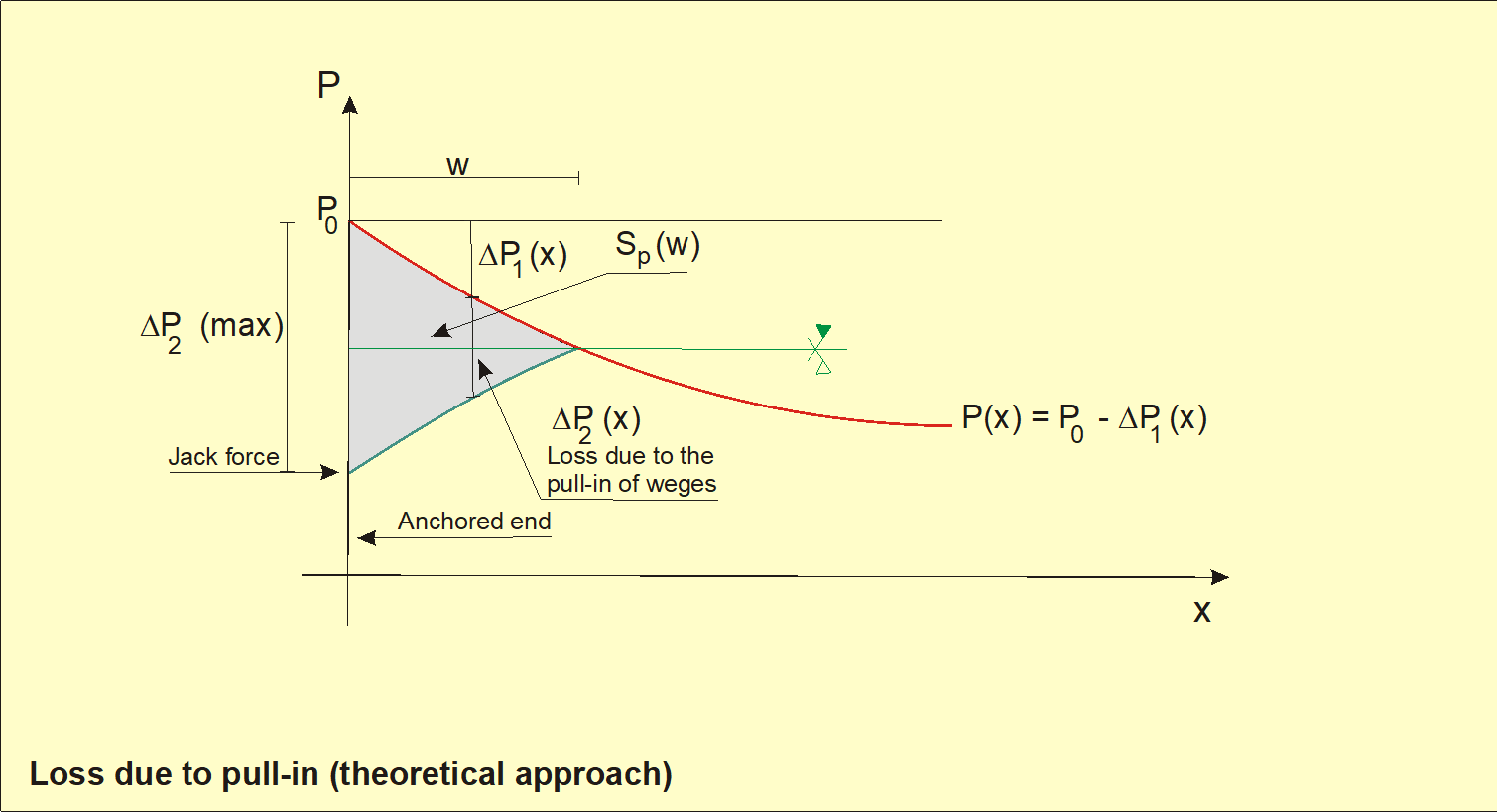
Due to the friction, the value of this loss depends on the distance to the anchorage device.
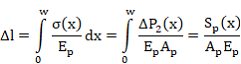
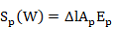
The shortening of the cable produces a relaxation that is developed through an extension w in plan view in such way that the following condition is verified:
Or
The problem is solved if found the extension w for which the value of the shadowed area of the bellow figure, divided by the product Ep .Ap, coincides with the elongation l = a, of slip anchorage.
CivilFEM contemplates the possibility of partial tensing and releasing. The losses due to the releasing operation are calculated in the same way as for the anchorage slip losses, taking, in this case, the stress increment as known datum.
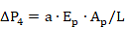
The slippage of strands in the anchorages for pre-tensioned members produces a constant loss in the length of the tendon due to absence of the friction. This value is given by the following equation:
Where:
|
a
|
Anchorage slip.
|
|
L
|
Length of the tendon.
|
|
EP
|
Elasticity module of the tendon steel.
|
|
AP
|
Area of tendon.
|
Losses due to elastic shortening of concrete (P5)
CivilFEM allows for the step by step tensing of the tendons. It means the possibility of prestressing one or more tendons at the same time, when other tendons have already been anchored.
Tensing a tendon causes some instantaneous deformations in the concrete member and, therefore, it causes losses in the previously anchored tendons.
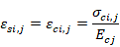
The deformation caused by prestressing a j tendon in the concrete member adjacent to the already anchored tendon i and in the tendon itself has the following value:
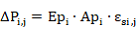
Therefore, the loss in the anchored i tendon force, caused by the j tendon prestressing, will be:
Where:
|
|
Area of tendon i.
|
|
|
Elasticity module of steel of tendon i.
|
Therefore:
|
|
Concrete elasticity module at the moment of prestressing the tendon j.
|
|
|
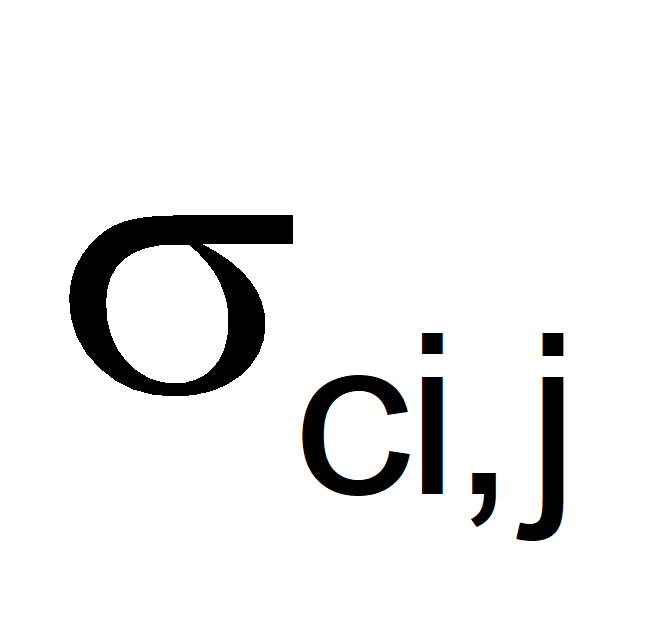
Stress in the concrete adjacent to tendon i. It’s calculated from the acting prestressing force (initial prestressing force less the friction and anchorage slip losses) on the considered point. The self-weight and other permanent actions are not taken into account for this stress calculation.
|
For pre-tensioned members, the elastic shortening of concrete is produced when the tendons are casted off the anchorage. Therefore, the difference to the post-tensioned is that all the tendons are released at the same time.
Long-term losses
The long-term losses are time-dependent losses that occur after the end of the last prestressing operation.
The time-dependent losses are due to the following reasons:
-
Losses due to concrete shrinkage.
-
Losses due to concrete creep.
-
Losses due to steel relaxation.
Losses due concrete shrinkage (P4)
For a given concrete age t, these losses are calculated according to the bellow expression:
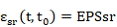
Where εsr (t, t0) is the estimated shrinkage strain (t0 is the concrete age at the initial loading of the concrete). A constant value is taken for this parameter, which is supplied by the user in the material properties definition.
Losses due concrete creep (P5)
These losses are calculated according to the bellow expression:
Where:
|
σcp0
|
Stress in the concrete adjacent to the tendons, due to prestress.
|
|
σcg
|
Stress in the concrete adjacent to the tendons, due to the permanent actions.
|
|
n
|
Equivalence coefficient Ep/Ec.
|
|
φ(t, t0)
|
Creep coefficient for a concrete age t and a concrete age t0 at the initial loading of concrete.
|
The coefficient (t, t0) is taken as a constant that should be defined by the user in the material properties definition.
The value of stress in the concrete due to prestress and to the permanent loads ((cg (x) + cp0 (x)) should be introduced by the user when defining the tendons. It is possible to define a different value for each considered section. By default it is equal to 5 N/mm2.
Losses due steel relaxation (P6)
These losses are calculated from the following equation:
Where:
|
P(x)
|
Force in the tendon after the immediate losses have occurred.
|
|
ρrl (t, σp , fpk)
|
Relaxation function that depends on the active code.
|
a) EUROCODE Nº 2
The value of the relaxation coefficient in each point of the tendon is obtained by interpolating for the stress value and the considered time.
The stress is interpolated from the relaxation values, introduced in the material properties, corresponding to 60%, 70% and 80% of the initial stress with respect to the characteristic tensile strength and to the 1000 hours.
For stress values less than 60%, the interpolation is done considering that the relaxation is null for values under 50%.
The time is interpolated considering that the evolution of the losses between 0 and 1000 hours is the following:
Relationship between relaxation losses and time up to 1000 hours
|
Time in hours
|
1
|
5
|
20
|
100
|
200
|
500
|
1000
|
|
Relaxation losses as % of losses after 1000 hours
|
15
|
25
|
35
|
55
|
65
|
85
|
100
|
The long-term losses are considered to take place for a time corresponding to 106 hours and have a value of LtRat times the relaxation losses at 1000 hours. The LtRat value is defined in the material properties ( by default LtRat = 3).
The calculation of a time exceeding 1000 hours is done by interpolating between this value and the one corresponding to 106 hours.
b) ACI-318 CODES
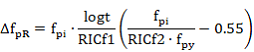
The relaxation losses are calculated by means of the expression:
Where:
|
t
|
time in hours in which the losses are evaluated.
|
|
fpi
|
tendon stresses after discounting the instantaneous losses.
|
|
fpy
|
specified yield strength of presstressing tendons.
|
|
RlCf1
|
Coefficient that depends on the prestressing steel type
|
StTp = 0 (Low-relaxation)
|
RlCf1 = 45
|
|
StTp = 1 (stress-relieved)
|
RlCf1 = 10
|
|
|
RlCf2
|
Coefficient (default value = 1.0)
|
|
|
|
Prestressing losses are not calculated for ACI 359 code.
c) EHE
The relaxation coefficient is calculated as:
Where k1 and k2 are coefficients that depend on the steel type and on the initial stress. The coefficients k1 and k2 are calculated from the material relaxation data corresponding to 60%, 70% and 80% of the stress with respect to the characteristic tensile strength and to the ages introduced by the user. Once these coefficients are obtained, a linear interpolation is done for the given stress, assuming the relaxation corresponding to 50% of the stress with respect to the characteristic tensile strength as null.
|