Polyhedron Generator
Input Data
Input data is entered through the following window:
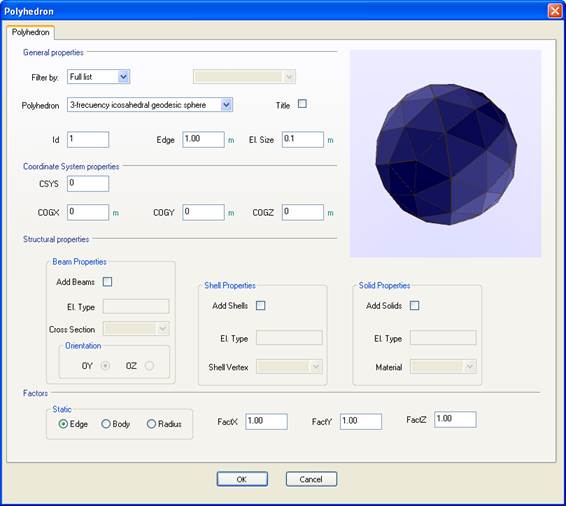
The broad range of polyhedra can be sorted:
- Alphabetically (complete list).
- By its author/origin.
- By its type.
The needed information to create a polyhedron is:
- Polyhedron: The polyhedron is selected from the list of polyhedra.
- Title: The name of the polyhedron is written as the title or not (/TITLE command).
- Id: Polyhedron Id number.
- Edge: Adjustment length of the polyhedron (see Static property).
- El. Size: Size of the mesh divisions (by default Edge/10).
- CSYS: Reference coordinate system (by defautl 0).
- COGX: X coordinate of the center of gravity of the polyhedron.
- COGY: Y coordinate of the center of gravity of the polyhedron.
- COGZ: Z coordinate of the center of gravity of the polyhedron.
- Beam Properties:
o Add Beams: Creates beam elements on the polyhedron’s edges.
o El. Type: Element type defined for the beams.
o Cross Section: Number of the cross section of the generated beam elements.
o Orientation: Beam orientation. It has two options:
· OY: Cross section’s Y axis is placed in the plane defined by the beam and the gravity center of the polyhedron.
· OZ: Cross section’s Z axis is placed in the plane defined by the beam and the gravity center of the polyhedron.
- Shell Properties:
o Add Shells: Creates shell elements on the polyhedron’s faces.
o El. Type: Element type defined for the shells.
o Shell Vertex: Number of the shell vertex of the generated beam elements.
- Solid Properties:
o Add Solids: Meshes the volume of the polyhedron.
o El. Type: Element type defined for the solids.
o Material: Element’s material.
- Static: Specifies which magnitude will be adjusted by the value given in Edge:
· Edge: Adjusts the length of the edge.
· Body: Adjusts the diameter of the polyhedron (maximum distance between two vertex).
· Radius: Adjusts the radius of the circumscribed sphere.
- FactX, FactY, FactZ: Scale factors applied to each of the axes.
Results
Created entites
Depending on the input data and the characteristics of the generated polyhedron, CivilFEM will generate the following entities:
|
K-Points, Links, Areas |
Always |
|
Volume |
If the polyhedron type allows it. |
|
Beam elements |
If chosen |
|
Shell elements |
If chosen |
|
Solid elements |
If chosen and the polyhedron type allows it. |
Components
The generated entities are grouped into component as follows:
|
MODEL |
COMPONENT |
CONTENT |
|
Solid |
PlhdrSolid%Id%K |
K-Points |
|
PlhdrSolid%Id%L |
Lines |
|
|
PlhdrSolid%Id%A |
Areas |
|
|
PlhdrSolid%Id%V |
Volumes |
|
|
Finite Elements |
PlhdrSolid%Id%N |
Nodes |
|
PlhdrSolid%Id%E1D |
Beam elements |
|
|
PlhdrSolid%Id%E2D |
Shell elements |
|
|
PlhdrSolid%Id%E3D |
Solid elements |
|
|
PlhdrSolid%Id%FEM |
All nodes and elements |
Where %Id% is the Id number given to the polyhedron.
Types of polyhedra/primitives
To the available primitives in ANSYS (sphere, cube…), CivilFEM adds more the 170 new solids that are grouped into the following families.
Classification by its author/origin
|
Origin |
Key |
Numbers |
|
Regular or Plato’s polyhedra |
R |
1 to 5 |
|
Kepler-Poinsot star-shaped polyhedra |
KP |
6 to 9 |
|
Semi-regular or Archimedian polyhedra |
A |
10 to 22 |
|
Prisms and Anti-prisms |
PA |
23 to 32 |
|
Catalan’s polyhedra (duals of the Archimedian polyhedra) |
C |
33 to 45 |
|
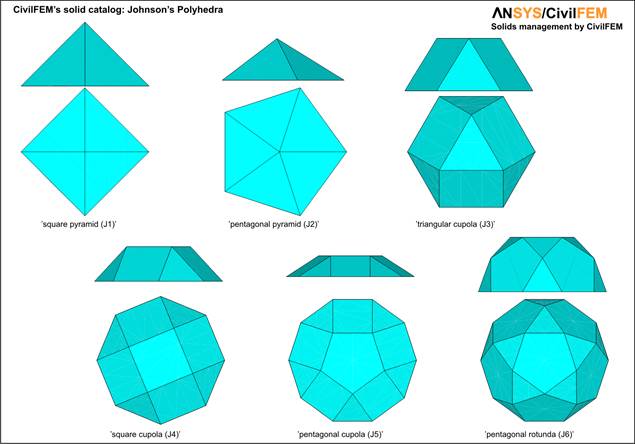
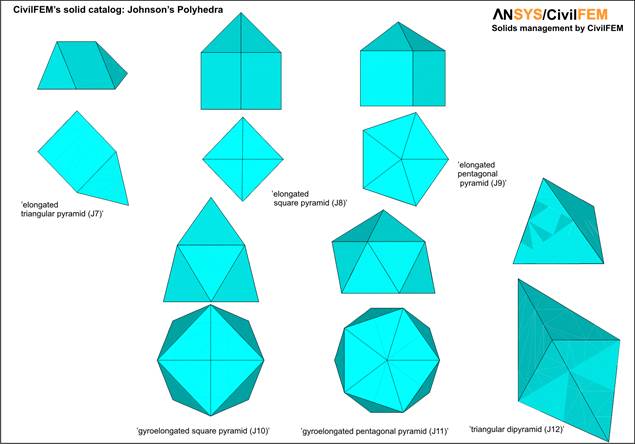
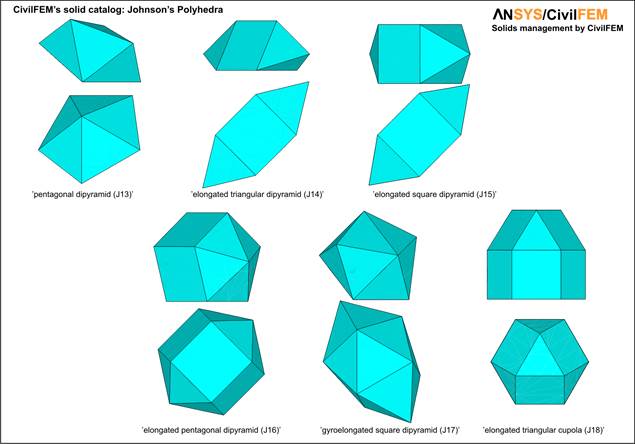
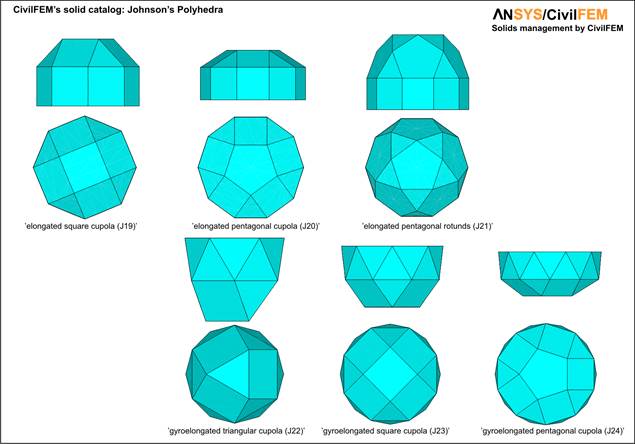
Johnson’s polyhedra |
J |
46 to 137 |
|
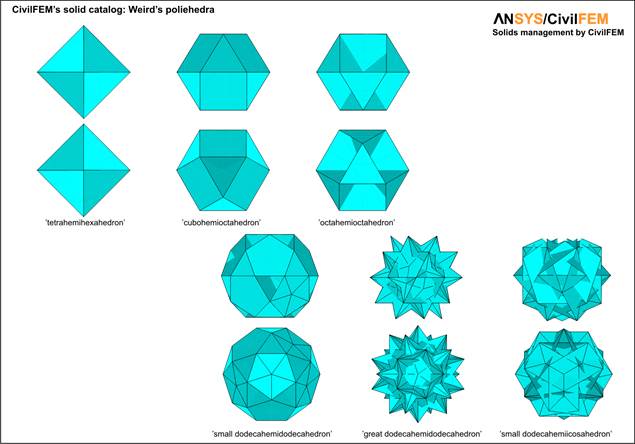
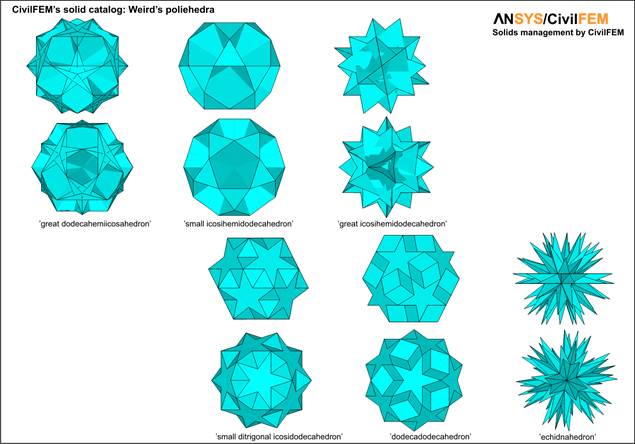
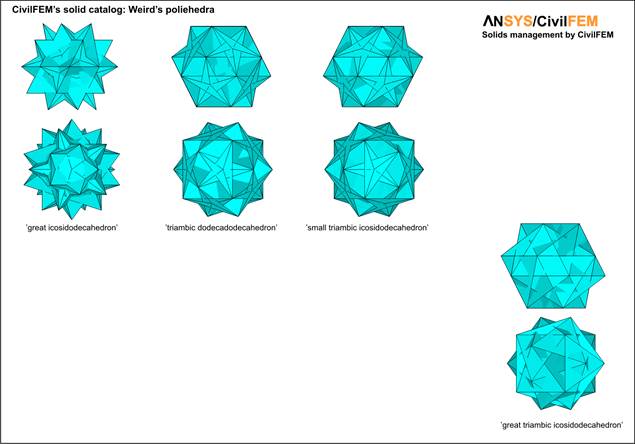
Weird’s polyhedra |
W |
138 to 153 |
|
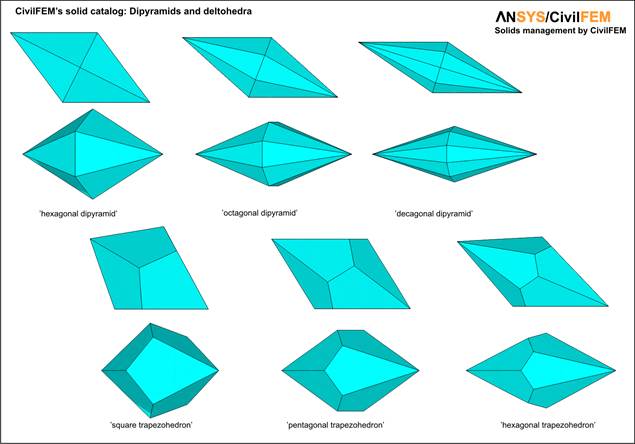
Di-pyramids and deltohedra |
DP |
154 to 161 |
|
Geodesic spheres |
GS |
162 to 170 |
|
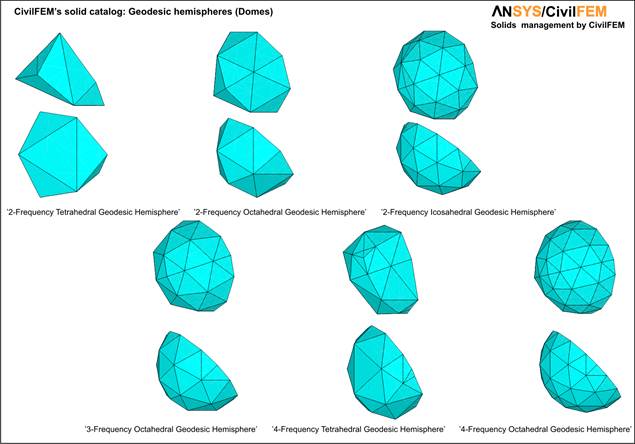
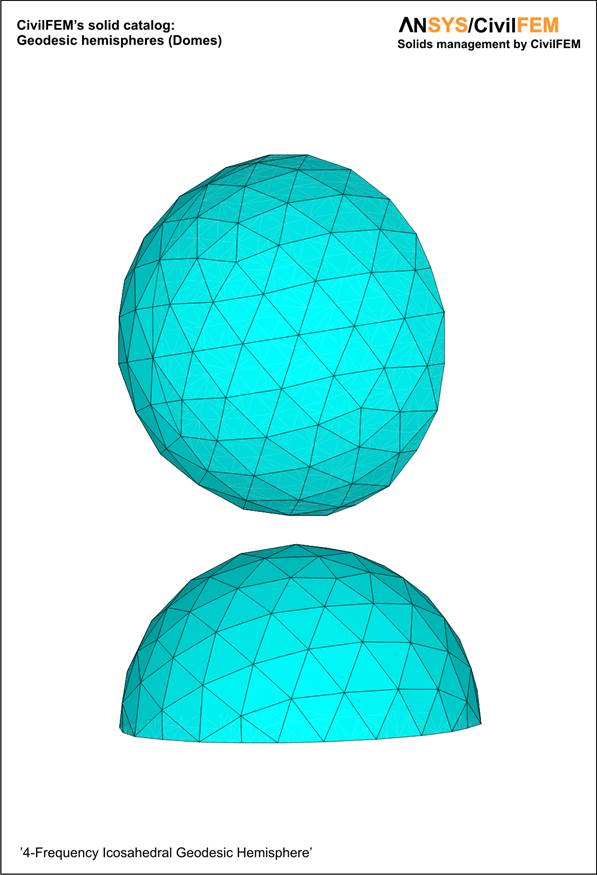
Geodesic hemi-spheres |
GH |
171 to 177 |
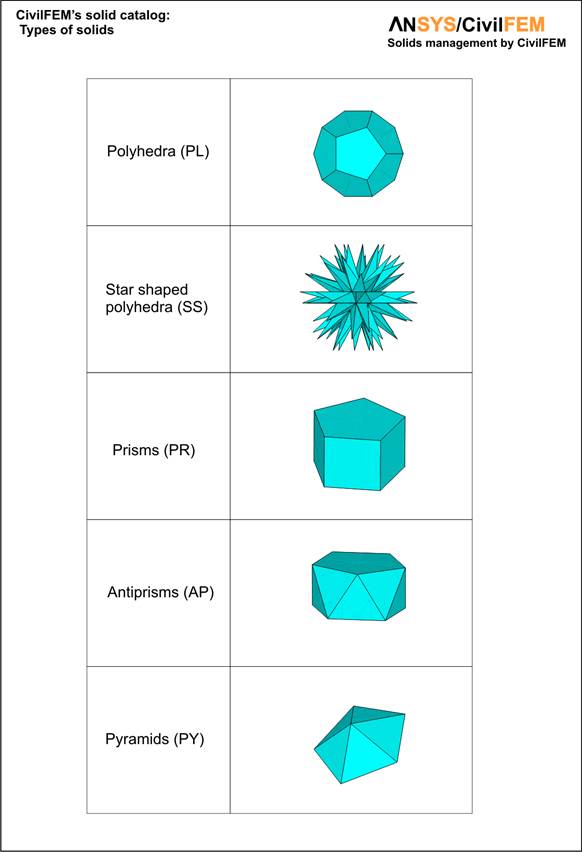
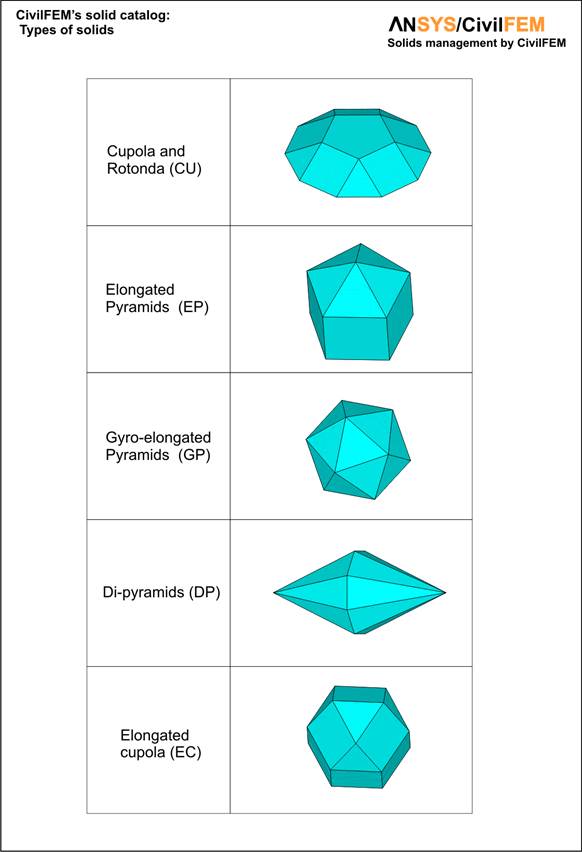
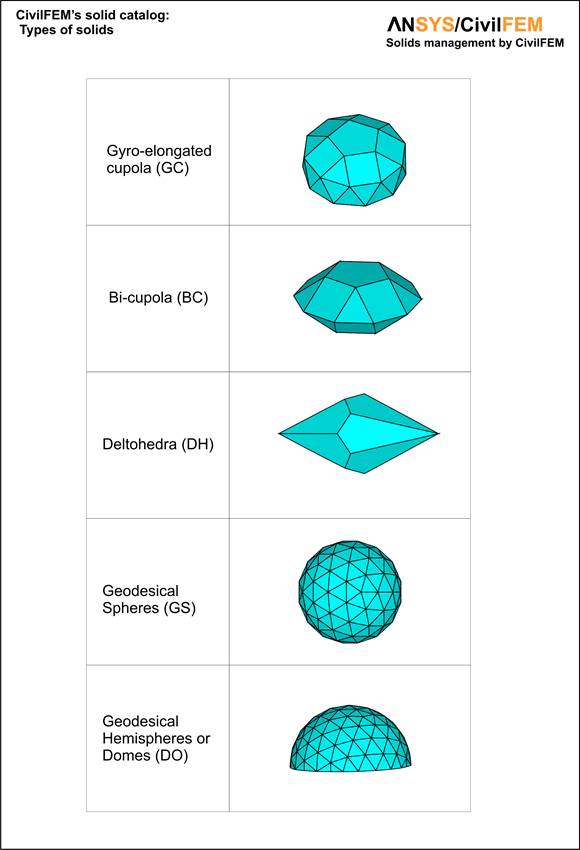
Classification by its shape
According to the shape of CivilFEM’s polyhedra, the following groups can be considered. They are shown with a graphical example:
List of polyhedra/primitives
The following chapters include a list of the polyhedra included in CivilFEM. This list is classified according to two concepts: by author/origin or by its geometric shape.
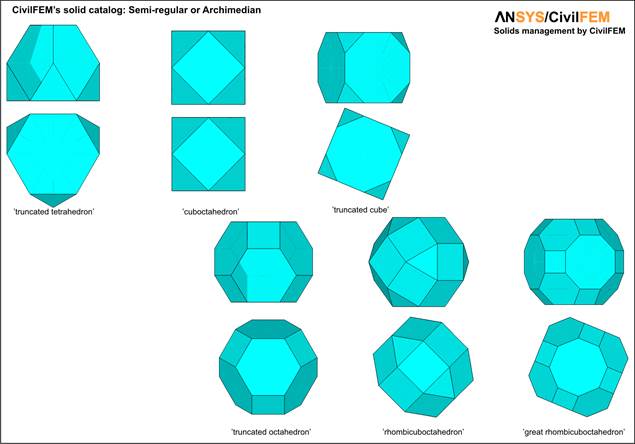
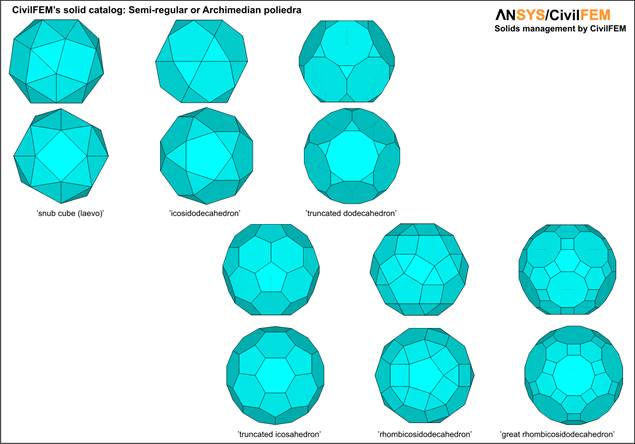
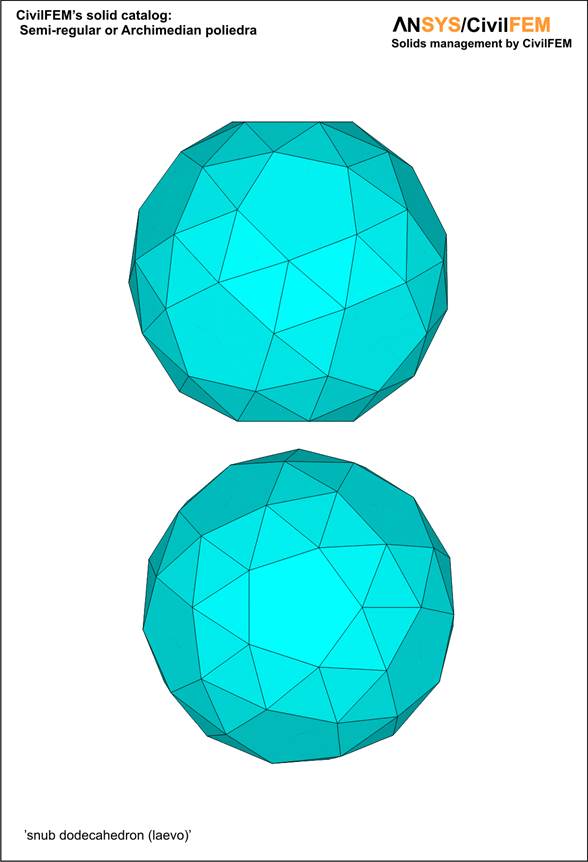
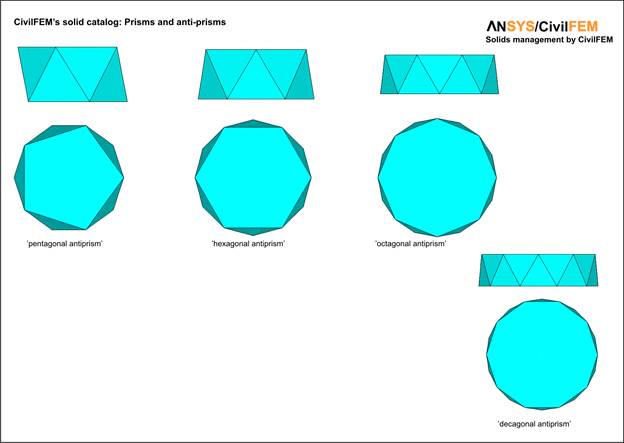
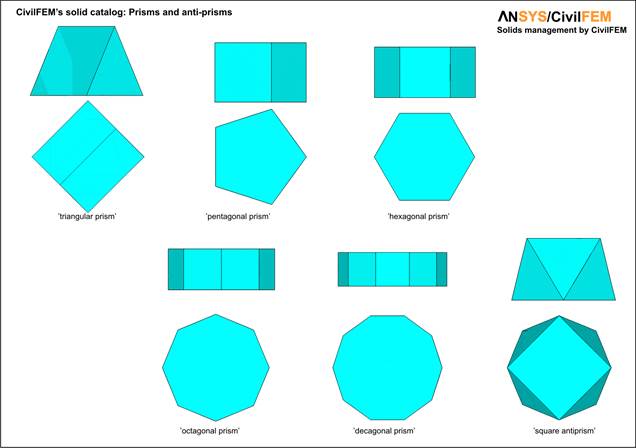
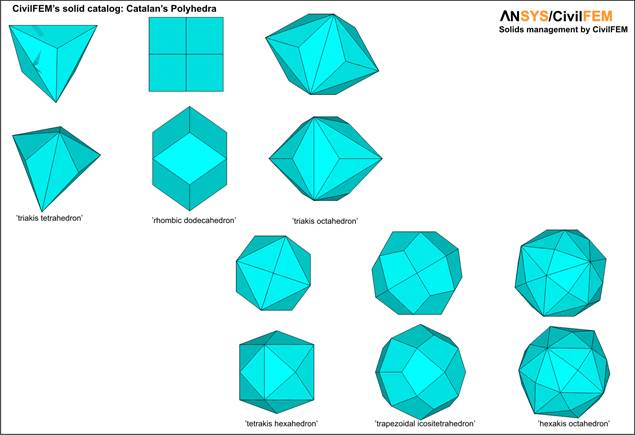
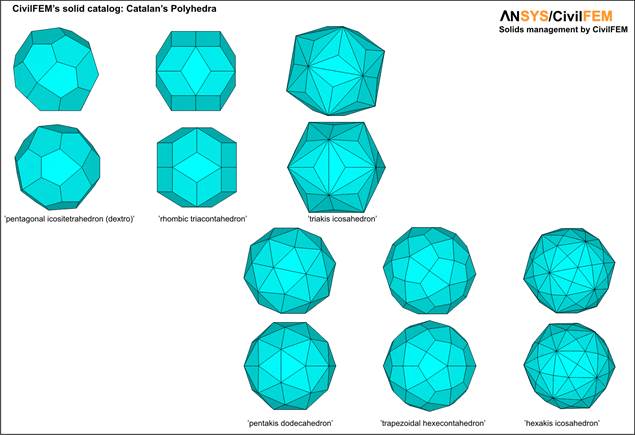
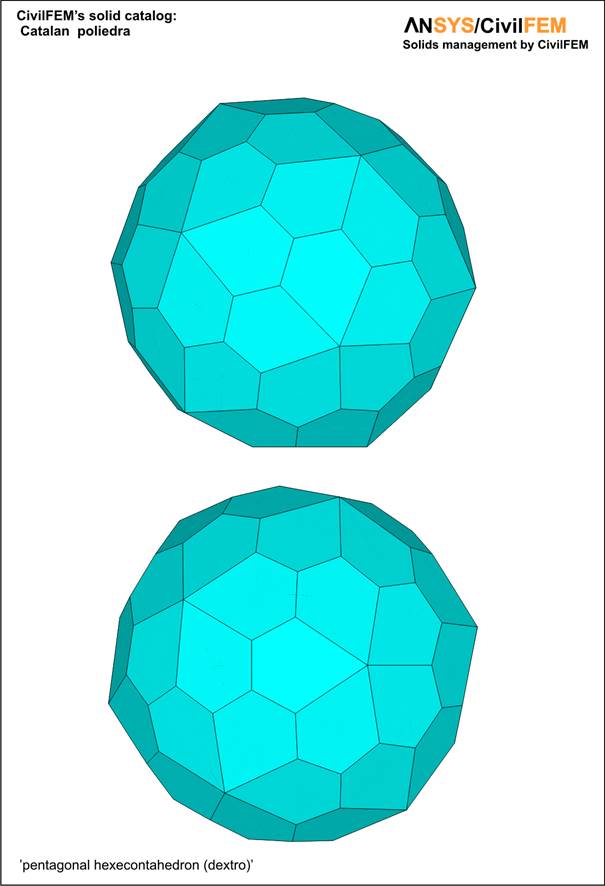
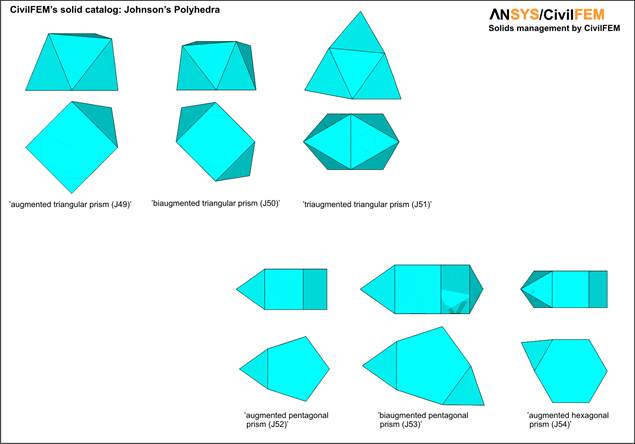
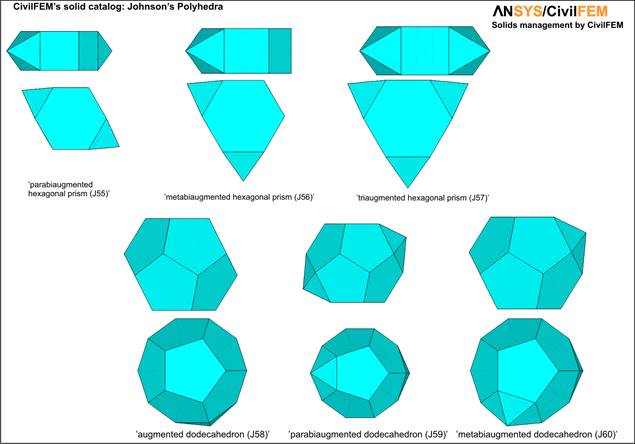
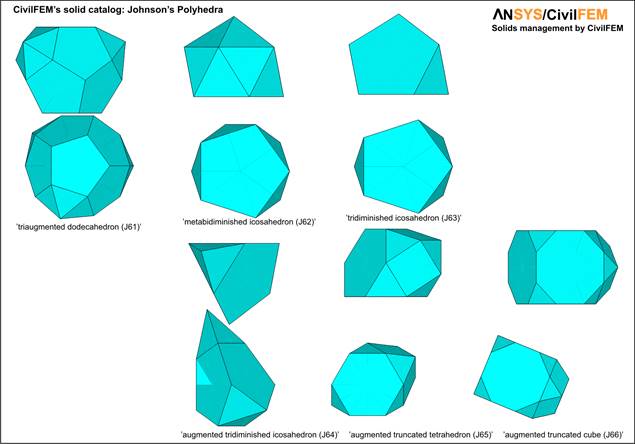
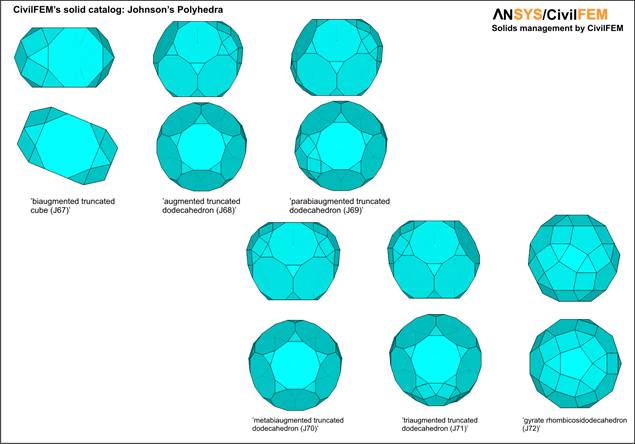
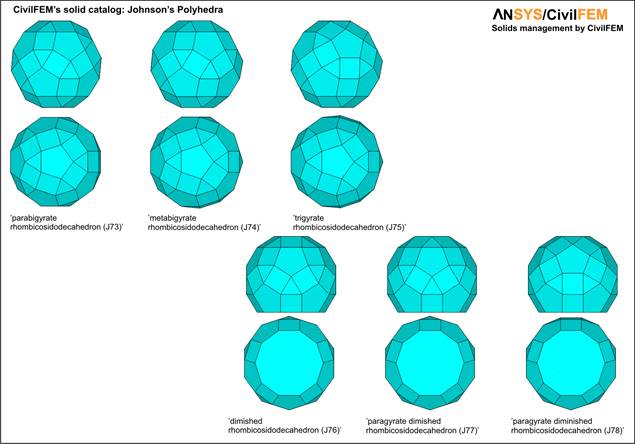
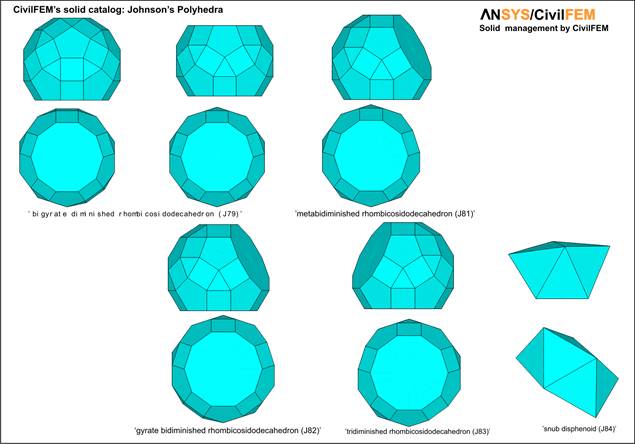
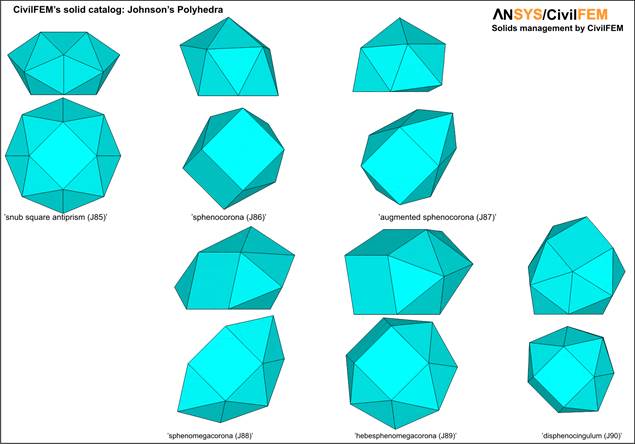
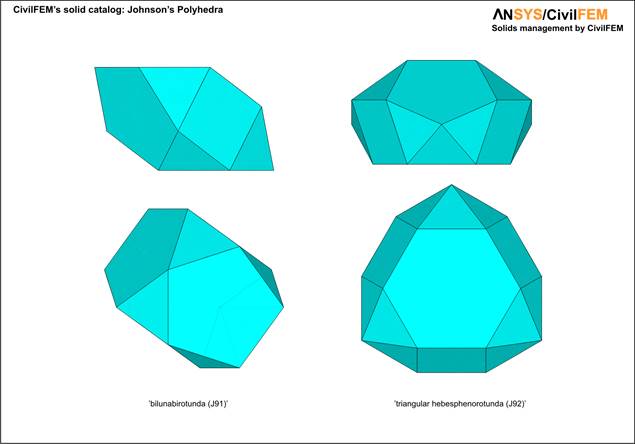
The last part of this text a plan view and a side view of each of the polyhedron are shown, classified by its author/origin.
By its author/origin
|
CLASS |
N |
NAME |
TYPE |
VOLUME |
|
R |
1 |
Tetrahedron |
PL |
Y |
|
R |
2 |
cube |
PL |
Y |
|
R |
3 |
octahedron |
PL |
Y |
|
R |
4 |
dodecahedron |
PL |
Y |
|
R |
5 |
icosahedron |
PL |
Y |
|
KP |
6 |
small stellated dodecahedron |
SS |
N |
|
KP |
7 |
great dodecahedron |
SS |
N |
|
KP |
8 |
great stellated dodecahedron |
SS |
N |
|
KP |
9 |
great icosahedron |
SS |
N |
|
A |
10 |
truncated tetrahedron |
PL |
Y |
|
A |
11 |
cuboctahedron |
PL |
Y |
|
A |
12 |
truncated cube |
PL |
Y |
|
A |
13 |
truncated octahedron |
PL |
Y |
|
A |
14 |
rhombicuboctahedron |
PL |
Y |
|
A |
15 |
great rhombicuboctahedron |
PL |
Y |
|
A |
16 |
snub cube (laevo) |
PL |
Y |
|
A |
17 |
icosidodecahedron |
PL |
Y |
|
A |
18 |
truncated dodecahedron |
PL |
Y |
|
A |
19 |
truncated icosahedron |
PL |
Y |
|
A |
20 |
rhombicosidodecahedron |
PL |
Y |
|
A |
21 |
great rhombicosidodecahedron |
PL |
Y |
|
A |
22 |
snub dodecahedron (laevo) |
PL |
Y |
|
A |
23 |
triangular prism |
PL |
Y |
|
PA |
24 |
pentagonal prism |
PR |
Y |
|
PA |
25 |
hexagonal prism |
PR |
Y |
|
PA |
26 |
octagonal prism |
PR |
Y |
|
PA |
27 |
decagonal prism |
PR |
Y |
|
PA |
28 |
square antiprism |
AP |
Y |
|
PA |
29 |
pentagonal antiprism |
AP |
Y |
|
PA |
30 |
hexagonal antiprism |
AP |
Y |
|
PA |
31 |
octagonal antiprism |
AP |
Y |
|
PA |
32 |
decagonal antiprism |
AP |
Y |
|
C |
33 |
triakis tetrahedron |
PL |
Y |
|
C |
34 |
rhombic dodecahedron |
PL |
Y |
|
C |
35 |
triakis octahedron |
PL |
Y |
|
C |
36 |
tetrakis hexahedron |
PL |
Y |
|
C |
37 |
trapezoidal icositetrahedron |
PL |
Y |
|
C |
38 |
hexakis octahedron |
PL |
Y |
|
C |
39 |
pentagonal icositetrahedron (dextro) |
PL |
Y |
|
C |
40 |
rhombic triacontahedron |
PL |
Y |
|
C |
41 |
triakis icosahedron |
PL |
Y |
|
C |
42 |
pentakis dodecahedron |
PL |
Y |
|
C |
43 |
trapezoidal hexecontahedron |
PL |
Y |
|
C |
44 |
hexakis icosahedron |
PL |
Y |
|
C |
45 |
pentagonal hexecontahedron (dextro) |
PL |
Y |
|
J |
46 |
square pyramid (J1) |
PY |
Y |
|
J |
47 |
pentagonal pyramid (J2) |
PY |
Y |
|
J |
48 |
triangular cupola (J3) |
CU |
Y |
|
J |
49 |
square cupola (J4) |
CU |
Y |
|
J |
50 |
pentagonal cupola (J5) |
CU |
Y |
|
J |
51 |
pentagonal rotunda (J6) |
CU |
Y |
|
J |
52 |
elongated triangular pyramid (J7) |
EP |
Y |
|
J |
53 |
elongated square pyramid (J8) |
EP |
Y |
|
J |
54 |
elongated pentagonal pyramid (J9) |
EP |
Y |
|
J |
55 |
gyroelongated square pyramid (J10) |
GP |
Y |
|
J |
56 |
gyroelongated pentagonal pyramid (J11) |
GP |
Y |
|
J |
57 |
triangular dipyramid (J12) |
DP |
Y |
|
J |
58 |
pentagonal dipyramid (J13) |
DP |
Y |
|
J |
59 |
elongated triangular dipyramid (J14) |
DP |
Y |
|
J |
60 |
elongated square dipyramid (J15) |
DP |
Y |
|
J |
61 |
elongated pentagonal dipyramid (J16) |
DP |
Y |
|
J |
62 |
gyroelongated square dipyramid (J17) |
DP |
Y |
|
J |
63 |
elongated triangular cupola (J18) |
EC |
Y |
|
J |
64 |
elongated square cupola (J19) |
EC |
Y |
|
J |
65 |
elongated pentagonal cupola (J20) |
EC |
Y |
|
J |
66 |
elongated pentagonal rotunds (J21) |
EC |
Y |
|
J |
67 |
gyroelongated triangular cupola (J22) |
GC |
Y |
|
J |
68 |
gyroelongated square cupola (J23) |
GC |
Y |
|
J |
69 |
gyroelongated pentagonal cupola (J24) |
GC |
Y |
|
J |
70 |
gyroelongated pentagonal rotunda (J25) |
GC |
Y |
|
J |
71 |
gyrobifastigium (J26) |
SS |
N |
|
J |
72 |
triangular orthobicupola (J27) |
BC |
Y |
|
J |
73 |
square orthobicupola (J28) |
BC |
Y |
|
J |
74 |
square gyrobicupola (J29) |
BC |
Y |
|
J |
75 |
pentagonal orthobicupola (J30) |
BC |
Y |
|
J |
76 |
pentagonal gyrobicupola (J31) |
BC |
Y |
|
J |
77 |
pentagonal orthocupolarontunda (J32) |
BC |
Y |
|
J |
78 |
pentagonal gyrocupolarotunda (J33) |
BC |
Y |
|
J |
79 |
pentagonal orthobirotunda (J34) |
BC |
Y |
|
J |
80 |
elongated triangular orthobicupola (J35) |
BC |
Y |
|
J |
81 |
elongated triangular gyrobicupola (J36) |
BC |
Y |
|
J |
82 |
elongated square gyrobicupola (J37) |
BC |
Y |
|
J |
83 |
elongated pentagonal orthobicupola (J38) |
BC |
Y |
|
J |
84 |
elongated pentagonal gyrobicupola (J39) |
BC |
Y |
|
J |
85 |
elongated pentagonal orthocupolarotunda (J40) |
BC |
Y |
|
J |
86 |
elongated pentagonal gyrocupolarotunda (J41) |
BC |
Y |
|
J |
87 |
elongated pentagonal orthobirotunda (J42) |
BC |
Y |
|
J |
88 |
elongated pentagonal gyrobirotunda (J43) |
BC |
Y |
|
J |
89 |
gyroelongated triangular bicupola (J44) |
BC |
Y |
|
J |
90 |
gyroelongated square bicupola (J45) |
BC |
Y |
|
J |
91 |
gyroelongated pentagonal bicupola (J46) |
BC |
Y |
|
J |
92 |
gyroelongated pentagonal cupolarotunda (J47) |
BC |
Y |
|
J |
93 |
gyroelongated pentagonal birotunda (J48) |
BC |
Y |
|
J |
94 |
augmented triangular prism (J49) |
PR |
Y |
|
J |
95 |
biaugmented triangular prism (J50) |
DP |
Y |
|
J |
96 |
triaugmented triangular prism (J51) |
PL |
Y |
|
J |
97 |
augmented pentagonal prism (J52) |
PR |
Y |
|
J |
98 |
biaugmented pentagonal prism (J53) |
PL |
Y |
|
J |
99 |
augmented hexagonal prism (J54) |
PR |
Y |
|
J |
100 |
parabiaugmented hexagonal prism (J55) |
PR |
Y |
|
J |
101 |
metabiaugmented hexagonal prism (J56) |
PL |
Y |
|
J |
102 |
triaugmented hexagonal prism (J57) |
PL |
Y |
|
J |
103 |
augmented dodecahedron (J58) |
PL |
Y |
|
J |
104 |
parabiaugmented dodecahedron (J59) |
PL |
Y |
|
J |
105 |
metabiaugmented dodecahedron (J60) |
PL |
Y |
|
J |
106 |
triaugmented dodecahedron (J61) |
PL |
Y |
|
J |
107 |
metabidiminished icosahedron (J62) |
PL |
Y |
|
J |
108 |
tridiminished icosahedron (J63) |
PL |
Y |
|
J |
109 |
augmented tridiminished icosahedron (J64) |
PL |
Y |
|
J |
110 |
augmented truncated tetrahedron (J65) |
PL |
Y |
|
J |
111 |
augmented truncated cube (J66) |
PL |
Y |
|
J |
112 |
biaugmented truncated cube (J67) |
PL |
Y |
|
J |
113 |
augmented truncated dodecahedron (J68) |
PL |
Y |
|
J |
114 |
parabiaugmented truncated dodecahedron (J69) |
PL |
Y |
|
J |
115 |
metabiaugmented truncated dodecahedron (J70) |
PL |
Y |
|
J |
116 |
triaugmented truncated dodecahedron (J71) |
PL |
Y |
|
J |
117 |
gyrate rhombicosidodecahedron (J72) |
PL |
Y |
|
J |
118 |
parabigyrate rhombicosidodecahedron (J73) |
PL |
Y |
|
J |
119 |
metabigyrate rhombicosidodecahedron (J74) |
PL |
Y |
|
J |
120 |
trigyrate rhombicosidodecahedron (J75) |
PL |
Y |
|
J |
121 |
diminished rhombicosidodecahedron (J76) |
PL |
Y |
|
J |
122 |
paragyrate diminished rhombicosidodecahedron (J77) |
PL |
Y |
|
J |
123 |
metagyrate diminished rhombicosidodecahedron (J78) |
PL |
Y |
|
J |
124 |
bigyrate diminished rhombicosidodecahedron (J79) |
PL |
Y |
|
J |
125 |
parabidiminished rhombicosidodecahedron (J80) |
PL |
Y |
|
J |
126 |
metabidiminished rhombicosidodecahedron (J81) |
PL |
Y |
|
J |
127 |
gyrate bidiminished rhombicosidodecahedron (J82) |
PL |
Y |
|
J |
128 |
tridiminished rhombicosidodecahedron (J83) |
PL |
Y |
|
J |
129 |
snub disphenoid (J84) |
PL |
Y |
|
J |
130 |
snub square antiprism (J85) |
PL |
Y |
|
J |
131 |
sphenocorona (J86) |
PL |
Y |
|
J |
132 |
augmented sphenocorona (J87) |
PL |
Y |
|
J |
133 |
sphenomegacorona (J88) |
PL |
Y |
|
J |
134 |
hebesphenomegacorona (J89) |
PL |
Y |
|
J |
135 |
disphenocingulum (J90) |
PL |
Y |
|
J |
136 |
bilunabirotunda (J91) |
CU |
Y |
|
J |
137 |
triangular hebesphenorotunda (J92) |
CU |
Y |
|
W |
138 |
tetrahemihexahedron |
PL |
N |
|
W |
139 |
cubohemioctahedron |
PL |
N |
|
W |
140 |
octahemioctahedron |
PL |
N |
|
W |
141 |
small dodecahemidodecahedron |
PL |
N |
|
W |
142 |
great dodecahemidodecahedron |
SS |
N |
|
W |
143 |
small dodecahemiicosahedron |
SS |
N |
|
W |
144 |
great dodecahemiicosahedron |
SS |
N |
|
W |
145 |
small icosihemidodecahedron |
PL |
N |
|
W |
146 |
great icosihemidodecahedron |
SS |
N |
|
W |
147 |
small ditrigonal icosidodecahedron |
PL |
Y |
|
W |
148 |
dodecadodecahedron |
PL |
Y |
|
W |
149 |
echidnahedron |
SS |
Y |
|
W |
150 |
great icosidodecahedron |
SS |
Y |
|
W |
151 |
triambic dodecadodecahedron |
SS |
Y |
|
W |
152 |
small triambic icosidodecahedron |
SS |
Y |
|
W |
153 |
great triambic icosidodecahedron |
SS |
Y |
|
DP |
154 |
hexagonal dipyramid |
DP |
Y |
|
DP |
155 |
octagonal dipyramid |
DP |
Y |
|
DP |
156 |
decagonal dipyramid |
DP |
Y |
|
DP |
157 |
square trapezohedron |
DH |
Y |
|
DP |
158 |
pentagonal trapezohedron |
DH |
Y |
|
DP |
159 |
hexagonal trapezohedron |
DH |
Y |
|
DP |
160 |
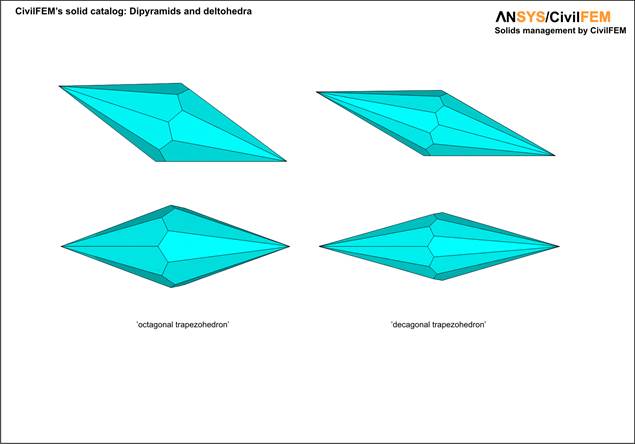
octagonal trapezohedron |
DH |
Y |
|
DP |
161 |
decagonal trapezohedron |
DH |
Y |
|
GS |
162 |
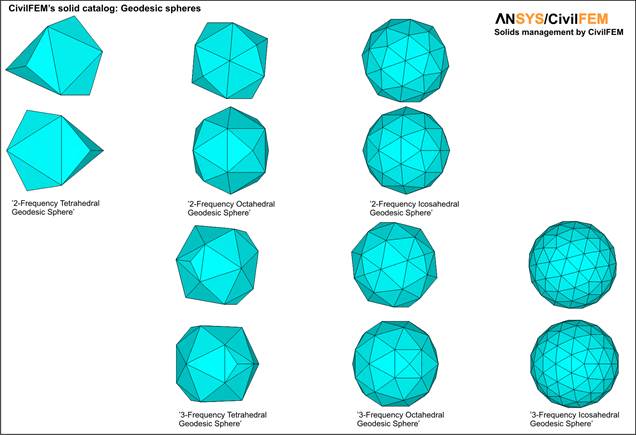
2-frecuency tetrahedral geodesic sphere (GS1) |
GS |
Y |
|
GS |
163 |
2-frecuency octahedral geodesic sphere (GS2) |
GS |
Y |
|
GS |
164 |
2-frecuency icosahedral geodesic sphere (GS3) |
GS |
Y |
|
GS |
165 |
3-frecuency tetrahedral geodesic sphere (GS4) |
GS |
Y |
|
GS |
166 |
3-frecuency octahedral geodesic sphere (GS5) |
GS |
Y |
|
GS |
167 |
3-frecuency icosahedral geodesic sphere (GS6) |
GS |
Y |
|
GS |
168 |
4-frecuency tetrahedral geodesic sphere (GS7) |
GS |
Y |
|
GS |
169 |
4-frecuency octahedral geodesic sphere (GS8) |
GS |
Y |
|
GS |
170 |
4-frecuency icosahedral geodesic sphere (GS9) |
GS |
Y |
|
DO |
171 |
2-frecuency tetrahedral geodesic hemisphere (DO1) |
DO |
Y |
|
DO |
172 |
2-frecuency octahedral geodesic hemisphere (DO2) |
DO |
Y |
|
DO |
173 |
2-frecuency icosahedral geodesic hemisphere (DO3) |
DO |
Y |
|
DO |
174 |
3-frecuency octahedral geodesic hemisphere (DO4) |
DO |
Y |
|
DO |
175 |
4-frecuency tetrahedral geodesic hemisphere (DO5) |
DO |
Y |
|
DO |
176 |
4-frecuency octahedral geodesic hemisphere (DO6) |
DO |
Y |
|
DO |
177 |
4-frecuency icosahedral geodesic hemisphere (DO7) |
DO |
Y |
Polyhedra that do not generate a volume
The polyhedra marked as VOLUME: N, because of its topology, do not define a volume that can be handled by ANSYS. Nevertheless they generate areas with which the program can work.
Examples
Following, several examples are shown in which the possibilities offered by the CivilFEM’s polyhedra generation to create a structure are pointed out.
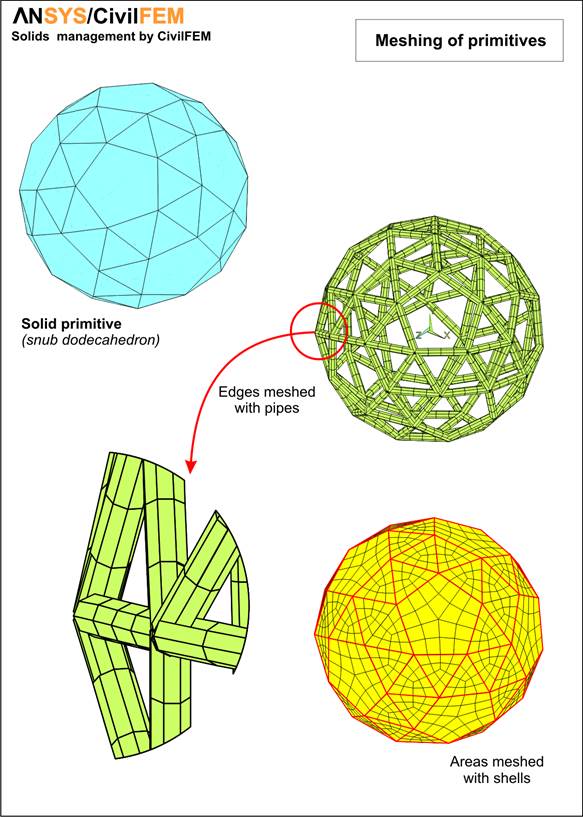
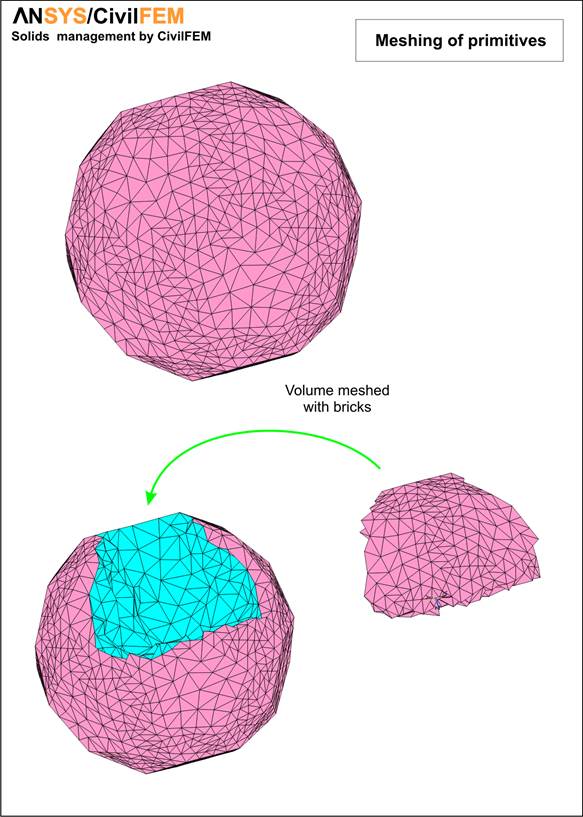
Solid mesh
From one of CivilFEM’s objects (Snub dodecahedron) finite elements models are generated (beams, shells and solids).
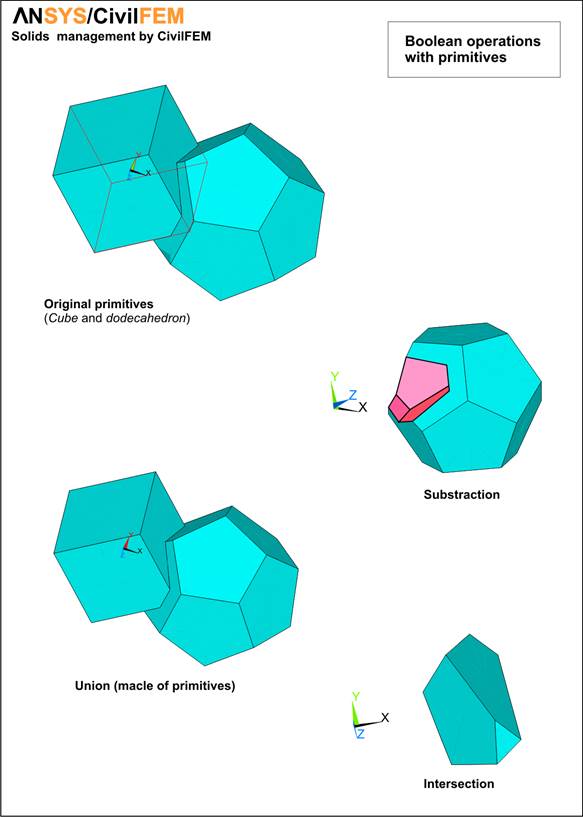
Primitives handling: Top-Down
Using as a starting point two polyhedra of CivilFEM (cube and dodecahedrom) new solids are obtained by Boolean operations.
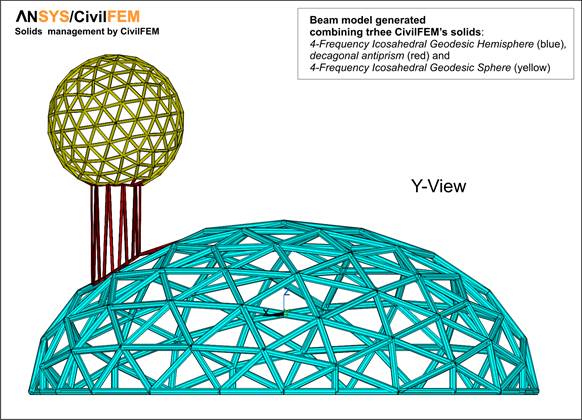
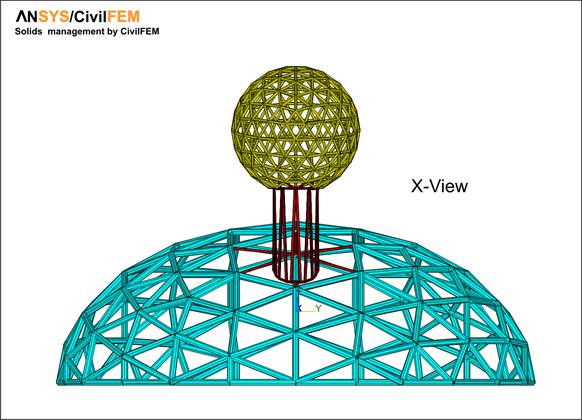
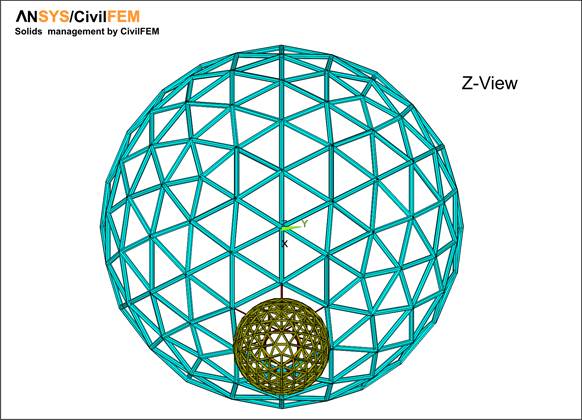
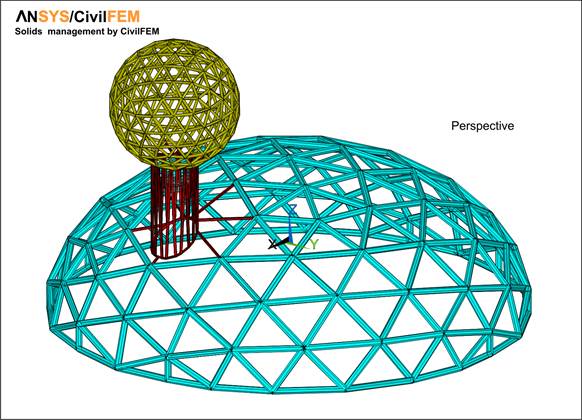
Frame structure model
Using three of CivilFEM’s polyhedra, and by boolean operations, the finite elements model is obtained for beam elements.
CivilFEM’s primitives catalogue
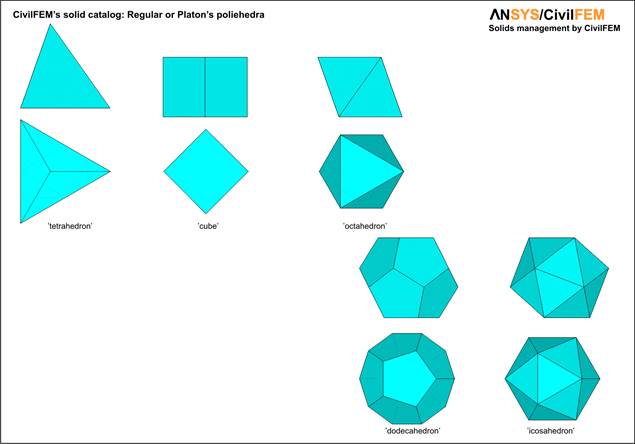
Regular or Plato’s polyhedra
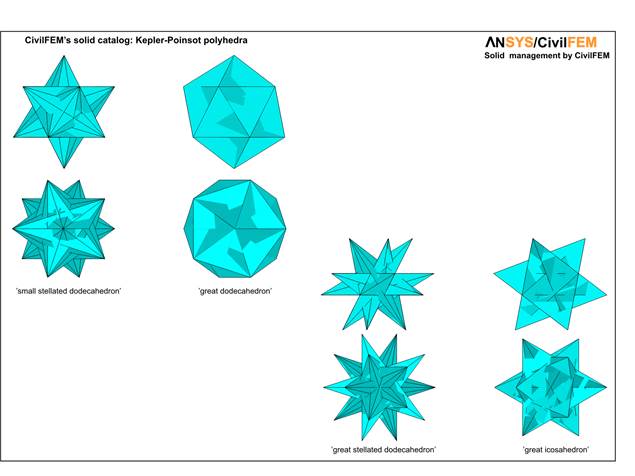
Kepler-Poinsot polyhedra
Semi-Regular or Archimedian polyhedra
Prims and Anti-prisms
Catalan’s polyhedra (duals of the Archimedian polyhedra)
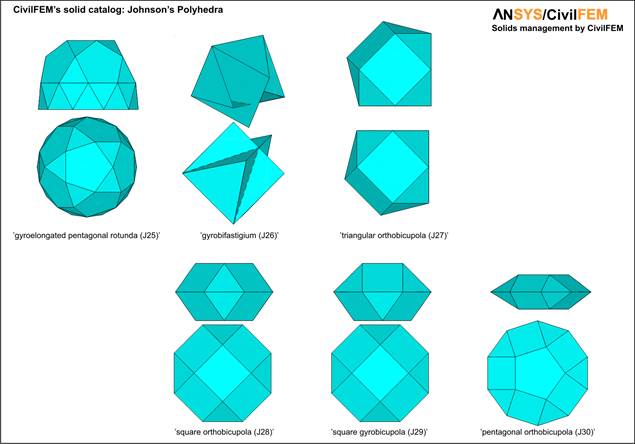
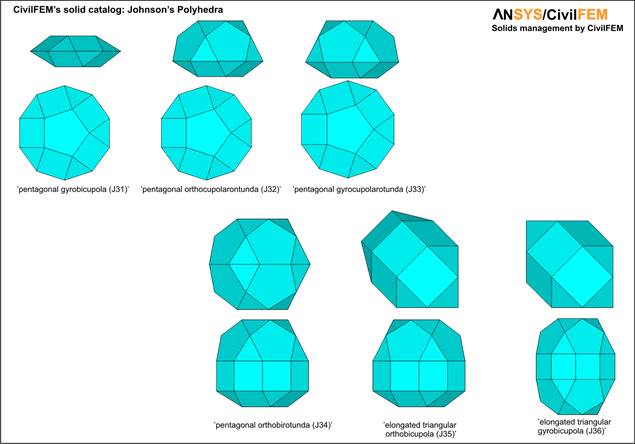
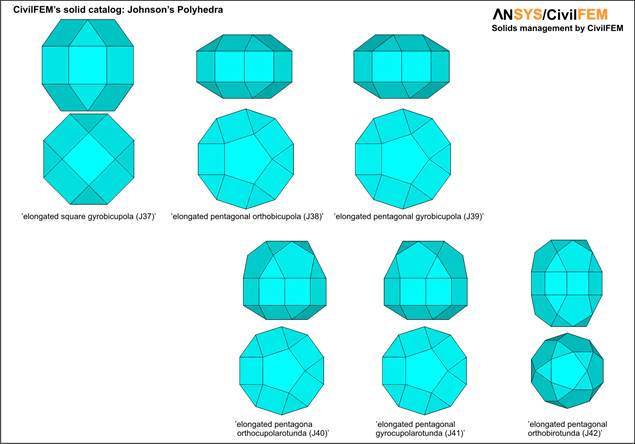
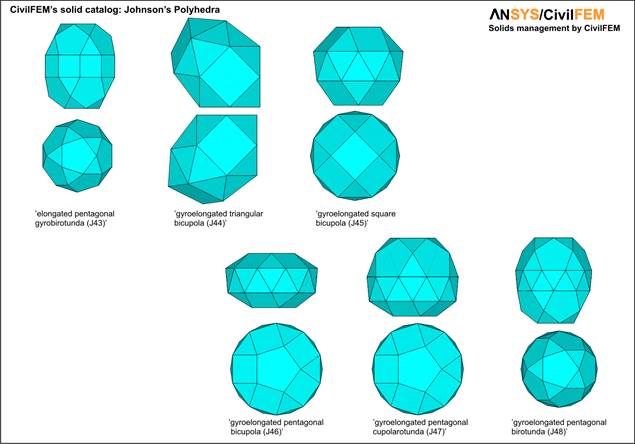
Johnson’s polyhedra
Weird’s polyhedra
Di-pyramids and deltohedra
Geodesic spheres
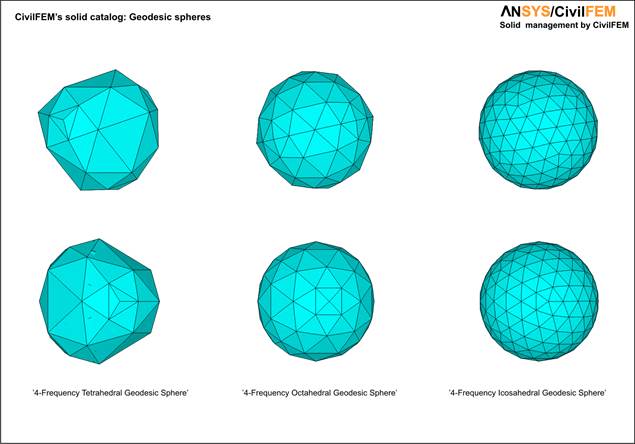
Geodesic hemi-spheres