

Chapter
7
Predesigned Structures
7.1 Introduction
CivilFEM allows the user to generate simple structures by defining the geometry and applied loads. From the data defined, a predesign of the variable parameters will be performed for this structure. These parameters, mainly shear and bending reinforcement, are combined with the geometric values of certain parts of the structure and are occasionally combined with design recommendations.
It is also possible to generate the finite elements model of the structure. With this model, the user can accomplish a more accurate check of the predesign, perform a transient analysis, include non linearities, create more complex structures from the initial one, etc.
7.2 Frames
7.2.1 Description
The objective of this utility is to make a direct calculation of the frame with a beam elements model from the data inputted by the user through the graphical screens.
Once the basic load hypotheses are defined, CivilFEM obtains the envelopes of each one of the predefined combinations block and performs the calculation of the reinforcement, checking the shear in the critical sections, as well as the stress state.
7.2.2 Input Data
The input data needed to generate and calculate the frame can be divided into four groups: geometrical data, soil and materials data, loads data and vehicles.
7.2.2.1 Geometrical Data
The geometrical data for the frame can be defined using the commands ~FRMDEF, ~FRMBS, ~FRMCR.
The geometrical data are as follows:
|
L |
Total distance between piers. |
|
H |
Free height between slab and lintel. |
|
PTH |
Pier thickness. |
|
LTH |
Lintel thickness. |
|
STH |
Slab thickness. |
|
LF |
Left flange length. |
|
RF |
Right flange length. |
|
VU |
Vertical projection of the upper brackets. |
|
HU |
Horizontal projection of the upper brackets. |
|
VD |
Vertical projection of the lower brackets. |
|
HD |
Horizontal projection of the lower brackets. |
7.2.2.2 Materials and Soil Data
The properties of soil and materials are entered into CivilFEM’s database through the commands ~FRMGT, ~FRMGEN.
The material and soil data are as follows:
|
HL |
Terrain height over the lintel. |
|
HS |
Terrain height over the slab. |
|
TGAMMA |
Terrain specific weight. |
|
FRIC |
Terrain internal friction angle. |
|
KFS |
Ballast module. |
|
MATCON |
Concrete material Id. |
|
MATREI |
Reinforcement material Id. |
|
MAXW |
Maximum cracking width. |
7.2.2.3 Loads Data
Data pertaining to the loads acting on the frame are entered into CivilFEM’s database through the commands ~FRMLDS, ~FRMVHS, ~FRTRCK.
The data for loads are the following:
|
SL |
Serviceability load over the frame (surface load). |
|
CL |
Terrain compactation load (surface load). |
|
LSL |
Lateral surface load. |
|
NAXL |
Number of axles of the vehicle (2 or 3). |
|
WAXL |
Axle length. Distance between wheels. |
|
CX |
Footprint length. |
|
CZ |
Footprint wodth. |
|
Di |
Distance between axles i and i+1. |
|
Li |
Load on axle i |
7.2.3 Load Hypothesis
7.2.3.1 Simple Loads
The simple load hypotheses used to calculate the envelopes are the following:
|
Hypothesis 1: |
Sw |
Self Weight. |
|
Hypothesis 2: |
|
At rest earth pressure + Earth weight. |
|
Hypothesis 3: |
|
Active earth pressure + Earth weight. |
|
Hypothesis 4: |
|
Surface load over left pier. |
|
Hypothesis 5: |
|
Surface load over right pier. |
|
Hypothesis 6: |
|
Compaction load. |
|
Hypothesis 7: |
|
Surface load over lintel. |
|
Hypothesis 8: |
|
Traffic / Centered vehicle. |
|
Hypothesis 9: |
|
Traffic / Eccentric vehicle. |


7.2.3.1.1 Hypothesis 1. Self weight
This load hypothesis consists of the self weight of the concrete frame, which is calculated multiplying its area by the specific weight of concrete.

7.2.3.1.2 Hypothesis 2. At rest earth pressure and earth weight
This load hypothesis is composed of the earth weight and the lateral at rest earth pressure that acts on the frame.
The earth weight is calculated from the height of the terrain above the considered point multiplied by its specific weight.

The lateral at rest earth pressure on the piers is the height of the terrain above each point multiplied by the specific weight of the terrain and by an at rest earth pressure coefficient.

Where:
|
f(h) |
Terrain height above each point. |
|
gt |
Earth specific weight. |
|
1- sinφ |
At rest earth pressure coefficient. |

7.2.3.1.3 Hypothesis 3. Active earth pressure and earth weight
This load hypothesis is made up by the earth weight and the lateral active earth pressure it produces on the frame.
The earth weight is calculated as described for hypothesis 2.
The active earth pressure on the piers is the height of the terrain above each point multiplied by the terrain specific weight and by the active earth pressure coefficient.

Where:
|
f(h) |
Terrain height above each point. |
|
gt |
Earth specific weight. |
|
|
Active earth pressure coefficient. |

7.2.3.1.4 Hypothesis 4. Surface load above left pier.
This load hypothesis consists of the pressure acting on the left pier as a consequence of the surface load LSL on the terrain to the left of the frame.
7.2.3.1.5 Hypothesis 5. Surface load above right pier.
This load hypothesis consists of the pressure acting on the right pier as a consequence of the surface load LSL on the terrain at the right of the frame.

7.2.3.1.6 Hypothesis 6. Compaction Load
This load hypothesis simulates the presence of the soil on both sides of the frame with a height difference of 2 meters. A compaction load CL acts on the highest terrain.

7.2.3.1.7 Hypothesis 7. Surface Load on Lintel
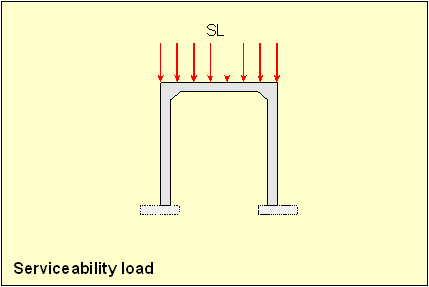
This hypothesis accounts for a surface load SL on the lintel.
7.2.3.1.8 Hypothesis 8 and 9. Traffic / Centered Vehicle. Traffic / Eccentric vehicle
A vehicle is considered in which the number of axles (2 or 3), the distance and load on each of them may vary (parameters NAXL, WAXL, CX, CZ, D1, D2, L1, L2 and L3).
For hypothesis 8 “Centered Vehicle”, it is assumed that the vehicle is in the middle of the lintel.
For hypothesis 9 “Eccentric Vehicle”, it is assumed that the vehicle is above the piers, to obtain the maximum shear force.
The load on each wheel is distributed on the lintel as shown in the following figure.

Note:
The vehicle defined by default has 3 axles, with a distance between them of 1.5 meters and a length of 2 meters with a footprint of 0.20 x 0.60 m and a load of 20 tons per axle.
7.2.3.2 Combined Hypothesis
The simple load states are combined to obtain the most unfavorable load hypothesis.
The simple load cases have been multiplied by safety factors for the Ultimate Limit State.
The considered load hypotheses are:
|
Ultimate limit state. |
|
|
Hypothesis 10: |
|
|
Hypothesis 11: |
|
|
Hypothesis 12: |
|
|
Hypothesis 13: |
|
|
Hypothesis 14: |
|
|
Hypothesis 15: |
|
|
Hypothesis 16: |
|
|
Hypothesis 17: |
|
|
Hypothesis 18: |
|





|
Serviceability Limit State. |
|
|
Hypothesis 19: |
|
|
Hypothesis 20: |
|
|
Hypothesis 21: |
|
|
Hypothesis 22: |
|
|
Hypothesis 23: |
|
|
Hypothesis 24: |
|
|
Hypothesis 25: |
|
|
Hypothesis 26: |
|
|
Hypothesis 27: |
|


|
Serviceability Limit State quasi-permanent combination for cracking. |
|
|
Hypothesis 28: |
|
|
Hypothesis 29: |
|
|
Hypothesis 30: |
|
|
Hypothesis 31: |
|
|
Hypothesis 32: |
|
|
Hypothesis 33: |
|
|
Hypothesis 34: |
|
|
Hypothesis 35: |
|
|
Hypothesis 36: |
|




7.2.4 Reinforcement
The reinforcement is predesigned by using simplified formulas that will generally produce values close to those obtained from code checking; however, these values are not guaranteed to be correct, so a later check of their accuracy will be necessary.
The reinforcement is calculated regarding:
- Bending
- Shear
- Cracking
- Minimum reinforcement considered