

17-B.1 Pile Caps
17-B.1.1 Introduction
17-B.1.1.1 Aim
The utility described is designed for:
- Regular polygonal or circular pile cap (piles + slab).

- Rectangular pile cap sustained by a mesh of piles.

- A single pile, used for load tests.
For circular or polygonal pile caps, the piles are numbered, beginning with the one with the greatest Y coordinate, anticlockwise, as it can be seen in the figure.
For rectangular caps, numbering is based on a Npx ´ Npy matrix of piles.
17-B.1.1.2 Terrain
In the behavior of a single pile, the nature of the terrain plays a fundamental role, and in particular if it is cohesionless or cohesive.
In practice, it is easy to distinguish the grounds that could be clearly called cohesionless since they are characterized by high values of the internal friction angle j and have a null value for the cohesion; and the same happens with purely cohesive soils.
Nevertheless, there is an intermediate zone with not very big values of j and small values of c in which it is possible to have doubts on the true characterization of the soil.
In general, the characteristics of both types of soils are the ones shown in the following tables.
Cohesive Soils
|
Consistency |
qu (kPa) |
NSPT |
j(º) |
c (kPa) |
|
Very soft |
30-50 |
2-4 |
15-20 |
0-10 |
|
Soft |
50-100 |
4-8 |
20-25 |
10-20 |
|
Medium |
100-200 |
8-15 |
25-30 |
20-30 |
|
Hard |
200-400 |
15-30 |
30-35 |
30-50 |
|
Very hard |
>400 |
>30 |
>35 |
>50 |
Cohesionless Soils
|
Compacity |
NSPT |
j(º) |
c (kPa) |
|
Very low |
0-4 |
<28 |
0-20 |
|
Low |
4-10 |
28-30 |
0-20 |
|
Medium |
10-30 |
30-36 |
0-20 |
|
High |
30-50 |
36-41 |
0-20 |
|
Very high |
>50 |
>41 |
0-20 |
Where
|
|
Unconfined compressive strength |
|
|
Number of blows obtained in the Standard Penetration Test |
|
|
Internal friction angle and cohesion |


From these values the following graph that characterizes soils by the pair of values (c, j) has been built. In it cohesionless soils are confined in a rectangle.

CivilFEM locates the soils within this
graph and will consider it cohesive or cohensionless depending on the area in
which the point is set.
The lower right vertex of the area of
cohesionless soils has by coordinate  and CivilFEM considers that is located at (20 kPa; 25º) by default,
although this value can be changed in the configuration window.
and CivilFEM considers that is located at (20 kPa; 25º) by default,
although this value can be changed in the configuration window.
All in all, a soil is cohesionless if the
conditions  and
and  are verified. In opposite case it is considered cohesive.
17-B.1.1.3 Types of piles
In this utility two different types of piles are taken into account, regarding its constructive process.
- Excavated/Drilled foundations.
- Driven piles.
The usage of one or other is done by selecting the corresponding radio button. The differences in the formulation of the calculation process are explained in this document.
17-B.1.2 Single pile load capacity
17-B.1.2.1 Introduction
A pile load capacity is made up of two addends:
- Skin friction contribution Qs.
- Point resistance contribution Qp.
Both of them depend on the type of terrain and the total settlement, obtaining a QT – w law as the one shown in the following figure.

The ultimate pile load Qu, is not taken as QT, the addition of Qp and Qs, but these two are affected by security factors, obtaining

taking, in general, the following values
|
MATERIAL |
Fs |
Fp |
|
Cohesive |
1.5 to 2.0 |
4.0 to 5.0 |
|
Cohesionless |
2.0 |
3.5 to 4.0 |
CivilFEM will propose, by default, the values represented in bold.
17-B.1.2.2 Cohesive soil load capacity
In order to determine the bilinear law seen in the previous section it is necessary to obtain the pairs of values (ws, Qs) and (wp, Qp).
Skin friction contribution
Calling fs the unit skin
friction,  where Dp is the pile diameter and Lp its
length.
where Dp is the pile diameter and Lp its
length.
For measures done in real test cases, the following graph is obtained.

Which relates the parameter , with the undrained shear strength. CivilFEM considers in the
calculations the relation
, with the undrained shear strength. CivilFEM considers in the
calculations the relation  where
where  is the curve represented in the following figure.
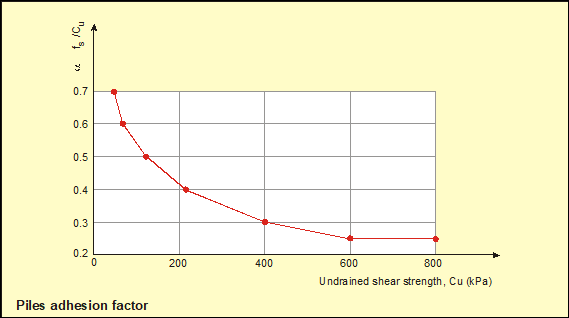
obtained from the previous graph, searching for a curve fitted in the middle of the shadowed area. The values that define the polygonal are:
|
cu (kPa) |
a |
|
50 |
0.70 |
|
70 |
0.60 |
|
120 |
0.50 |
|
210 |
0.40 |
|
400 |
0.30 |
|
600 |
0.25 |
being perfectly fit  by the equation:

when cu is expressed in kPa.
The displacement ws is related
with the diameter of the pile by the expression  where the g coefficient (shaft
deformability factor) takes values between
where the g coefficient (shaft
deformability factor) takes values between  and
and  , as it can be verified in the following graph, which represents
test results.
, as it can be verified in the following graph, which represents
test results.

CivilFEM will propose the default value for
 (adimensional) but will allow to enter any other, warning when the
given value is out of the normal range.
(adimensional) but will allow to enter any other, warning when the
given value is out of the normal range.
Undrained shear strength cu and unconfined compressive strength qu
CivilFEM, among all the properties of the
geotechnical materials uses the magnitude qu, or unconfined compressive strength. Between
this property and the undrained shear strength cu, there is a
theoretical relationship  which can be easily deduced from the Mohr diagram, represented in
the following figure.
which can be easily deduced from the Mohr diagram, represented in
the following figure.

This relationship, which is always verified in the practice, will be the one used by CivilFEM.
On the other hand in this same Mohr
diagram, looking at the OAB triangle, the expression  is obtained, from which the value cu, can be obtained as
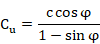
which relates the undrained shear strength with cohesion and the internal friction angle of the material, when it verifies the Mohr-Coulomb failure criterion (This relationship is shown as merely illustrative, since CivilFEM does not use it as it does not provide good results).
Point resistance contribution
Calling now qp to the unit point resistance, the point resistance contribution is:

where, as in the previous cases, Dp is the diameter of the pile. The unit point resistance is related with the undrained shear strength by:

where NCB, parameter known as Bearing capacity factor, is a function of the diameter, following the law:


CivilFEM will calculate the NCB value corresponding to the piles and it will be this one the purposed one, although it will allow to enter any other value, warning if the entered value is out of the valid range (8.00, 9.00).
For the settlement associated with the load
Qp, the equation which relates it with the pile diameter  is used, just as in the case of friction resistance.
In this case the parameter d has greater
variations than g, because its value is between  and 13.5
 .
.
CivilFEM will give a default value of 8 , although it is possible to choose any other value. CivilFEM will
give a warning if the entered value is out of the previous range
, although it is possible to choose any other value. CivilFEM will
give a warning if the entered value is out of the previous range  .
.
17-B.1.2.3 Cohesionless soils load capacity
As a main difference from cohesive soils, where cu (undrained shear strength) is the parameter used to characterize the soil, in cohesionless soils it is the number of blows in the Standard Penetration Test (SPT) the parameter that will be used (NSPT).
Skin friction contribution
Unit skin friction contribution is obtained
from  where b is a coefficient with pressure units, for which CivilFEM will give
the default value of 2 kPa.
where b is a coefficient with pressure units, for which CivilFEM will give
the default value of 2 kPa.
For ws the same relationship as
for cohesive soils will be used where g has a variation range of  , giving CivilFEM, by default, the value
  .
.
Point resistance contribution
Unit point resistance contribution is related with the SPT by the following expression

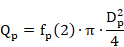
where x is a parameter, with pressure units, for which CivilFEM will give the by default the value of 400 kPa and fe a dimensionless coefficient called scale factor, which value depends on the diameter of the pile as follows:


CivilFEM will purpose the value obtained from this expression, although it is possible to enter any other. CivilFEM will warn if the entered value is out of the range (0.50, 1.00).
For the settlement associated with the load Qp, the equation which relates it with the pile diameter wp = d · Dp is used, just as in the case of friction resistance.
About the parameter d not much can be said, because in general, the real load tests do not fully mobilize the point resistance, although it seems that it is in the interval between 6.0´10-2 y 12.0 ´10-2. CivilFEM will give the default value of 9.0´10-2.
17-B.1.3 Predesign: Piles length
17-B.1.3.1 Introduction
The utility for the analysis of pile caps assumes that the layered terrain has been previously defined (~TERDEF command), which at the same time implies that the materials have been defined (~CFMP command).
For the analysis at least the following material parameters must be defined:
- Mechanical parameters that define the intrinsic resistance.
|
~CFMP, nn, SOIL, cMCeff |
Effective Cohesion (Mohr-Coulomb) |
|
~CFMP, nn, SOIL, PHIMCeff |
Internal friction angle (Mohr-Coulomb) |
With this pair (c, j), CivilFEM classifies the soil as cohesive or cohesionless, as explained in 17-B.1.1.2.
- Depending on the type of soil:
Cohesionless soils.
|
~CFMP, nn, SOIL, SPT |
SPT number of blows |
|
~CFMP, nn, SOIL, GAMd |
Dry specific weight |
|
~CFMP, nn, SOIL, W |
Moisture content |
Cohesive soils.
|
~CFMP, nn, SOIL, qu |
Unconfined compressive strength |
Nota: CivilFEM will warn in the following cases:
|
Cohesionless soil: |
Null NSPT, null GAMd |
|
Cohesive soil: |
Null qu |
With these parameters it is now possible to obtain the values of fs and fp for each layer.
It is important to notice that the vertical direction of the terrain (terrain heights) must be set as OZ, setting ~TERDEF, nn, NEW, mm,, Z, … which defined as coordinate system the one given by ANSYS as default, and as height axis, the OZ axis.
17-B.1.3.2 Load on piles
The loads on the slab are entered as forces and moments on the column (Fx, Fy, Fz, Mx, My, Mz), with the signs and directions shown in the following figure
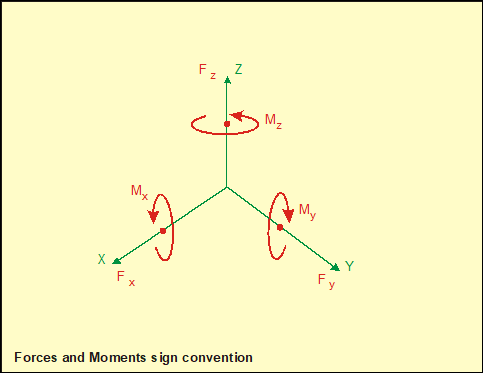
From these values, and the pressure acting on the slab surface, assuming for the caps, as a first approach, a rigid behavior, the compression axial force will be obtained for the most loaded pile by the expression

where
|
|
Total number of piles. |
|
P |
Slab weight. |
|
A |
Slab surface area. |
|
q |
Surface load on the slab. |
|
|
Coordinates of each pile.
|


The structure can also can subjected to a mass acceleration of (axg, ayg, azg) components, where g is the gravity acceleration and ax, ay and az dimensionless factors.
17-B.1.3.3 Pile strength
Resistance-Height law
The  law will be obtained. This law gives the pile strength related with
its length. For this, the following steps are followed:
law will be obtained. This law gives the pile strength related with
its length. For this, the following steps are followed:
Being nL the total number of layers of the terrain, zi the upper height at each of them and zp the upper height of the pile.
For each layer i the following values are calculated
· fs (i) Unit skin friction.
· fp (i) Unit point resistance.
The equation to obtain the strength of each pile for a Lp length is a piecewise polygonal obtained as:
·

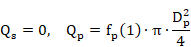
·


·

· ...
·


·

 = same as above

·


Point effect correction in multi-layered terrains
The unit point resistance fp is not really a function that depends exclusively of the soil on which the pile ends, because the area that contributes to this resistance development has a bigger influence length that may even include several layers of the terrain, or part of them.
When this happens it is necessary to do a correction (proposed by Delft) which is shown hereafter.

· Three areas are considered: Passive, Active and Security area
· For each area a unit point resistance value fp is obtained as an average of the resistances of the layers included in each area, taking as weight factors its lengths. In the example shown in the figure, the point resistance corresponding to the passive area would be calculated as:

·
Once the values of  have been obtained, the final point resistance is

For the parameters a1, a2, a3, CivilFEM gives the following default values that can be changed.
|
Material at the base of the pile |
a1/Dp |
a2/Dp |
a3/Dp |
|
Cohesive |
4 |
2 |
2 |
|
Cohesionless |
8 |
3 |
3 |
Piles predesign
In all cases, pile strength is calculated as

CivilFEM will obtain the necessary pile
length to fulfil the following equation  .
.
This length, multiplied by a certain factor FL, will be the one proposed as design length, but can be changed for any other value.
For FL (length security factor) CivilFEM will take 1.00 as default value.
Note - This utility (length of the pile design) is only executed if chosen by the user, who can ask for its value to CivilFEM or to enter it directly.
Grouping effect predesign correction
The settlement of a group of piles does not coincide, in practice, with the one of a single pile. This phenomenon is much more important for those piles on which its strength is attributable to the skin friction.
In general, the existence of two dimensionless factors is admitted. These factors, called efficiency factors hs and hp, are less or equal to one, so that the total strength of the group of np piles is

this way, the equation  that had to be solved in the previous
chapter is
that had to be solved in the previous
chapter is

In 17-B.1.4.4 this phenomenon is studied in detail.
Mean Design Stress checking
For different commercial codes and manufacturers of piles, it is common to limit the mean design stress of each pile to values which depend on the diameter of the pile and the type of load action placed on the cap.
In the following graph recommended values are shown, obtained from different sources, and the ones proposed by CivilFEM.

From these graphs, the following table has been obtained with the recommended value by CivilFEM for ssc (MPa).
|
Type of load |
Diameter |
||||||||
|
£ 0.40 |
0.60 |
0.80 |
1.00 |
1.20 |
1.40 |
1.60 |
1.80 |
³2.00 |
|
|
Normal |
3.25 |
3.90 |
4.50 |
5.00 |
5.60 |
6.00 |
6.30 |
6.50 |
6.60 |
|
Extraordinary |
4.25 |
4.60 |
5.50 |
6.40 |
7.25 |
7.80 |
8.20 |
8.40 |
8.50 |
It is important to point out that the curves proposed by CivilFEM are associated to quality assurance levels, shown in the following chart:

CivilFEM will recommend the assurance level according to the following table
|
Diameter (m) |
£0.50 |
>0.50 – 0.90 |
>0.90 – 1.30 |
>1.30 |
|
Assurance level |
Low |
Medium |
High |
Very High |
The vertical load acting on each pile will be obtained, as shown in 17-B.1.3.2 and the following condition will be checked
 (Dp,
Type of load)
(Dp,
Type of load)
In case this condition is not fulfilled, CivilFEM will show a message with the recommended minimum diameter value, which can be accepted by the user or not.
CivilFEM also shows the recommend the assurance level.
17-B.1.4 Equivalent springs
17-B.1.4.1 Horizontal skin springs
Elastic zone
The horizontal ballast module Wh, origins two non-linear springs in the x and y directions, with spring constants defined as
kx = ky = Wh · Dp · Le · l
where
|
|
Spring affection distance (see figure). |
||||
|
l |
Dimensionless coefficient:
|

The value for the ballast or Winkler module is calculated from the following chart (Chadeysson). It depends on the resistance parameters of the material (c,j).


The springs are modeled in CivilFEM using the LINK8 element.
Taking into account the relationship:

which can be expressed as

Where km, Am and Lm are the stiffness, area and length of the spring (LINK8 element), and comparing it with the expression s = Em e, in which Em is the elasticity module of the material used for the elements, the following equivalence is established:

Taking Em = Epile and calling kmin the less rigid spring constant

and therefore

this is to say, the spring length is taken as a fifth of the quotient between the less rigid spring stiffness and the actual spring stiffness, and therefore Lm £ 1/5 always (length units).
The factor of 1/5 is only introduced to improve the visibility of the model.
Plastic zone
The maximum reaction that can be developed
by the terrain is limited by the passive earth pressure. It is assumed that in
the plastic zone the spring has an elasticity module of .
.
CivilFEM proposes a default value for x equal to  (x is a dimensionless
coefficient).
(x is a dimensionless
coefficient).
The calculation of the maximum limit for the lateral pressure pu is done in a different way, depending on the type of soil.
Cohesive soils
The pu value is obtained from:

Cohesionless soils
In this case, the lateral pressure limit depends on the height of soil above the point:

Where Kp is the passive earth
pressure coefficient 
The value of  is
is

where i is the number of the layer above
the point,  its specific weight, hi its thickness and u the pore
pressure, calculated as
its specific weight, hi its thickness and u the pore
pressure, calculated as

where zw is the water table height, zp the point height and gw the specific weight of water.
The specific weight gi is obtained from the equation gi = gd (1+w), where gd is the dry specific weight and w the moisture content of the material, which has been entered using the commands ~CFMP, nn, SOIL, GAMd and ~CFMP, nn, SOIL, w.
The specific weight of water gw can be entered using the command ~CFMP, nn, SOIL, GAMw. In case this value has not been modified the default value of gw = 9.81 kN/m3 will be used.
Horizontal springs ultimate stress
Taking into account that

it is

which is the ultimate stress on the
horizontal springs, being  p, in which h is the depth of the
point, measured from the upper surface of the slab: h = HeightSl – Point
Height.
p, in which h is the depth of the
point, measured from the upper surface of the slab: h = HeightSl – Point
Height.
17-B.1.4.2 Vertical skin springs
Elastic zone
Opposed to what happened with the horizontal springs, in which the ballast module was known (F´L-3), for these springs the Qs load is known (or the unit load fs) which produces a maximum displacement ws.
The dimensions of both magnitudes are:
|
|
|
|
|
L |


The quotient

has the ballast module dimensions. The process to follow to obtain the spring characteristics is similar to the previous case, although there is no difference now between cohesionless or cohesive soils to obtain the effective area (l = 1 always). The effective area is not either the projection of the pile diameter, but its complete lateral surface:

The area of the springs is taken as

and the length is:

Plastic zone
The value of ws defines the limit of the elastic zone and corresponds to the value of of the friction strength capacity, for which the yield stress is

of  where x is the same coefficient seen in the previous chapter.
As in the case of horizontal springs, the plastic branch will have an elasticity modulus
17-B.1.4.3 Point vertical springs
Elastic zone
In the same way as for vertical skin springs, two values are needed with the following dimensions
|
|
|
|
|
L |
The quotient

has the ballast module dimensions and multiplied by the area of the base of the pile, it turns into the point spring constant:

The area of the cross section of the LINK8 element that simulates the spring is taken as

and its length is therefore:

Plastic zone
The value of wp defines the elastic limit and corresponds to the bearing capacity Qp, for which the yield stress is

Also in these springs the plastic zone is
not considered horizontal, but with a certain slope defined by its elasticity
modulus  where x is the same coefficient as the one used in the rest of the springs.
17-B.1.4.4 Grouping effect correction
Description
In all the previous chapters the springs have been defined by a bilinear law, that goes through the origin, reaches a certain point of coordinates (w,f) and from there it remains horizontal.
The grouping effect is characterized, for
all cases, in the translation of the (w,f) point to a new point  with
with  maintaining the shape of the law just as it has been previously
described.
maintaining the shape of the law just as it has been previously
described.
To perform this transformation a pair of factors (hw, hf) will be used, so that


These factor are defined, for the skin
effect , point effect
  and horizontal ballast module
 .
.
Efficiency factors h calculation
Horizontal loads
For these types of loads, the efficiency factors do not depend on the nature of the soil, and CivilFEM will take the following values:
·
 factor:
It is obtained from the following table, adjusted to the curve proposed by Reese (1992), obtained from tests done by different authors.
|
|
1 |
2 |
3 |
4 |
³5 |
|
|
0.52 |
0.86 |
0.94 |
0.98 |
1.00 |


·
 factor:
It is obtained interpolating linearly in the table given by NAVFAC 02 (p. 241).
|
|
3 |
4 |
6 |
³8 |
|
|
4.0 |
2.5 |
1.4 |
1.0 |
Horizontal loads
·
 (skin) and
  (point) factors:
In bibliography
it is usual to find values of a single factor that includes both phenomena
(skin and point). CivilFEM considers the difference between them, so that they
can be used independently if they are known, although by default CivilFEM will
propose the same values .
.
Cohesionless
soils 

Cohesive soils

In these expressions:
 Surface of the piled area
 Perimeter of the piled area
 = Length of the piles
 = Number of piles
The expression
that gives hf for  (Feld) is deduced for caps with an irregular distribution of the
piles, and it really is:
(Feld) is deduced for caps with an irregular distribution of the
piles, and it really is:

where ne is the number of piles around the considered one. For polygonal distributions it is always 2.
For rectangular slabs on cohesive soils, CivilFEM uses de Los Angeles formulation:

in which
|
m |
Number of piles in the horizontal direction (Npx). |
|
n |
Number of piles in the vertical direction (Npx). |
|
f |
Angle measured in radians, calculated as
|

·
 (skin) and
  (point) factors:
In the same way as what has been described for the applicable efficiency for the load capacity, in bibliography only values for the global effect are found, reason why CivilFEM will propose default values for

which can be changed independently.
Cohesionless soils 
expression
given by Vesic, in which  is the lowest width
of the group, that for a polygonal distribution is
is the lowest width
of the group, that for a polygonal distribution is

For cohesive soils, values from the following graph will be obtained. This graph is given by Cooke (1977) who tested caps with groups of 32 piles.

From this graph the following table has been obtained
|
|
1.75 |
3.00 |
4.00 |
5.00 |
6.00 |
³7.00 |
|
|
4.0 |
2.5 |
1.9 |
1.5 |
1.2 |
1.0 |
in which CivilFEM will do a linear interpolation to obtain the values of hw.
17-B.1.5 Reinforcement Analysis
17-B.1.5.1 Introduction
For the analysis of the needed reinforcements for the slab-pile group, it is common to make a distinction between rigid caps and flexible caps.
It is called rigid cap when the semi-length, at any direction, is not greater than twice the width of the slab. With the notation of the cap scheme shown in 17-B.1.1.1, this condition is verified if

The calculation methods that can be used for the reinforcement study on the slab depend on the type of structure, and are the following ones
|
Pile Cap |
Method |
|
Rigid |
|
|
Flexible |
Wood-Armer |
|
CEB-FIP |
17-B.1.5.2 Reinforcement Groups
Rigid Caps
In this case, on the lower surface and on the piles heads, a group of reinforcement is set that will bond all the heads. This group is called primary reinforcement.
This group is complemented with a reinforcement mesh on the lower surface and another one on the upper surface, called secondary reinforcement.

Flexible caps
In this case, the reinforcement set are meshes on both sides of the slab.

17-B.1.5.3 Reinforcement design
Rigid caps
Obtaining of forces and moments
The method used in this case is the Strut and Tie Method.
The resistant scheme that will be applied is the one shown in the following figure.

From this figure, the following expressions are obtained


Calculating b from the expression

where
 for circular columns, and
 for rectangular columns
RecLos = MAX [Slab Reinf Cover, Width – (HeightSl – HeightPil)]
aR is an effective width reduction factor, needed for the creation of the struts. CivilFEM will take the default value of 0.85.
Calling fyd and fcd the ultimate stresses in steel and concrete, the following operations are performed.
Slab reinforcement design
· Primary reinforcement calculation:

Where k2 is a safety factor that reduces the steel strength, which is not normally used except for high strength steel (fyd>400MPa).
· Secondary reinforcement calculation:


For a1 and a2 CivilFEM proposes the values 0.25 and 0.10 respectively, but they can be changed.
· Concrete strength checking in struts.
As the strut transversal section, CivilFEM considers the lowest of these two values:
o Column cross section divided into the number of piles.

o Pile cross section.

Where w is

in which l is the distance between piles axis and lm is the mean length of the secundary reinforcement bars, which is taken as twice the apothem of the polygon that joins the heads of each pile, and therefore

This is to say

which is latter projected on the plane perpendicular to the pile axis

and the checking consists in verifying the following condition

Where k1 is a coeffcient with a default value of 0.70.
If this condition is not verified CivilFEM will show it along with the minimum slab width needed, that is obtained from.

If the obtained value for sinb is greater than one, the condition cannot be verified just by increasing the width of the slab. It would be necessary to change the piles or column dimensions (increasing Ss).
In case it is less than one, a new b* angle can be obtained:

The primary reinforcement is braced by stirrups with a total section, for all the slab, of

where k3 is a dimensionless coefficient for which CivilFEM proposes de value of 1.50.
It is important to note that this reinforcement is set as stirrups and therefore, the value in surface units per length units would be

Where Lcp is the distance between piles centers.
Pile reinforcement design
Bending reinforcement
It is calculated from the maximum axial force (Nmax) obtained in the analysis, and is

Where Nc is the axial force that can be withstanded by concrete (without considering reinforcement):

Shear reinforcement
It is calculated from the maximum shear forces (Fy, Fz) obtained with the analysis, following the expression

which assumes that the shear stirrups are circumferential, this is to say, in case of having stirrups each x meters in height, the diameter ds of each of them would be

17-B.1.5.4 Flexible caps
In this case, the slab will be designed using the selected method (Wood-Armer or CEB-FIP) and the piles will be designed as beams with the existing forces and moments.
17-B.2 Micropiles
17-B.2.1 Introduction
17-B.2.1.1 Aim
The utility described is designed for:
- Regular polygonal or circular distribution of micropiles (micropiles + slab).
- Rectangular slab sustained by a mesh of micropiles.
- A single micropile, used for load tests.
For circular or polygonal distributions, the micropiles are numbered, beginning with the one with the greatest Y coordinate, anticlockwise, as it can be seen in the figure.
For rectangular distributions, numbering is based on a Npx ´ Npy matrix of micropiles.
17-B.2.1.2 Terrain
In the behavior of a single micropile, the nature of the terrain plays a fundamental role, and in particular if it is cohesionless or cohesive.
In practice, it is easy to distinguish the grounds that could be clearly called cohesionless since they are characterized by high values of the internal friction angle j and have a null value for the cohesion; and the same happens with purely cohesive soils.
Nevertheless, there is an intermediate zone with not very big values of j and small values of c in which it is possible to have doubts on the true characterization of the soil.
In general, the characteristics of both types of soils are the ones shown in the following tables.
Cohesive Soils
|
Consistency |
qu (kPa) |
NSPT |
j(º) |
c (kPa) |
|
Very soft |
30-50 |
2-4 |
15-20 |
0-10 |
|
Soft |
50-100 |
4-8 |
20-25 |
10-20 |
|
Medium |
100-200 |
8-15 |
25-30 |
20-30 |
|
Hard |
200-400 |
15-30 |
30-35 |
30-50 |
|
Very hard |
>400 |
>30 |
>35 |
>50 |
Cohesionless Soils
|
Compacity |
NSPT |
j(º) |
c (kPa) |
|
Very low |
0-4 |
<28 |
0-20 |
|
Low |
4-10 |
28-30 |
0-20 |
|
Medium |
10-30 |
30-36 |
0-20 |
|
High |
30-50 |
36-41 |
0-20 |
|
Very high |
>50 |
>41 |
0-20 |
Where
|
qu |
Unconfined compressive strength |
|
NSPT |
Number of blows obtained in the Standard Penetration Test |
|
j, c |
Internal friction angle and cohesion |
From these values the following graph that characterizes soils by the pair of values (c, j) has been built. In it cohesionless soils are confined in a rectangle.
CivilFEM locates the soils within this graph and will consider it cohesive or cohensionless depending on the area in which the (c, j) point is set.
The lower right vertex of the area of cohesionless soils has by coordinate (cL, jL) and CivilFEM considers that is located at (20 kPa; 25º) by default, although this value can be changed in the configuration window.
All in all, a soil is cohesionless if the conditions j > jL and c £ cL are verified. In opposite case it is considered cohesive.
17-B.2.2 Single micropile load capacity
17-B.2.2.1 Introduction
A micropile load capacity is made up of two addends:
- Skin friction contribution Qs.
- Point resistance contribution Qp.
Both of them depend on the type of terrain and the total settlement, obtaining a QT – w law as the one shown in the following figure.
The ultimate pile load Qu, is not taken as QT, the addition of Qp and Qs, but these two are affected by security factors, obtaining
taking, in general, the following values
|
MATERIAL |
Fs |
Fp |
|
Cohesive |
1.65 to 2.0 |
1.65 to 2.0 |
|
Cohesionless |
1.65 to 2.0 |
1.65 to 2.0 |
CivilFEM will propose, by default, the values represented in bold.
17-B.2.2.2 Load capacity
In order to determine the bilinear law seen in the previous section it is necessary to obtain the pairs of values (ws, Qs) and (wp, Qp).
Skin friction contribution
Calling fs the unit skin friction (Bustamante 1985 a 1994):

where Dp is the diameter of the micropile, Lp its length and a a coefficient that takes tha values shown in the following table:
|
|
|
|
|
|
|
|
|
|
|
a - coefficient range |
|
|||
|
|
SOIL |
IRS (1) |
IGU (1) |
IR(2) |
|
|
|
|
Gravel |
1.8 |
1.3 to 1.4 |
1.5 to 1.6 |
|
|
|
|
Sandy gravel |
1.6 to 1.8 |
1.2 to 1.4 |
1.4 to 1.6 |
|
|
|
|
Sand with gravel |
1.5 to 1.6 |
1.2 to 1.3 |
1.3 to 1.4 |
|
|
|
|
Thick sand |
1.4 to 1.5 |
1.1 to 1.2 |
1.2 to 1.3 |
|
|
|
|
Mediumu sand |
1.4 to 1.5 |
1.2 to 1.2 |
1.3 to 1.4 |
|
|
|
|
Thin sand |
1.4 to 1.5 |
1.2 to 1.2 |
1.3 to 1.4 |
|
|
|
|
Slimy sand |
1.4 to 1.5 |
1.2 to 1.2 |
1.3 to 1.4 |
|
|
|
|
Slime |
1.4 to 1.6 |
1.1 to 1.2 |
1,2 to 1.4 |
|
|
|
|
Clay |
1.8 to 2.0 |
1.2 |
1.5 to 1.6 |
|
|
|
|
|
|
|
|
|
|
|
|
(1) Bustamante |
|
|
|
|
|
|
|
(2) CivilFEM proposed |
|
|
|
|
|
|
|
|
|
|
|
|
|
|
|
IRS = Selective and Repetitive Injection |
Soil type |
|
|||
|
|
IR = Repetitive Injection |
Cohesionless |
|
|||
|
|
IGU = Single and Global Injection |
|
Cohesive |
|
||
|
|
|
|
|
|
|
|
The value of fs depends on the type of soil, its level of compaction (which CivilFEM obtains from the value of the SPT test) and the type of injection done.
The following table and figures represent the unitary skin friction values.
|
|
|
|
|
|
|
|
|
Cohesionless soils |
|
|
|
|
|
|
|
|
fs (MPa) |
|
|
|
|
SPT |
IRS |
IGU |
IR |
|
|
|
10 |
0,10 |
0,05 |
0,08 |
|
|
|
120 |
0,65 |
0,60 |
0,63 |
|
|
|
Correlation |
0.005xSPT+0.05 |
0.005xSPT+0.025 |
0.005xSPT |
|
|
|
|
|
|
|
|
|
|
Cohesive soils |
|
|
|
|
|
|
|
|
fs (MPa) |
|
|
|
|
SPT |
IRS |
IGU |
IR |
|
|
|
5 |
0,10 |
0,04 |
0,07 |
|
|
|
10 |
0,15 |
0,08 |
0,11 |
|
|
|
20 |
0,21 |
0,12 |
0,17 |
|
|
|
30 |
0,26 |
0,16 |
0,21 |
|
|
|
35 |
0,28 |
0,18 |
0,23 |
|
|
|
Correlation |
0.0432xSPT 0.5298 |
0.0274xSPT 0.5994 |
0.0129xSPT 0.7383 |
|
|
|
|
|
|
|
|
|
|
Notes |
|
|
|
|
|
|
- IRS and IGU, based in Bustamante values |
|
|
||
|
|
- IR, CivilFEM proposed values |
|
|
|
|
|
|
|
|
|
|
|


The displacement ws is related with the diameter of the micropile by the expression ws = g·Dp where the g coefficient (shaft deformability factor) takes values between 0.5´10-2 and 1.5´10-2, as it can be verified in the following graph, which represents test results.

CivilFEM will propose the default value for g = 1.0´10-2 (adimensional) but will allow to enter any other, warning when the given value is out of the normal range.
Point resistance contribution
Calling now qp to the unit point resistance, the point resistance contribution is:
The point resistance for micropiles is usually evaluated as a fraction of the skin resistance, normally between 0 and 0.15.
CivilFEM proposes a value of 0.0 for qp.
17-B.2.3 Predesign: Micropiles length
17-B.2.3.1 Introduction
The utility for the analysis of pile caps assumes that the layered terrain has been previously defined (~TERDEF command), which at the same time implies that the materials have been defined (~CFMP command).
For the analysis at least the following material parameters must be defined:
- Mechanical parameters that define the intrinsic resistance.
|
~CFMP, nn, SOIL, cMCeff |
Effective Cohesion (Mohr-Coulomb) |
|
~CFMP, nn, SOIL, PHIMCeff |
Internal friction angle (Mohr-Coulomb) |
With this pair (c, j), CivilFEM classifies the soil as cohesive or cohesionless, as explained in 17-B.2.1.2.
- Depending on the type of soil:
Cohesionless soils.
|
~CFMP, nn, SOIL, SPT |
SPT number of blows |
|
~CFMP, nn, SOIL, GAMd |
Dry specific weight |
|
~CFMP, nn, SOIL, W |
Moisture content |
Cohesive soils.
|
~CFMP, nn, SOIL, qu |
Unconfined compressive strength |
Nota: CivilFEM will warn in the following cases:
|
Cohesionless soil: |
Null NSPT, null GAMd |
|
Cohesive soil: |
Null qu |
With these parameters it is now possible to obtain the values of fs and fp for each layer.
It is important to notice that the vertical direction of the terrain (terrain heights) must be set as OZ, setting ~TERDEF, nn, NEW, mm,, Z, … which defined as coordinate system the one given by ANSYS as default, and as height axis, the OZ axis.
17-B.2.3.2 Load on micropiles
The loads on the slab are entered as forces and moments on the column (Fx, Fy, Fz, Mx, My, Mz), with the signs and directions shown in the following figure:
From these values and from the pressure acting on the slab surface, the compression axial force can be obtained for the most loaded micropile, assuming a rigid behavior for the cap for the first approach:

Where:
|
np |
Total number of micropiles. |
|
P |
Slab weight. |
|
A |
Slab surface area. |
|
q |
Surface load on the slab. |
|
(xi, yi) |
Coordinates of each micropile.
|

The structure can also can subjected to a mass acceleration of (axg, ayg, azg) components, where g is the gravity acceleration and ax, ay and az dimensionless factors.
17-B.2.3.3 Micropile strength
Resistance-Height law
The law will be obtained. This law gives the pile strength related with
its length. For this, the following steps are followed:
Being nL the total number of layers of the terrain, zi the upper height at each of them and zp the upper height of the micropile.
For each layer i the following values are calculated
· fs (i) Unit skin friction.
· fp (i) Unit point resistance.
The equation to obtain the strength of each pile for a Lp length is a piecewise polygonal obtained as:
·
=0, 
·
·
 same as above
· ...
·


·

= same as above
·


Point effect correction in multi-layered terrains
The unit point resistance fp is not really a function that depends exclusively of the soil on which the micropile ends, because the area that contributes to this resistance development has a bigger influence length that may even include several layers of the terrain, or part of them.
When this happens it is necessary to do a correction (proposed by Delft) which is shown hereafter.
· Three areas are considered: Passive, Active and Security area
· For each area a unit point resistance value fp is obtained as an average of the resistances of the layers included in each area, taking as weight factors its lengths. In the example shown in the figure, the point resistance corresponding to the passive area would be calculated as:
·
Once the values of have been obtained, the final point resistance is

For the parameters a1, a2, a3, CivilFEM gives the following default values that can be changed.
|
Material at the base of the micropile |
a1/Dp |
a2/Dp |
a3/Dp |
|
Cohesive |
4 |
2 |
2 |
|
Cohesionless |
8 |
3 |
3 |
Micropiles predesign
In all cases, micropile strength is calculated as
CivilFEM will obtain the necessary pile
length to fulfil the following equation
This length, multiplied by a certain factor FL, will be the one proposed as design length, but can be changed for any other value.
For FL (length security factor) CivilFEM will take 1.00 as default value.
Note - This utility (length of the pile design) is only executed if chosen by the user, who can ask for its value to CivilFEM or to enter it directly.
Grouping effect predesign correction
The settlement of a group of micropiles does not coincide, in practice, with the one of a single micropile.
In general, the existence of two dimensionless factors is admitted. These factors, called efficiency factors hs and hp, are less or equal to one, so that the total strength of the group of np micropiles is
this way, the equation that had to be solved in the previous
chapter is

In 17-B.2.4.4 this phenomenon is studied in detail.
Mean Design Stress Checking
For different commercial codes and manufacturers of piles, it is common to limit the mean design stress of each pile to values which depend on the diameter of the pile and the type of load action placed on the cap.
In the following graph recommended values are shown, obtained from different sources, and the ones proposed by CivilFEM.
From these graphs, the following table has been obtained with the recommended value by CivilFEM for ssc (MPa).
|
Type of load |
Diameter |
||||||||
|
£ 0.40 |
0.60 |
0.80 |
1.00 |
1.20 |
1.40 |
1.60 |
1.80 |
³2.00 |
|
|
Normal |
3.25 |
3.90 |
4.50 |
5.00 |
5.60 |
6.00 |
6.30 |
6.50 |
6.60 |
|
Extraordinary |
4.25 |
4.60 |
5.50 |
6.40 |
7.25 |
7.80 |
8.20 |
8.40 |
8.50 |
It is important to point out that the curves proposed by CivilFEM are associated to quality assurance levels, shown in the following chart:
CivilFEM will recommend the assurance level according to the following table
|
Diameter (m) |
£0.50 |
>0.50 – 0.90 |
>0.90 – 1.30 |
>1.30 |
|
Assurance level |
Low |
Medium |
High |
Very High |
The vertical load acting on each pile will be obtained, as shown in 17-B.2.3.2 and the following condition will be checked
 (Dp, Type of load)
In case this condition is not fulfilled, CivilFEM will show a message with the recommended minimum diameter value, which can be accepted by the user or not.
CivilFEM also shows the recommend the assurance level.
17-B.2.4 Equivalent springs
17-B.2.4.1 Horizontal skin springs
Elastic zone
The horizontal ballast module Wh, origins two non-linear springs in the x and y directions, with spring constants defined as

where
|
Le |
Spring affection distance (see figure). |
||||
|
l |
Dimensionless coefficient:
|
The value for the ballast or Winkler module is calculated from the following chart (Chadeysson). It depends on the resistance parameters of the material (c,j).
The springs are modeled in CivilFEM using the LINK8 element.
Taking into account the relationship:
which can be expressed as

Where km, Am and Lm are the stiffness, area and length of the spring (LINK8 element), and comparing it with the expression s = Em e, in which Em is the elasticity module of the material used for the elements, the following equivalence is established:
Taking Em = Epile and calling kmin the less rigid spring constant
and therefore
this is to say, the spring length is taken as a fifth of the quotient between the less rigid spring stiffness and the actual spring stiffness, and therefore Lm £ 1/5 always (length units).
The factor of 1/5 is only introduced to improve the visibility of the model.
Plastic zone
The maximum reaction that can be developed by the terrain is limited by the passive earth pressure. It is assumed that in the plastic zone the spring has an elasticity module of Et = x´Em.
CivilFEM proposes a default value for x equal to (x is a dimensionless
coefficient).
The calculation of the maximum limit for the lateral pressure pu is done in a different way, depending on the type of soil.
Cohesive soils
The pu value is obtained from:

Cohesionless soils
In this case, the lateral pressure limit depends on the height of soil above the point:

Where Kp is the passive earth
pressure coefficient
The value of  is
is

where i is the number of the layer above the point, gi its specific weight, hi its thickness and u the pore pressure, calculated as
where zw is the water table height, zp the point height and gw the specific weight of water.
The specific weight gi is obtained from the equation gi = gd (1+w), where gd is the dry specific weight and w the moisture content of the material, which has been entered using the commands ~CFMP, nn, SOIL, GAMd and ~CFMP, nn, SOIL, w.
The specific weight of water gw can be entered using the command ~CFMP, nn, SOIL, GAMw. In case this value has not been modified the default value of gw = 9.81 kN/m3 will be used.
Horizontal springs ultimate stress
Taking into account that

it is

which is the ultimate stress on the horizontal springs, being Sy(h) = pu(h)·l·Dp, in which h is the depth of the point, measured from the upper surface of the slab: h = HeightSl – Point Height.
17-B.2.4.2 Vertical skin springs
Elastic zone
Opposed to what happened with the horizontal springs, in which the ballast module was known (F´L-3), for these springs the Qs load is known (or the unit load fs) which produces a maximum displacement ws.
The dimensions of both magnitudes are:
|
|
|
|
|
|

The quotient
has the ballast module dimensions. The process to follow to obtain the spring characteristics is similar to the previous case, although there is no difference now between cohesionless or cohesive soils to obtain the effective area (l = 1 always). The effective area is not either the projection of the micropile diameter, but its complete lateral surface:
The area of the springs is taken as
and the length is:
Plastic zone
The value of ws defines the limit of the elastic zone and corresponds to the value of of the friction strength capacity, for which the yield stress is

As in the case of horizontal springs, the
plastic branch will have an elasticity modulus of where x is the same coefficient seen in the previous chapter.
17-B.2.4.3 Point vertical springs
Elastic zone
In the same way as for vertical skin springs, two values are needed with the following dimensions
|
|
|
|
|
|


The quotient
has the ballast module dimensions and multiplied by the area of the base of the micropile, it turns into the point spring constant:
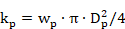
The area of the cross section of the LINK8 element that simulates the spring is taken as
and its length is therefore:
Plastic zone
The value of wp defines the elastic limit and corresponds to the bearing capacity Qp, for which the yield stress is

Also in these springs the plastic zone is not considered horizontal, but with a certain slope defined by its elasticity modulus Et = x´Em where x is the same coefficient as the one used in the rest of the springs.
17-B.2.4.4 Grouping effect correction
Description
In all the previous chapters the springs have been defined by a bilinear law, that goes through the origin, reaches a certain point of coordinates (w,f) and from there it remains horizontal.
The grouping effect is characterized, for all cases, in the translation of the (w,f) point to a new point (w*,f*) with f*£ f y w*³w maintaining the shape of the law just as it has been previously described.
To perform this transformation a pair of factors (hw, hf) will be used, so that


These factor are defined, for the skin
effect, point effect  and horizontal ballast module.
Efficiency factors h calculation
Horizontal loads
For these types of loads, the efficiency factors do not depend on the nature of the soil, and CivilFEM will take the following values:
·
 factor:
It is obtained from the following table, adjusted to the curve proposed by Reese (1992), obtained from tests done by different authors.
|
S/Dp |
1 |
2 |
3 |
4 |
³5 |
|
|
0.52 |
0.86 |
0.94 |
0.98 |
1.00 |
·
factor:
It is obtained interpolating linearly in the table given by NAVFAC 02 (p. 241).
|
S/Dp |
3 |
4 |
6 |
³8 |
|
|
4.0 |
2.5 |
1.4 |
1.0 |
Horizontal loads
·
 (skin) and (point) factors:
In bibliography
it is usual to find values of a single factor that includes both phenomena
(skin and point). CivilFEM considers the difference between them, so that they
can be used independently if they are known, although by default CivilFEM will
propose the same values  .
.
Cohesionless soils 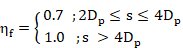
Cohesive soils 

In these expressions:
 Surface of the piled area
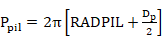 Perimeter of the piled area
Lp = Length of the micropiles
np = Number of micropiles
The expression that gives hf for s>2Dp (Feld) is deduced for slabs with an irregular distribution of the micropiles, and it really is:
where ne is the number of micropiles around the considered one. For polygonal distributions it is always 2.
For rectangular slabs on cohesive soils, CivilFEM uses de Los Angeles formulation:

in which
|
m |
Number of micropiles in the horizontal direction (Npx). |
|
n |
Number of micropiles in the vertical direction (Npx). |
|
f |
Angle measured in radians, calculated as
|
·
 (skin) and (point) factors:
In the same way as what has been described for the applicable efficiency for the load capacity, in bibliography only values for the global effect are found, reason why CivilFEM will propose default values for
which can be changed independently.
Cohesionless soils 
expression
given by Vesic, in which is the lowest width
of the group, that for a polygonal distribution is
For cohesive soils values from the following graph will be obtained. This graph is given by Cooke (1977) who tested caps with groups of 32 piles.
From this graph the following table has been obtained
|
S/Dp |
1.75 |
3.00 |
4.00 |
5.00 |
6.00 |
³7.00 |
|
|
4.0 |
2.5 |
1.9 |
1.5 |
1.2 |
1.0 |
in which CivilFEM will do a linear interpolation to obtain the values of hw.
17-B.2.5 Reinforcement Analysis
17-B.2.5.1 Introduction
For the analysis of the needed reinforcements for the slab-pile group, it is common to make a distinction between rigid caps and flexible caps.
It is called a rigid cap when the semi-length, at any direction, is not greater than twice the width of the slab. Using the notation of the pile caps shown in 17-B.2.1.1, this condition is valid if:

The calculation methods that can be used for the reinforcement study on the slab depend on the type of structure, and are the following ones
|
Pile Cap |
Method |
|
Rigid |
Strut and Tie |
|
Flexible |
Wood-Armer |
|
CEB-FIP |
17-B.2.5.2 Reinforcement groups
Rigid Caps
In this case, on the lower surface and on the micropiles heads, a group of reinforcement is set that will bond all the heads. This group is called primary reinforcement.
This group is complemented with a reinforcement mesh on the lower surface and another one on the upper surface, called secondary reinforcement.
Flexible Caps
In this case, the reinforcement set are meshes on both sides of the slab.
17-B.2.5.3 Reinforcement design
Rigid Caps
Obtaining of forces and moments
The method used in this case is the Strut and Tie Method.
The resistant scheme that will be applied is the one shown in the following figure.
From this figure, the following expressions are obtained

Calculating b from the expression
where
for circular columns, and
 for rectangular columns

aR is an effective width reduction factor, needed for the creation of the struts. CivilFEM will take the default value of 0.85.
Calling fyd and fcd the ultimate stresses in steel and concrete, the following operations are performed.
Slab reinforcement design
· Primary reinforcement calculation:
Where k2
is a safety factor that reduces the steel strength, which is not normally used
except for high strength steel .
.
· Secondary reinforcement calculation:


For a1 and a2 CivilFEM proposes the values 0.25 and 0.10 respectively, but they can be changed.
· Concrete strength checking in struts.
As the strut transversal section, CivilFEM considers the lowest of these two values:
o Column cross section divided into the number of micropiles.
o Micropile cross section.

Where w is

in which l is the distance between micropiles axis and lm is the mean length of the secundary reinforcement bars, which is taken as twice the apothem of the polygon that joins the heads of each micropile, and therefore
This is to say

which is latter projected on the plane perpendicular to the micropile axis
and the checking consists in verifying the following condition
Where k1 is a coeffcient with a default value of 0.70.
If this condition is not verified CivilFEM will show it along with the minimum slab width needed, that is obtained from.
If the obtained value for sinb is greater than one, the condition cannot be verified just by increasing the width of the slab. It would be necessary to change the micropiles or column dimensions (increasing Ss).
In case it is less than one, a new b* angle can be obtained:

The primary reinforcement is braced by stirrups with a total section, for all the slab, of

where k3 is a dimensionless coefficient for which CivilFEM proposes de value of 1.50.
It is important to note that this reinforcement is set as stirrups and therefore, the value in surface units per length units would be
Where Lcp is the distance between piles centers.
17-B.2.5.4 Flexible Caps
In this case, the slab will be designed using the selected method (Wood-Armer or CEB-FIP) .