

10-0.1 Scope
Steel structures checking according to the Steel Construction Manual of AISC 14th Edition in CivilFEM includes the checking of structures composed of welded or rolled shapes under axial forces, shear forces and bending moments in 3D.
The calculations made by CivilFEM conform to the following sections of Part 16 Specifications and Codes:
|
D |
Design of members for tension. |
|
E |
Design of members for compression. |
|
F |
Design of members for flexure. |
|
G |
Design of members for shear. |
|
H |
Design of members for combined forces and torsion. |
10-0.2 Checking Types
With CivilFEM it is possible to perform the following checking and analysis types:
· Checking of sections subjected to:
|
Tension |
D |
|
Flexure |
F |
|
Shear Force |
G |
|
Flexure and axial force |
H1 |
|
Bending plus axial force, shear & torsion |
H3.3 |
· Buckling check:
|
Compression members subjected to flexure |
E3,E7 |
|
Compression members subjected to flexure and torsion |
E4,E7 |
10-0.3 Valid Element Types
The valid element types supported by CivilFEM are the following 2D and 3D ANSYS link and beam elements:
|
2D Link |
LINK1 |
|
3D Link |
LINK8 |
|
3D Link |
LINK10 |
|
2D Beam |
BEAM3 |
|
3D Beam |
BEAM4 |
|
3D Tapered Unsymmetrical Beam |
BEAM44 |
|
2D Tapered Elastic Unsymmetrical Beam |
BEAM54 |
|
2D Plastic Beam |
BEAM23 |
|
3D Thin-walled Beam |
BEAM24 |
|
3D Elastic Straight Pipe |
PIPE16 |
|
3D Plastic Straight Pipe |
PIPE20 |
|
3D Finite Linear Strain Beam |
BEAM188 |
|
3D Quadratic Linear Strain Beam |
BEAM189 |
Moreover, it is possible to check solid sections captured from 2D or 3D models with a transversal cross section classified as “structural steel”.
10-0.4 Valid Cross-Section Types
The steel type cross-sections used by CivilFEM can be classified as:
- All the rolled shapes (I shapes, U or channel shapes, etc.) included in the program libraries (see the hot rolled shapes library and ~SSECLIB command).
- The following welded beams: I shapes, U or channel shapes, T shapes, box, equal and unequal legs angles and pipes. (~SSECDMS commands). These sections are considered as a generic shape.
- Structural steel sections defined by plates (command ~SSECPLT). These sections are considered as a generic shape.
- Shapes from solid sections captured from 2D or 3D models which transverse cross section is classified as “structural steel” (command ~SLDSEC).
The cross-sections considered in the AISC 14TH EDITION code depend on the type of checking:
|
Checking |
Valid Cross Sections |
|
TENSION |
All. |
|
COMPFBK |
All. |
|
COMPFTBK |
All. |
|
BENDING |
I shape with non slender web (no plate girder), C shape with non slender web (no plate girder), pipe shapes, box shapes and T shapes. |
|
SHEAR |
I and C shape with non slender web, loaded in the plane of the web. |
|
BEND_AXL |
I shape with non slender web (no plate girders), C shape with non slender web (no plate girders), pipe shapes, box shapes and T shapes. |
|
BDAxSHTR |
All. |
10-0.5 Data and Results used by CivilFEM
CivilFEM utilizes the following groups of data and results for checking according to AISC 14TH EDITION:
· Data concerning to sections: properties and dimensions of gross, net and effective sections, characteristics and dimensions of section plates.
· Member properties.
· Material properties.
· Forces and moments over the sections.
· Checking results.
Sections Data
AISC 14TH EDITION considers the following data set for the section:
· Gross section data
· Net section data
· Effective section data
· Data concerning to the section and plates class.
Gross section data correspond to the nominal properties of the cross-section.
From net section, only the area is considered. This area is calculated by subtracting the holes for screws, rivets and other holes from the gross section area. The user should be aware that AISC 14TH EDITION indicates the diameter from which to calculate the parameter AHOLES is greater than the real diameter (the total calculated area is introduced in the parameter AHOLES with the command ~SECMDF).
The effective section data and the section and plates class data are obtained in the checking process according to chapter B, section B4 of the code. This chapter classifies steel sections into three groups (compact, noncompact and slender), depending upon the width-thickness ratio and other mandatory limits.
The AISC 14TH EDITION module utilizes the gross section data in user units and the CivilFEM axis or section axis as initial data. The program calculates the effective section data and the class data, and stores them in CivilFEM’s results file, in user units and in CivilFEM or section axis. The data can be listed and plotted with the ~PLLSSTL and ~PRSTL commands.
the section data used in AISC 14TH EDITION are shown in the following tables:
Table 5‑1 Common data for gross, net and effective sections
|
Description |
Data |
|
Input data: 1.- Height 2.- Web thickness 3.- Flanges thickness 4.- Flanges width 5.- Distance between flanges 6.- Radius of fillet (Rolled shapes) 7.- Toe radius (Rolled shapes) 8.- Weld throat thickness (Welded shapes) 9.- Web free depth |
H Tw Tf B Hi r1 r2 a d |
|
Output data |
(None) |
Table 5‑2 Gross section data
|
Description |
Data |
Reference axes |
|
Input data: 1.- Depth in Y 2.- Depth in Z 3.- Cross-section area 4.- Moments of inertia for torsion 5.- Moments of inertia for bending 6.- Product of inertia 7.- Elastic resistant modulus 8.- Plastic resistant modulus 9.- Radius of gyration 10.- Gravity center coordinates 11.- Extreme coordinates of the perimeter
12.- Distance between GC and SC in Y and in Z 13.- Warping constant 14.- Shear resistant areas 15.- Torsional resistant modulus 16.- Moments of inertia for bending about U, V 17.- Angle Y->U or Z->V |
Tky tkz A It Iyy, Izz Izy Wely, Welz Wply, Wplz iy, iz Ycdg, Zcdg Ymin, Ymax, Zmin, Zmax Yms, Zms Iw Yws, Zws Xwt Iuu, Ivv a |
CivilFEM CivilFEM
CivilFEM CivilFEM CivilFEM CivilFEM CivilFEM CivilFEM Section Section
Section
CivilFEM CivilFEM Principal CivilFEM |
|
Output data: |
(None) |
|
Table 5‑3 Net section data
|
Description |
Data |
|
Input data: 1.- Gross section area 2.- Area of holes |
Agross Aholes |
|
Output data: 1.- Cross-section area |
Anet |
* The section holes are introduced as a property at member level
The effective section depends upon the geometry of the section; thus, the effective section is calculated for each element and each of the ends of the element.
Table 5‑4 Net section data
|
Description |
Data |
|
Input data: |
(None) |
|
Output data: 1.- Reduction factor 2.- Reduction factor 3.- Reduction factor |
Q Qs Qa |
Table 5‑5 Data referred to the section plates
|
Description |
Data |
|
Input data: 1.- Plates number 2.- Plate type: flange or web (for the relevant bending axis) 3.- Union condition at the ends: free or fixed 4.- Plate thickness 5.- Coordinates of the extreme points of the plate (in Section axes) |
N Pltype Cp1, Cp2 t Yp1, Yp2, Zp1, Zp2 |
|
Output data: 1.- Class 2.- Bending axis for checking purposes 3.- Plate’s class 4.- Plate reduction factor in point 1 5.- Plate reduction factor in point 2 6.- Compression class 7.- Bending class 8.- Width to thickness ratio (b/t) 9.- lp compression 10.- lr compression 11.- Plate compression class 12.- lp bending 13.- lr bending 14.- Bending class |
CLASS AXIS PC PF1 PF2 CLS_COMP CLS_FLEX RATIO LAMBDP_C LAMBDR_C CLASE_C LAMBDR_P LAMBDR_F CLASE_F |
Member Properties
For AISC 14TH EDITION the checked data set used at member level is shown in the following table. All data is stored with the section data in user units and in the CivilFEM reference axis. (Parameters L, KY, KZ, KTOR, CB, LB, CHCKAXIS, of ~MEMBPRO command).
Table 5‑6 Member Properties
|
Description |
Data |
|
Input data: 1.- Unbraced length of member (global buckling) 2.- Effective length factors Y direction 3.- Effective length factors Z direction 4.- Effective length factors for torsional buckling 5.- Flexural factor relative to bending moment 6.- Length between lateral restraints |
L KY KZ KTOR Cb Lb |
|
Output data: 1.- Compression class 2.- Bending class |
CLS_COMP CLS_FLEX |
Material Properties
For AISC 14TH EDITION checking, the following material properties are used:
Table 5‑7 Material properties
|
Description |
Property |
|
Steel yield strength |
Fy(th) |
|
Ultimate strength |
Fu(th) |
|
Elasticity modulus |
E |
|
Poisson coefficient |
n |
|
Shear modulus |
G |
10-0.6 Checking Process
Necessary steps to conduct the different checks in CivilFEM are as follows:
a)
Obtain material properties corresponding to the
element stored in CivilFEM database and calculate the rest of the properties
needed for checking:
Properties obtained from CivilFEM database: (command ~CFMP)
|
Elasticity modulus |
E |
|
Poisson’s ratio |
n |
|
Yield strength |
Fy (th) |
|
Ultimate strength |
Fu (th) |
|
Shear modulus |
G |
|
Thickness of corresponding plate |
th |
b) Obtain the cross-sectional data corresponding to the element.
c) Initiate the values of the plate’s reduction factors and the other plate’s parameters to determine its class.
d) Perform a check of the section according to the type of external load.
e) Results. In CivilFEM, checking results for each element end are grouped into alternatives in the results file .RCV, so that the user may access them by indicating the number of the alternative using the CivilFEM command ~CFSET.
The required data for the different checking types are provided within tables found in their corresponding section of this manual.
Design Requirements.
Design for Strength Using Load and Resistance Factor Design (LRFD)
Design shall be performed in accordance with:

Where:
|
|
Required strength (LRFD). |
|
|
Nominal strength. |
|
|
Resistance factor. |
|
|
Design strength |


Design for Strength Using Allowable Strength Design (ASD)
Design shall be performed in accordance with:

Where:
|
Ra |
Required strength (ASD) |
|
Rn |
Nominal strength. |
|
Ω |
Safety factor |
|
Rn/ Ω |
Allowable strength |
General Processing of Sections. Section Class and Reduction Factors Calculation.
Steel sections
are classified as compact, noncompact or slender-element sections for bending
sections and slender or non slender for compression sections. For a section to
qualify as compact its flanges must be continuously connected to the web or
webs and the width-thickness ratios of its compression elements must not exceed
the limiting width-thickness ratios  (see table B4.1 of AISC 14TH EDITION). If the width-thickness ratio
of one or more compression elements exceeds but does not exceed
(see table B4.1 of AISC 14TH EDITION). If the width-thickness ratio
of one or more compression elements exceeds but does not exceed  , the section is noncompact. If the width-thickness ratio of any
element exceeds , (see table B4.1 of AISC 14TH EDITION), the section is referred to
as a slender-element compression section.
, the section is noncompact. If the width-thickness ratio of any
element exceeds , (see table B4.1 of AISC 14TH EDITION), the section is referred to
as a slender-element compression section.
Therefore, the code suggests different lambda values depending on if the element is subjected to compression, flexure or compression plus flexure.
The section classification is the worst-case scenario of all of its plates. Therefore, the class is calculated for each plate with the exception of pipe sections, which have their own formulation because it cannot be decomposed into plates. This classification will consider the following parameters:
a) Length of elements:
The program will define the element length (b or h) as the length of the plate (distance between the extreme points), except when otherwise specified.
b) Flange or web distinction:
To distinguish between flanges or webs, the program follows the criteria below:
Once the principal axis of bending is defined, the program will
examine the plates of the section. Fields Pty and Ptz of the plates indicate if
they behave as flanges, webs or undefined, choosing the correct one for the
each axis. If undefined, the following criterion will be used to classify the
plate as flange or web: if  (increments of end coordinates) and flexure is in the Y axis, it
will be considered a web; if not, it will be a flange. The reverse will hold
true for flexure in the Z-axis.
(increments of end coordinates) and flexure is in the Y axis, it
will be considered a web; if not, it will be a flange. The reverse will hold
true for flexure in the Z-axis.
· Hot rolled Steel Shapes:
Section I and C:
The length of the plate h will be taken as the value d for the section dimensions.
Section Box:
The length of the plate will be taken as the width length minus three times the thickness.
Members Subjected to Compression
In order to check for compression it is necessary to determine if the element is stiffened or unstiffened.

Pipe sections

Box sections

- Unstiffened elements:

Angular sections

Stem of T sections

Members Subjected to Bending
The bending check is only applicable to very specific sections. Therefore, the slenderness factor is listed for each section:
· Section I and C:


|
|
69 MPa for hot rolled shapes (10 ksi) |
|
114 MPa for welded sections (16.5 ksi) |

 = minimum of (
 ) and (
 ) where
  and
and are the
  of flange and web respectively.
Flanges of rolled sections:


Flanges of welded sections:


Flange:
If :

If :


Always: 
 is the compression axial force (taken as positive). If in tension,
it will be taken as zero.
is the compression axial force (taken as positive). If in tension,
it will be taken as zero.
· Pipe section:


· Box section:
Flanges of box section:


Flanges: the program distinguishes between the flange and web upon the principal axis chosen by the user.
If: 

If: 


Always: 

· T section:

Stem: 
Flanges: 
Checking of Members for Tension (Chapter D)
The axial tension force must be taken as positive (if the tension force has a negative value, the element will not be checked)
Design tensile
strength  and the allowable tensile strength
  , of tension members, shall be the lower
value of :
, of tension members, shall be the lower
value of :
a) yielding in the gross section:


b) rupture in the net section:


Being:
|
|
Effective net area. |
|
|
Gross area. |
|
|
Minimum yield stress. |
|
|
Minimum tensile strength. |


The effective net area will be taken as Ag – AHOLES. The user will need to enter the correct value for AHOLES (the code indicates that the diameter is 1/16th in. (2 mm) greater than the real diameter).
Checking of Members in Axial Compression (Chapter E)
The design
compressive strength,  ,and the allowable compressive strength,
  , are determined as follows:
The nominal
compressive strength,  , shall be the lowest value obtained according to the limit states
of flexural buckling, torsional buckling and flexural-torsional buckling.
, shall be the lowest value obtained according to the limit states
of flexural buckling, torsional buckling and flexural-torsional buckling.


Compressive Strength for Flexural Buckling
This type of check can be carried out for compact sections as well as for noncompact or slender sections. These three cases adhere to the following steps:
Nominal compressive strength, :
 (E3-1)


(a) for 
 =
= 
(b) for 

Where:
|
|
Gross area of member. |
|
r |
Governing radius of gyration about the buckling axis. |
|
K |
Effective length factor. |
|
l |
Unbraced length. |
|
|
Elastic critical buckling stress |


Factor Q for compact and noncompact sections is always 1. Nevertheless, for slender sections, the value of Q has a particular procedure. Such procedure is described below:
Factor Q for slender sections:
For unstiffened plates, Qs must be calculated and for stiffened plates, Qa must be determined. If these cases do not apply (box sections or angular sections, for example), a value of 1 for these factors will be taken.
For circular sections, there is a particular procedure of calculating Q. Such procedure is described below:
· For circular sections, Q is:


Factor Qs:
If there are several plates free, the value of Qs is taken as the biggest value of all of them. The program will check the slenderness of the section in the following order:
· Angular
|
If |
|
|
|
If |
|
|


· Stem of T
|
If |
|
|
|
If |
|
|


· Rolled shapes
|
If |
|
|
|
If |
|
|


· Other sections
|
If |
|
|
|
If |
|
|


Where l is the element slenderness and
|
|
for I sections |
|
|
for other sections |


Factor Qa:
The calculation of factor Qa is an iterative process. Its procedure is the following:
1) An initial value of Q equal to Qs is taken.
2) With this value is calculated.
3) This  value is taken to calculate
4) For elements with stiffened plates, the effective width be is calculated.
5) With be the effective area is calculated.
6) With the value of the effective area, Qa is calculated, and the process starts again.

· For a box section
|
If |
|
|


· For other sections
|
If |
|
|


If it is not within those limits, 
With the  values for each plate, the part that does not contribute
 )] is subtracted from the area (where t is the plate thickness).
Using this procedure, the effective area is calculated.
)] is subtracted from the area (where t is the plate thickness).
Using this procedure, the effective area is calculated.
Finally, with Qs and Qa, Q is calculated,
and is obtained.
Output results are written in the CivilFEM results file (.RCV) as an alternative.
Compressive Strength for Flexural-Torsional Buckling
This type of check can be carried out for compact sections as well as for noncompact or slender sections. The steps for these three cases are as follows:
Nominal compressive strength,:
(E4-1)
(a) for 
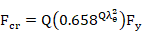
(b) for 

Where:

Factor Q for compact and noncompact sections is 1. Nevertheless, for slender sections, the Q factor has a particular procedure of calculation. Such procedure is equal to the one previously described.
The elastic stress for critical torsional buckling or flexural-torsional buckling Fe is calculated as the lowest root of the following third degree equation, in which the axis have been changed to adapt to the CivilFEM normal axis:
 (E4-6)
Where:
|
|
Effective length factor for torsional buckling. |
|
G |
Shear modulus (MPa). |
|
|
Warping constant (mm6). |
|
J |
Torsional constant (mm4). |
|
|
Moments of inertia about the principal axis (mm4). |
|
|
Coordinates of shear center with respect to the center of gravity (mm). |


where:
|
A |
Cross-sectional area of member. |
|
l |
Unbraced length. |
|
|
Effective length factor, in the z and y directions. |
|
|
Radii of gyration about the principal axes. |
|
|
Polar radius of gyration about the shear center. |


In this formula, CivilFEM principal axes are used. If the CivilFEM axes are the principal axes ±5º sexagesimal degrees, Ky and Kz are calculated with respect to the Y and Z-axes of CivilFEM. If this is not the case (angular shapes, for example) axes U and V will be used as principal axes, with U as the axis with higher inertia.
The torsional inertia (Ixx in CivilFEM, J in AISC 14TH EDITION) is calculated for CivilFEM sections, but not for captured sections. Therefore the user will have to introduce this parameter in the mechanical properties of CivilFEM.
Output results are written in the CivilFEM results file (.RCV) as an alternative.
Checking of Members for Flexure (Chapter F)
Chapter F is only applicable to members subject to simple bending about one principal axis.
Flexure Check
The design flexural strength, , and the allowable flexural strength,
  , shall be determined as follows:
For all provisions: = 0.90 (LRFD)
  = 1.67 (ASD)
Where  is the lowest value of four checks according to sections F2 through
F12:
is the lowest value of four checks according to sections F2 through
F12:
Where Mn is the lowest value of four checks according to sections F2 through F12:
a) Yielding
b) Lateral-torsional buckling
c) Flange local buckling
d) Web local buckling
The value of the nominal flexural strength with the following considerations:
- For compact
sections, if
 only yielding of steel will be checked.
 - For T sections, and other compact sections, only yielding and torsional buckling will be checked.
- The case of lateral-torsional buckling does not apply to sections loaded on the minor axis of inertia nor box or square sections.
- The case of lateral-torsional buckling only applies for sections with double symmetry, channel and T sections. Therefore the rest of sections will be checked for torsion plus combined loads and will not be checked under flexure.
- For slender sections, the code contemplates the following cases:
|
Shape |
Limit State |
Mr |
Fcr |
l |
lp |
lr |
|
I, C loaded in the axis of higher inertia.
|
LTB |
|
|
|
|
|
|
FLB |
|
|
|
Class B4.1 |
Class B4.1 |
|
|
WLB |
|
N.A. |
|
Class B4.1 |
Class B4.1 |


|
Shape |
Limit State |
Mr |
Fcr |
l |
lp |
lr |
|
I, C loaded in the axis of lower inertia.
|
LTB |
N.A. |
N.A. |
N.A. |
N.A. |
N.A. |
|
FLB |
|
|
|
Class B4.1 |
Class B4.1 |
|
|
WLB |
N.A. |
N.A. |
N.A. |
N.A. |
N.A. |


|
Shape |
Limit State |
Mr |
Fcr |
l |
lp |
lr |
|
Box
|
LTB |
|
|
|
|
|
|
FLB |
|
|
|
Class B4.1 |
Class B4.1 |
|
|
WLB |
|
N.A. |
|
Class B4.1 |
Class B4.1 |


|
Shape |
Limit State |
Mr |
Fcr |
l |
lp |
lr |
Notes |
|
Pipe
|
LTB |
NA |
NA |
NA |
NA |
NA |
Limited by Class B4.1 |
|
FLB |
Slender:
Non-compact:
|
|
|
Class B4.1 |
Class B4.1 |
||
|
WLB |
NA |
NA |
NA |
NA |
NA |


|
Shape |
Limit State |
Mr |
Fcr |
l |
lp |
lr |
|
T, loaded in web plane
|
LTB |
|
N.A. |
N.A. |
N.A. |
N.A. |
|
FLB |
N.A. |
N.A. |
N.A. |
N.A. |
N.A. |
|
|
WLB |
N.A. |
N.A. |
N.A. |
N.A. |
N.A. |


Where:


(positive sign if the stem is under tension, negative if it is under compression)
In T sections:  stem in tension;
  stem in compression.
For slender webs
the nominal flexural strength  is the minimum of the following checks:
- tension-flange yield
- compression flange buckling
The first check uses the following formula:

where:
|
|
Section modulus referred to tension flange. |
|
|
Yield strength of tension flange. |

The second check uses the following formula:

where:

The critical stress depends upon different
slenderness parameters such as l, ,  and
and  in the following way:
|
For |
|
|
For |
|
|
For |
|


The slenderness values have to be calculated for the following limit states:
- Lateral torsional buckling


 (International System units)
 is the radius of gyration of compression flange plus one third of
the compression portion of the web (mm).
is the radius of gyration of compression flange plus one third of
the compression portion of the web (mm).
By default, the
program takes a conservative value of  . Nevertheless, the user may calculate this value and introduce it
as a member property
. Nevertheless, the user may calculate this value and introduce it
as a member property
- Flange local buckling


 (IS units)
where:

 and
and 
Between these two slenderness, the program will choose values the value that produces a lower critical stress.
Output results are written in the CivilFEM results file (.RCV) as an alternative.
Checking of Members for Shear (Chapter G)
The design shear
strength,  , and the allowable shear strength,
  , shall be determined as follows:
For all provisions:  = 0.90 (LRFD)
  = 1.67 (ASD)
According to the
limit states of shear yielding and shear buckling, the nominal shear strength,  , of unstiffened webs is:

For webs of
rolled I-shaped members with  :
:
= 1.00 (LRFD) = 1.50 (ASD)
 = 1.0 (web shear coefficient)
For webs of all
other doubly symmetric shapes and singly symmetric shapes and channels  is determined as follows:
- For


- For


- For


Where  is the overall depth times the web thickness.
It is assumed that there are no stiffeners;
therefore, the web plate buckling coefficient  will be calculated as a constant equal to 5.0.
Output results are written in the CivilFEM results file (.RCV) as an alternative.
Checking of Members for Combined Forces and Torsion (Chapter H)
Checking of Members Subject to Flexure and Axial Tension / Compression
For this check, it is first necessary to
determine the value of Mn. This value comes into play in the checking of
formulas. The value of Mn, will be calculated in the same way as members
subjected to flexure; thus, the nominal flexure strength ( ) is the minimum of four checks:
1. Yielding
2. Lateral-torsional buckling
3. Flange local buckling
4. Web local buckling
In the case of having bending plus tension or bending plus compression, the interaction between flexure and axial force is limited by the following equations:
(a) For 
 (H1-1a)
(b) For 
 (H1-1b)
If the axial force is tension:
|
|
Required tensile strength (N). |
|
|
Available tensile strength (N):
|
|
|
Required flexural strength (N·mm). |
|
|
Available flexural strength (N·mm): Design: Allowable: |
|
y |
Strong axis bending. |
|
z |
Weak axis bending. |
|
|
Resistance factor for tension (Sect.D2) |
|
|
Resistance factor for flexure = 0.90 |
|
|
Safety factor for tension (Sect D2) |
|
|
Safety factor for flexure = 1.67 |


If the axial force is compression:
|
|
Required compressive strength (N). |
|
|
Available compressive strength (N): Design: Allowable: |
|
|
Required flexural strength (N·mm). |
|
|
Available flexural strength (N·mm): Design: Allowable: |
|
Y |
Strong axis of bending. |
|
Z |
Weak axis of bending. |
|
|
Resistance factor for compression =0.90 |
|
|
Resistance factor for flexure = 0.90 |
|
|
Safety factor for compression =1.67 |
|
|
Safety factor for flexure = 1.67 |


The following checks are carried out by CivilFEM:
- Axial force and flexural buckling
- Bending moment Z direction
- Bending moment Y direction
If one of these checks do not meet the code requirements, it will not be possible to check the member under flexure plus tension / compression.
Output results are written in the CivilFEM results file (.RCV) as an alternative.
Checking of Members Subjected to Torsion, Flexure, Shear and/or Axial Force
The design torsional strength, fTTn , and the allowable torsional strength, Tn/ΩT , shall be the lowest value obtained according to the limit states of yielding under normal stress, shear yielding under shear stress or buckling, determined as follows:
 = 0.90 (LRFD)
  = 1.67 (ASD)
· For the limit state of yielding, under normal stress:

· For the limit state of yielding, under shear stress:

· For the limit state of buckling:

-
Where  is calculated
Output results are written in the CivilFEM results file (.RCV) as an alternative.