

10-I.1 Scope
Steel structures checking according to AISC-ASD Ninth Edition (1989) in CivilFEM includes the checking of structures composed by welded or rolled shapes under axial forces, 2D bending + axial forces and bending and torsional moments in 3D.
Calculations conform to the provisions of the 5 th part of the Specifications and Codes of the Manual of Steel Construction Allowable Stress Design. This Code corresponds to the ninth edition of the technical specifications.
Valid section types include: I-shaped sections, U or channel sections, T sections for rolled or welded shapes, tubular or pipe sections, rectangular tubular sections and L sections.
Calculations made by CivilFEM according to the design requirements of AISC-ASD of the following sections:
|
B |
Design requirements |
|
D |
Tension members |
|
E |
Columns and other compression members |
|
F |
Beams and other flexural members |
|
G |
Plate girders |
|
H |
Combined stresses |
10-I.2 Checking Types
With CivilFEM, it is possible to perform the following checking and analysis types:
· Checking of sections subjected to:
|
- Tension |
AISC-ASD chap. D |
|
- Bending |
AISC-ASD chap. F |
|
- Shear force |
AISC-ASD chap F |
|
- Axial compression and bending |
AISC-ASD chap H-1 |
|
- Axial tension and bending |
AISC-ASD chap H-2 |
· Buckling Checking:
|
- Compression members subjected to flexure |
AISC-ASD chap. E-2 |
|
- Compression members subjected to flexure and torsion |
AISC-ASD chap. E-3 |
10-I.3 Valid Element Types
The valid element types supported by CivilFEM are the following 2D and 3D ANSYS link and beam elements:
|
2D Link |
LINK1 |
|
3D Link |
LINK8 |
|
3D Link |
LINK10 |
|
2D Beam |
BEAM3 |
|
3D Beam |
BEAM4 |
|
3D Tapered Unsymmetrical Beam |
BEAM44 |
|
2D Tapered Elastic Unsymmetrical Beam |
BEAM54 |
|
2D Plastic Beam |
BEAM23 |
|
3D Thin-walled Beam |
BEAM24 |
|
3D Elastic Straight Pipe |
PIPE16 |
|
3D Plastic Straight Pipe |
PIPE20 |
|
3D Finite Linear Strain Beam |
BEAM188 |
|
3D Quadratic Linear Strain Beam |
BEAM189 |
Moreover, it is possible to check solid sections captured from 2D or 3D models with a transversal cross section classified as “structural steel”.
10-I.4 Valid Cross-Section Types
Valid steel cross-sections supported by CivilFEM for checking according to AISC-ASD are as follows:
- All rolled shapes (I shapes, U or channel shapes, etc.) included in the program libraries (see the hot rolled shapes library and ~SSECLIB command)
- The following welded beams: I shapes, U or channel shapes, T shapes, box, equal and unequal leg angles and pipes. (~SSECDMS command). These sections are considered as a generic shape.
- Structural steel sections defined by plates (~SSECPLT command). These sections are considered as a generic shape.
- Shapes from solid sections captured from 2D or 3D models which transverse cross section is classified as “structural steel” (~SLDSEC command).
10-I.5 Data and Results used by CivilFEM
CivilFEM works with the following groups of data and results for checking according to AISC-ASD:
· Data pertaining to sections: properties and dimensions of gross, net and effective sections, characteristics and dimensions of section plates.
· Member properties.
· Material properties.
· Forces and moments acting on the sections.
· Checking results.
10-I.5.1 Section Data
AISC-ASD considers the following data set for the section:
· Gross section data
· Net section data
· Effective section data
· Data concerning the section and plates class.
Gross section data correspond to the nominal properties of the cross-section.
From net section only the area is considered. This area is calculated by subtracting the holes for screws, rivets and other holes from the gross section area. The user should be aware that AISC-ASD indicates the diameter used to calculate the parameter AHOLES is greater than the real diameter (the total calculated area is introduced in the parameter AHOLES with the ~SECMDF command).
Effective section data and section and plates class data are obtained in the checking process according to chapter B, section B5 of the code. This chapter classifies steel sections into three groups, compact, non compact, and slender, depending upon the width-thickness ratio and other specified requirements.
The AISC-ASD module takes the gross section data in user units and the CivilFEM axis or section axis as initial data. The program calculates the effective section data and class data and stores these data sets in the CivilFEM results file in user units and in the CivilFEM or section axis. The data can be listed or plotted with the ~PLLSSTL, ~PLCSEC3 and ~PRSTL commands.
The section data used in AISC-ASD are shown in the following tables:
Table 10-G.5‑1 Common data for gross, net and effective sections
|
Description |
Data |
|
Input data: 1.- Height 2.- Web thickness 3.- Flanges thickness 4.- Flanges width 5.- Distance between flanges 6.- Radius of fillet (Rolled shapes) 7.- Toe radius (Rolled shapes) 8.- Weld throat thickness (Welded shapes) 9.- Web free depth |
H Tw Tf B Hi r1 r2 a d |
|
Output data |
(None) |
Table 10-G.5‑2 Gross section data
|
Description |
Data |
Reference axes |
|
Input data: 1.- Depth in Y 2.- Depth in Z 3.- Cross-sectional area 4.- Moments of inertia for torsion 5.- Moments of inertia for bending 6.- Product of inertia 7.- Elastic resistant modulus 8.- Plastic resistant modulus 9.- Radius of gyration 10.- Center of gravity coordinates 11.- Extreme coordinates of the perimeter
12.- Distance between GC and SC in Y and in Z 13.- Warping constant 14.- Shear resistant areas 15.- Torsional resistant modulus 16.- Moments of inertia for bending about U, V 17.- Angle Y->U or Z->V |
Tky tkz A It Iyy, Izz Izy Wely, Welz Wply, Wplz iy, iz Ycdg, Zcdg Ymin, Ymax, Zmin, Zmax Yms, Zms Iw Yws, Zws Xwt Iuu, Ivv a |
CivilFEM CivilFEM
CivilFEM CivilFEM CivilFEM CivilFEM CivilFEM CivilFEM Section Section
Section
CivilFEM CivilFEM Principal CivilFEM |
|
Output data: |
(None) |
|
Table 10-G.5‑3 Net section data
|
Description |
Data |
|
Input data: 1.- Gross section area 2.- Area of holes |
Agross Aholes |
|
Output data: 1.- Cross-section area |
Anet |
* The section holes are introduced as a property at member level
The effective section depends upon the geometry of the section; thus, the effective section is calculated for every element and element end.
Table 10-G.5‑4 Net section data
|
Description |
Data |
|
Input data: |
(None) |
|
Output data: 1.- Full reduction factor for slender sections 2.- Unstiffened compression elements reduction factor 3.- Stiffened compression elements reduction factor |
Q Qs Qa |
Table 10-G.5‑5 Data referred to the section plates
|
Description |
Data |
|
Input data: 1.- Plates number 2.- Plate type: flange or web (for the relevant bending axis) 3.- Union condition at the ends: free or fixed 4.- Plate thickness 5.- Coordinates of the extreme points of the plate (in Section axes) |
N Pltype Cp1, Cp2 t Yp1, Yp2, Zp1, Zp2 |
|
Output data: 1.- Class 2.- Bending axis for checking purposes 3.- Plate’s class 4.- Plate reduction factor in point 1 5.- Plate reduction factor in point 2 6.- Compression class 7.- Bending class 8.- Width to thickness ratio (b/t) 9.- lp compression 10.- lr compression 11.- Plate compression class 12.- lp bending 13.- lr bending 14.- Bending class |
CLASS AXIS PC PF1 PF2 CLS_COMP CLS_FLEX RATIO LAMBDP_C LAMBDR_C CLASE_C LAMBDR_P LAMBDR_F CLASE_F |
10-I.5.2 Member Properties
For AISC-ASD, the data set checked at member level is shown in the following table. The data are stored with the section data in user units and in CivilFEM reference axis. (Parameters L, Kxy, Kxz, Kz, CB, LB of ~MEMBPRO command).
Table 10-G.5‑6 Member Properties
|
Description |
Data |
Section |
|
Input data: 1.- Unbraced length of member (global buckling) 2.- Effective length factors in both planes 3.- Effective length factors for torsional buckling 4.- Factor depending on the My moments gradient |
L Kxy,Kxz Kz Cb |
Table C-C2.1 E3 F1.3 |
|
Output data: 1.- Compression class 2.- Bending class |
CLS_COMP CLS_FLEX |
|
10-I.5.3 Material Properties
The following material properties are used for AISC-ASD checking:
Table 10-G.5‑7 Material properties
|
Description |
Property |
|
Steel yield strength |
Fy(th) |
|
Ultimate strength |
Fu(th) |
|
Elasticity modulus |
E |
|
Poisson coefficient |
n |
*th = plate thickness
The AISC-ASD code specifies fixed values for the modulus of elasticity and the shear modulus:
E= 29000 ksi (U.S.) or 200 GPa (S.I.)
G= 11200 ksi (U.S.) or 77.2 GPa (S.I.)
Default values for any material can be modified (user defined).
10-I.5.4 Forces and Moments
Forces and moments for element’s ends are obtained from CivilFEM’s results file (file. RCV) for the selected load step and substep.
Table 10-G.5‑8 Forces and Moments
|
Forces and Moments |
Description |
|
|
Axial force. |
|
|
Design Shear force in Y. |
|
|
Design Shear force in Z. |
|
|
Design torsional moment. |
|
|
Bending moment in Y. |
|
|
Bending moment in Z. |


10-I.6 Checking Process
Necessary steps to conduct the different checks in CivilFEM are as follows:
a)
Obtain material properties corresponding to the
element, stored in CivilFEM database, and calculate the rest of the properties
needed for checking:
Properties obtained from CivilFEM database: (~CFMP
command)
b) Obtain the cross-sectional data corresponding to the element.
c) Calculate the values of the plate reduction factors and the other plate parameters to determine the section class.
d) Check specific sections according to the type of external load.
e) Results. In CivilFEM, checking results for each element end are grouped into alternatives in the results file .RCV, so that the user may access them by indicating the number of the alternative using the CivilFEM command ~CFSET.
The required data for each checking types are provided within tables found in the corresponding section of this manual.
10-I.6.1 Section Classification
The AISC-ASD Code establishes three sections types: compact, non compact and slender section.
For a section to qualify as compact, its flanges must be continuously connected to the web or webs and the width-thickness ratios of its compression elements must not exceed the limiting width-thickness ratios lp (table B5.1 of AISC-ASD). If the width-thickness ratio of one or more compression elements exceeds lp, but does not exceed lr, the section is non compact. If the width-thickness ratio of any element exceeds lr (table B5.1 of AISC-ASD), the section is referred to as a slender compression element.
Therefore, the code suggests different lambda values depending if the element is subjected to compression, flexure or compression plus flexure.
The classification of the entire section is the worst-case scenario of all of its plates. Therefore, it is calculated for each plate with the exception of pipe sections; these sections have a separate calculation because it cannot be decomposed into plates. This classification will consider the following parameters:
a) Length of elements:
The program will define the element length (b or h) as the length of the plate (distance between the extreme points), except when otherwise specified.
b) Flange or web distinction:
To distinguish between flanges or webs, the program follows the criteria below:
Once the principal axis of bending is defined, the program will
examine the section’s plates. Fields  and
and  and of the plates indicate if they behave as flanges, webs or
undefined, choosing the correct one for the each axis. With the undefined case,
the following criterion will be used to classify the plate as flange or web: if
and of the plates indicate if they behave as flanges, webs or
undefined, choosing the correct one for the each axis. With the undefined case,
the following criterion will be used to classify the plate as flange or web: if
 (increments of end coordinates) and flexure is in the Y axis, it will
be considered as a web; if not, it will be a flange. The reverse will hold true
for flexure in the Z-axis.
(increments of end coordinates) and flexure is in the Y axis, it will
be considered as a web; if not, it will be a flange. The reverse will hold true
for flexure in the Z-axis.
· Hot rolled steel shapes:
Section I and C:
The length of the plate h will be taken as the value d of the section dimensions.
Section Box:
The length of the plate will be taken as the width length minus three times the thickness.
10-I.6.1.1 Members Subjected to Compression
In order to check for compression it is necessary to determine if the element is stiffened or unstiffened.
- For stiffened elements:


1. Pipe sections

2. Box sections


- Unstiffened elements:

1. Angular sections

2. Stem of T sections

10-I.6.1.2 Members Subjected to Bending
The checking for bending is only applicable to very specific sections; therefore, the slenderness factor is indicated for each section:
· Section I and C:
Flanges of rolled sections:

Flanges of welded sections:

Where  is the specified minimum yield stress and Kc is a coefficient, computed
as follows:
is the specified minimum yield stress and Kc is a coefficient, computed
as follows:
 for rolled sections
for user defined (welded) sections with a clear distance between
flanges and a web thickness ratio 

Webs: the program distinguishes between flanges and webs using the principal axis defined by the user.
Where:


fa is the computed axial stress in YZ plane
· Pipe section:
· Box section:
Flanges of a box section:


Webs: the program distinguishes between flanges and webs using the principal axis indicated by the user.
Where:

fa is the computed axial stress in YZ plane
· T section:
Stem:

Flanges:
10-I.6.2 Checking of Members for Tension
In CivilFEM, tension is checked according to chapter D of the AISC-ASD code for each end of the selected elements or solid sections of the model with a structural steel cross section. The axial tension force must be taken as positive (if the tension force has a negative value the element will not be checked).
10-I.6.2.1 Calculation of the Maximum Allowable Stress
The allowable
tensile stress FT obtained will not exceed  , which corresponds to the gross area, nor
  corresponding to the effective net area, accounting for holes. The
value of
corresponding to the effective net area, accounting for holes. The
value of  assumes the effective net area is the 75% of the gross area:

10-I.6.2.2 Slenderness Ratio
For
members whose design is based on tensile force, the slenderness ratio 
is saved into the slend CivilFEM parameter.
10-I.6.2.3 Calculation of AISC-ASD Criterion
The total criterion is stored as the CRT_TOT parameter in the active alternative in CivilFEM’s results file for each element end. This value must be between 0.0 and 1.0 for the element will be valid according to the AISC-ASD code; consequently, the equivalent stress must be less than the steel design stress.

Where  is the computed axial stress on the gross area:

10-I.6.3 Checking of Members in Axial Compression
In CivilFEM the checking of elements under axial compression is done for each element end of those selected elements or solid sections of the model whose cross section type is structural steel.
Among the checks for members subjected to axial compression, the AISC-ASD distinguishes between the following checks, depending on consideration of flexural-torsional buckling according to specified in Chapter E and Appendix B.
10-I.6.3.1 Compressive Strength for Flexural Buckling
This type of check can be carried out for compact sections, non compact or slender sections.
Equations proposed by the AISC-ASD Code for buckling of members under compression are:
- The value of KL/r is calculated, with K as the factor of effective length, L as the length of the bar and r as the respective radius of gyration. KL/r defines the maximum slenderness of the member:

- Cc’ is calculated as:

When the ratio  is less than
  , the allowable stress is:
 (A-B5-11)
When the ratio KL/r is less than Cc’, the allowable stress is:
 (A-B5-12)
Calculation of the reduction factor Q is explained in following section:
Stress Reduction Factors
When there is a risk of local buckling, the AISC-ASD Code decreases the effectiveness of a section through the reduction factor Q.
The factor Q for compact and non compact sections is always 1. Nevertheless, for slender sections, the value of Q has a particular procedure.
For unstiffened plates, Qs must be calculated, and for stiffened plates, Qa must be determined. If these cases do not apply (box sections or angular sections, for example), a value of 1 will be taken.
a) Qs Calculation:
If there are several non fixed plates, Qs will be the largest value of the plates. The program will check the slenderness of the section in the following order:
· Angles: the width-thickness ratio will consist of the maximum leg length and thickness (of flange or web) values:

|
When |
|
|
|
When |
|
|
|
When |
|
|


Always:
t thickness of the angle
b full width of the longest leg of the angle.
· Stem of Ts:
|
If |
|
|
|
If |
|
|
|
If |
|
|


· I-Shaped and Channels:
|
If |
|
|
|
If |
|
|
|
If |
|
|





·
Other Sections:
 (A-B5.2c)
Always:
 flange thickness
 total flange width
 is calculated as in chapter 10-G6.1.2
b) Qa Calculation:
The resistance reduction factor Qa due to local buckling of the web is calculated as follows. This value is computed as the ratio of the effective net area to the gross area of the shape:
-
If:

Then
- Otherwise:
Effective web depth:
For I-shape and channel sections:
 (A-B5-8)
For box sections:
 (A-B5-7)
Effective net area:


An iterative process is required for the bef calculation because the stress f in the plate depends on the effective net area. The program starts this iterative process with the assumption of:


For other sections 
Finally, Q is calculated from Qs and Qa and FA is obtained from equations A-B5-11 and A-B5-12.
10-I.6.3.2 Slenderness Ratio
For members whose design is based on compressive force, the slenderness ratio KL/r is saved as the slend CivilFEM parameter.
When slender channels or tees do not satisfy the limiting proportions of table A-B5.1, slenderness ratio will be defined as 2.0E50.
Table 10-G.6‑1 Limiting Proportions for Channels and Tees (A-B5.1)
|
Shape |
Ratio of Flange Width to Profile Depth |
Ratio of Flange Thickness to Web or Stem Thickness |
|
Built-up channels |
|
|
|
Rolled channels |
|
|
|
Built-up tees |
|
|
|
Rolled tees |
|
|


10-I.6.3.3 Calculation of AISC-ASD Criterion
The total criterion is stored as the CRT_TOT parameter in the active alternative in CivilFEM’s results file for each element end. This value must be between 0.0 and 1.0 for the element to be valid according to the AISC-ASD code; therefore, the equivalent stress must be less than the steel design stress.

Where fa is the computed axial stress on the gross area:
Output results are written in the CivilFEM results file (.RCV) as an alternative.
10-I.6.3.4 Compressive Stress with Flexural-Torsional Buckling
This type of check is applicable for compact, non compact, and slender sections.
Although the code considers flexural-torsional buckling failure unusual in hot-rolled shapes, if these shapes are contain relatively thin plate elements, it is possible this failure may occur. Appendix E3 of LRFD Specification (AISC 1986) can be utilized to reproducing the flexural-torsional buckling effect. The elastic buckling stress Fe can be directly determined from equations found in Appendix E3 of LRFD. The equivalent slenderness le is as follows:
 (C-E2-2)
The elastic stress for critical torsional buckling or flexural-torsional buckling Fe is calculated as the lowest root of the following third degree equation, in which the axis have been changed to adapt to the CivilFEM normal axis:

(LRFD A-E3-7)
Where:
|
Kz |
Effective length factor for torsional buckling. |
|
G |
Shear modulus (MPa). |
|
Cw |
Warping constant (mm6). |
|
J |
Torsional constant (mm4). |
|
Iy, Iz |
Moments of inertia about the principal axis (mm4). |
|
x0,y0 |
Coordinates of shear center with respect to the center of gravity (mm). |


where:
|
A |
Cross-sectional area of member. |
|
l |
Unbraced length. |
|
Kxy, Kxz |
Effective length factor, in the z and y directions. |
|
ry, rz |
Radius of gyration about the principal axes. |
|
|
Polar radius of gyration about the shear center. |

In the equations above, CivilFEM principal axes are used. If the CivilFEM axes are the principal axes ±5º sexagesimal degrees, Ky and Kz are calculated with respect to the Y and Z-axes of CivilFEM. If this is not the case (angular shapes, for example) axes U and V will be used as principal axes, with U as the axis with higher inertia.
The torsional inertia (Ixx in CivilFEM, J in LRFD) is calculated for CivilFEM sections, but not for captured sections. Therefore, the user will have to introduce this parameter in the mechanical properties of CivilFEM.
Factor Q for compact and non compact sections is 1. Nevertheless, for slender sections, the factor Q has a particular procedure of calculation. Such procedure is equal to the one previously described.
Once the elastic buckling stress Fe has been calculated, it is possible to obtain the equivalent slenderness le; with this value, the allowable compression strength FA is calculated considering flexural-torsional buckling with equations A-B5-11 and A-B5-12.
10-I.6.3.5 Calculation of AISC-ASD Criterion
The total criterion is stored as the CRT_TOT parameter in the active alternative in the CivilFEM results file for each element end. This value shall vary between 0.0 and 1.0 so that the element will be valid according to the AISC-ASD code, that is, the equivalent stress must be less than the steel design stress.

(when considering flexural-torsional buckling)
Where fa is the computed axial stress on the gross area:
Output results are written in the CivilFEM results file (.RCV) as an alternative.
10-I.6.4 Checking of Flexural Members
In CivilFEM, flexure is checked according AISC-ASD code for each element end of the selected elements or solid sections of the model with a structural steel cross section. Chapter F of the code is only applicable for compact and non compact sections subjected to bending moment and shear. Chapter G is dedicated to plate girders.
10-I.6.4.1 Allowable Bending Stress of I-Shaped and Channel Sections
10-I.6.4.1.1 Strong Axis Bending
Firstly, the section is checked for its compliance with the requirements for compact sections, shown in Table B5.1 Limiting Width-Thickness Ratios for Compression Elements. These requirements are classified in terms of compact web or compact flange conditions and these conditions differ for rolled or welded sections. Next, the section can be checked with specifications from section F1.1 Members with Compact Sections. The laterally unsupported length must be less than Lc, as defined as the smaller value of:
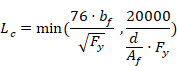 (F1-2)
Where:
|
bf |
Total flange width. |
|
d |
Total depth. |
|
Af |
Area of flange. |
a) Members with unbraced length less than Lc
Elements with compact sections. If the condition F1-2, defined in article F1.1, is satisfied and both the web and flange conditions are met, the section can reach its ultimate plastic moment without any buckling effects. As a result, the strength can be increased by 10%, and the allowable stress can be determined as follows:
 (F1-1)
Elements with non compact sections. If the condition F1-2 is satisfied, but the web is non compact, the section can reach its ultimate plastic moment without buckling; therefore the resistance can be increased up to 10 %. As a result the allowable stress will be:
 (F1-5)
This equation must be multiplied by the full reduction factor Qs, obtaining:

With the case that the condition F1-2 is fulfilled, but the flanges are non compact or slender elements, the allowable stress is assumed as:
- For rolled shapes:
 (F1-3)
- For welded shapes:
 (F1-4)
The factor Kc is obtained as:
If  then
then 
If  then
then 
b) Members with unbraced length greater than Lc
If the condition defined in article F1.1 is not satisfied, regardless of whether the section is compact, the allowable bending stress will be calculated as follows:
If  then
then
If  then
then

If  then
then 
Where:
|
rt |
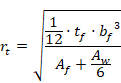
The radius of gyration of a section consisting of the area of the compression flange plus one third of the area of the compression web, taken about an axis in the plane of the web, is given by:
Where Af is the area of a flange and Aw the area of the web. The inertia corresponding to the additional 1/3 of the compression web area is neglected.
|
|
Cb |
Where M1 is the smaller bending moment at the ends of the unbraced length and M2 the larger one. |

An exact calculation would require the coefficient Cb to be defined in terms of moments and forces for each beam and for each load hypothesis.
AISC-ASD Code indicates this constant can be defined
conservatively with a value of  ; as a result, the program assumes this
value for Cb.
; as a result, the program assumes this
value for Cb.
However, this value can be changed by the user in the member properties (~MEMBPRO command).
c) Allowable Bending Stress Reduction (Chapter G)
When the web of a member buckles under bending, a portion of the stresses resisted by the web is transferred to the flanges. Therefore, the actual stresses of the flange under compression are greater those calculated. In order to avoid lateral buckling problems, the allowable stresses must be reduced.
When the following is fulfilled:

the allowable bending stress should not exceed the value given by:
 (G2-1)
Where:


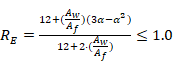 (hybrid girders)
 (non-hybrid girders)
In the above expressions,  is defined as 1.0 because currently the program only considers
non-hybrid girders.
is defined as 1.0 because currently the program only considers
non-hybrid girders.
10-I.6.4.1.2 Weak Axis Bending
Elements with compact sections. For doubly symmetric beams, such as I-shaped sections, with compact sections, the allowable stress can be determined as follows:
 (F2-1)
This stress is allowed for I-shaped compact sections because of its high stiffness value against lateral buckling in the direction of maximum inertia.
Elements with non compact sections. For the rest of the non compact sections, the allowable bending stress will be:
 (F2-3)
If the section does not satisfy the non compact section requirement, the allowable bending stress will be given by:
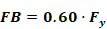
For channel sections the allowable bending stress in the direction of minimum inertia is taken as follows:
(F2-2)
10-I.6.4.2 Allowable Stress of Pipe Sections
For pipe sections, the allowable bending stress for both strong and weak axes of bending is taken as:
For compact sections:
(F3-1)
For non-compact sections:
(F3-3)
10-I.6.4.3 Allowable Stress of T Sections
10-I.6.4.3.1 Strong Axis Bending
As with I-shaped sections, the section F1.1 Members with compact sections specifies a check for T sections: the laterally unsupported length must be less than Lc, given as the smaller of:
 (F1-2)
Where:
|
bf |
Total flange width. |
|
d |
Total depth. |
|
Af |
Area of flange. |
a) Members with an unbraced length less than Lc
Elements with compact sections. If the compact web and flange conditions as well as the condition F1-2, defined in article F1.1, are fulfilled, the section can reach its ultimate plastic moment without experiencing buckling effects. As a result, the strength can be increased by at least 10%, and the allowable stress can be adopted as follows:
(F1-1)
Elements with non compact sections. For the case that the condition F1-2 is fulfilled but the web is non compact, the section still can reach its ultimate plastic moment without experiencing buckling; therefore the resistance can be increased to 10 %. As a result the allowable stress will be:
(F1-5)
This equation must be multiplied by the full reduction factor Qs, obtaining:
b) Members with unbraced length greater than Lc
If the condition defined in the article F1.1 is not fulfilled, regardless of whether the section is compact, the allowable bending stress will be calculated as follows:
If then
If then
If then
c) Allowable bending stress reduction (Chapter G)
When the web of a member buckles under bending, a portion of the stresses resisted by the web is transferred to the flanges. Therefore, the actual stresses of the flange under compression are greater those calculated. In order to avoid lateral buckling problems, the allowable stresses must be reduced.
When the following is fulfilled:
the allowable bending stress shall not exceed the value given by:
(G2-1)
The definitions for Qs ,Cb,rt , RPG and RE are equivalent to those previously described.
10-I.6.4.3.2 Weak Axis Bending
For sections that do not fulfill conditions of section F2.1, specifically those that are not doubly symmetrical or those that are non compact, the allowable stress will be given by:
(F2-2)
10-I.6.4.4 Allowable Stress of Box Sections
For compact sections members that are bent about either principle axis, satisfy the requirements of section B5 and contain flanges continuously connected to the webs, the allowable stress is:
(F3-1)
If the section does not satisfy the non compact section requirement of B5, the allowable bending stress will be given by:
(F3-3)
When the web of a member buckles under bending, a portion of the stresses resisted by the web is transferred to the flanges. Therefore, the actual stresses of the flange under compression are greater than the calculated stresses. In order to avoid lateral buckling problems, the allowable stresses must be reduced.
When the following is fulfilled:
the allowable bending stress shall not exceed the value given by:
(G2-1)
The definitions for RPG and RE are equivalent to those previously described.
10-I.6.4.5 Allowable Stress of Single-Angle Members
AISC-ASD code includes a specification (5-303) for the allowable stress design of single angle members.
The allowable bending stresses are calculated based on their principal axes of bending.
The allowable stress is the minimum between the limit states of local buckling and lateral-torsional buckling:
10-I.6.4.5.1 Local Buckling
To prevent local buckling when the tip of an angle leg is in compression:
When  then
then
(5-1a)
When  then
then
(5-1b)
When  then
then
(5-1c)
Where:
b full width of angle leg in compression.
t thickness of the leg under consideration.
Q stress reduction factor per Eq. (4-3a), (b) and (c)
An angle leg is considered to be in compression if the tip of the angle leg is in compression; consequently, the calculated stress at the tip of this leg is used.
For the tip of an angle leg in tension:
(5-2)
10-I.6.4.5.2 Lateral-Torsional Buckling
To prevent lateral-torsional buckling, the maximum compression stress shall not exceed:
When  then
then
 (5-3a)
When  then
then
 (5-3b)
Where  is the elastic lateral-torsional buckling stress as calculated below.
a) Bending about the Major Axis:
 (5-6)
(5-6)
Where:
|
IUU |
Major principal moment of inertia. |
|
IVV |
Minor principal moment of inertia. |
|
WU |
Major section modulus for compression at the tip of one leg |
|
rV |
Radius of gyration for minor principal axis |
|
βU |
|
|
v0 |
Coordinate along v axis of the shear center with respect to centroid. |

b) Bending about the Minor Axis
This case follows the same procedure as described for local buckling (10-G.6.4.5.1).
10-I.6.4.6 Calculation of AISC-ASD Criterion
The total criterion is stored as the CRT_TOT parameter in the active alternative in CivilFEM’s results file for each element end. This value must be between 0.0 and 1.0 for the element to be valid according to the AISC-ASD code; therefore, the equivalent stress must be less than the steel design stress.

Where fb is the computed bending stress (z axis default):

10-I.6.5 Allowable Stress in Shear
In CivilFEM, elements subjected to shear forces are checked according to the AISC-ASD code for each end of the selected elements or solid sections of the model with a structural steel cross section.
10-I.6.5.1 Bending about the Major Axis
The allowable shear stress for all sections except I-shaped, T, box and channel sections, is calculated as follows:
 (F4-1)
The allowable shear stress for shear directed along the major axis for I-shapes, tees, boxes and channels is evaluated as follows:
If the ratio h/tw is less than:

Where:
|
h |
Clear distance between flanges |
|
tw |
Web thickness |
the allowable shear stress for the overall depth divided by the web thickness is:
(F4-1)
Otherwise, allowable stress for the clear distance between flanges divided by the web thickness is:
 (F4-2)
where Cv is calculated by the following expression:

If Cv is greater than 0.8, Cv is calculated as follows:

Where KV is a variable that depends on the distance between the flanges, t, and the spacing between stiffeners, a:
If  :
:

If :

For the AISC-ASD code, the program assumes there are no stiffeners; therefore a/t is greater than 1.0 and Kv will be calculated as a constant equal to 5.34.
Also, the code check module does not include the diagonal tension field action specified by the Code in the chapter G3, Allowable shear stress with tension field action.
10-I.6.5.2 Bending about the Minor Axis
The Code establishes that the allowable shear stress is equal to:
(F4-1)
10-I.6.5.3 Calculation of AISC-ASD Criterion
The total criterion is stored as the CRT_TOT parameter in the active alternative in CivilFEM’s results file for each element end. This value must be between 0.0 and 1.0 for the element to be valid according to the AISC-ASD code; as a result, the equivalent stress must be less than the steel design stress.

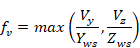
This equivalent stress fv is the maximum value obtained for both directions:
10-I.6.6 Combined Stresses: Axial Compression and Bending
In CivilFEM, bending and axial compression forces are checked according to the AISC-ASD code (chapter H1) for each end of the selected elements or solid sections of the model with a structural steel cross section.
The following requirements shall be met simultaneously:


Cm is a coefficient that depends on the bending moment distribution along the structure. This coefficient can also have different values depending on the constraint conditions and its mobility, according to the section H1 of AISC-ASD Code. In the case above, both Cmx and Cmy are equal to 0.85; this value is recommended for compression members in frames subjected to joint translation (sideways) or for members whose ends are restrained against translation in the plane of bending. This value is usually conservative.
FEY and FEZ are Euler stresses in two principal directions, each divided by a factor of safety. This factor allows for residual stresses or a possible failure due to initial imperfections in the member. The factor of safety is equal to 1.67; however, in slender columns extremely sensitive to initial eccentricities, the AISC-ASD code increases this factor by approximately 15%. Therefore, the global factor of safety is 23/12.


10-I.6.6.1 Calculation of AISC-ASD Criterion
The total criterion is stored as the CRT_TOT parameter in the active alternative in the CivilFEM’s results file for each element end. This value must be between 0.0 and 1.0 so that the element will be valid according to the AISC-ASD code; consequently, the equivalent stress must be less than the steel design stress.

10-I.6.7 Combined Stresses: Axial Tension and Bending
In CivilFEM, bending and axial tension forces are checked according to AISC-ASD code (chapter H2) for each element end of those selected elements or solid sections of the model with a structural steel cross section.
10-I.6.7.1 Calculation of AISC-ASD Criterion
The total criterion is stored as the CRT_TOT parameter in the active alternative in CivilFEM’s results file for each element end. This value must be between 0.0 and 1.0 for the element to be valid according to the AISC-ASD code; therefore, the equivalent stress must be less than the steel design stress.
