

11-C.1 Introduction
11-C.2 Shear and Torsion according to ACI 349-01 and ACI 349-06
Strength reduction factor ϕ is taken as ϕ = 0.85 (ACI 349-01) and ϕ = 0.75 (ACI 349-06) for shear and torsion according to Chapter 9.3.2 of Code Requirements for Nuclear Safety Related Concrete Structures (ACI 349-01 and ACI 349-06) documents.
11-C.2.1 Shear Checking
Shear checking according to ACI 349-01and ACI 349-06 is described in this section. Units in these equations refer to the US (British) force, length, time units measured in pounds, inches, and seconds.
1) Obtaining material strength properties. The required material properties associated with each transverse cross section at the active time (see ~CFMP command) are:
 specified compressive strength of concrete.
 specified yield strength of reinforcement.
2) Obtaining geometrical data of the section. Section geometrical requirements must be defined within the CivilFEM database, (~CSECDMS commands). Required data for shear checking:
 area of concrete section.
3) Obtaining geometrical parameters depending on specified code. Geometrical parameters used for shear calculations must be defined within the CivilFEM database, (see ~SECMDF command). The required data:
 web width or diameter
of circular section, (parameter BW_VY or BW_VZ of ~SECMDF command).
web width or diameter
of circular section, (parameter BW_VY or BW_VZ of ~SECMDF command).
d distance from the extreme compressed fiber to the centroid of the longitudinal tensile reinforcement in the Y direction, (for circular sections, this must not be less than the distance from the extreme compressed fiber to the centroid of the tensile reinforcement in the opposite half of the member), (parameter D_Y or D_Z of ~SECMDF command).
Section 11-A.7 “Previous Considerations to Shear and Torsion Calculation” provides detailed information on how to calculate the required data for each code and valid section.
4) Obtaining section reinforcement data. Data concerning reinforcements of the section must be included within the CivilFEM database. (See ~RNFDEF and ~RNFMDF commands). Required data includes:
a angle between shear reinforcement and the longitudinal axis of the member section, (parameter ALPHA of ~RNFDEF or ~RNFMDF commands).
 area of reinforcement per unit length (reinforcement ratio)
in both the Y and Z directions, (These can be defined directly using the ASSY
and ASSZ parameters as part of the ~RNFDEF or ~RNFMDF
commands).
area of reinforcement per unit length (reinforcement ratio)
in both the Y and Z directions, (These can be defined directly using the ASSY
and ASSZ parameters as part of the ~RNFDEF or ~RNFMDF
commands).
The reinforcement ratio may also be obtained with the following data:
 total area of the reinforcement legs, (parameters ASY
and ASZ of ~RNFDEF or ~RNFMDF commands - both Y and Z directions are available).
total area of the reinforcement legs, (parameters ASY
and ASZ of ~RNFDEF or ~RNFMDF commands - both Y and Z directions are available).
s spacing of the stirrups, (parameter S of ~RNFDEF or ~RNFMDF commands).
or with the data below:
s spacing of the stirrups, (parameter S of ~RNFDEF or ~RNFMDF commands).
f diameter of bars, (parameter PHI of ~RNFDEF or ~RNFMDF commands).
N number of reinforcement legs, (parameters NY or NZ of ~RNFDEF or ~RNFMDF commands for Y and Z directions).
5) Obtaining forces acting on the section. The forces that act on the section are obtained from the CivilFEM results file (.RCV).
Force Description
 Factored design shear force in the section
 Factored axial force occurring
simultaneously to the shear force (positive for compression).
Factored axial force occurring
simultaneously to the shear force (positive for compression).
6) Calculating the shear strength provided by concrete for nonprestressed members. First, the shear strength provided by concrete (Vc) is calculated with the following expression:

where:
 square root of specified compressive strength of
concrete, in psi (always taken as less than 100 psi).
square root of specified compressive strength of
concrete, in psi (always taken as less than 100 psi).
For sections subject to a compressive axial force:

If the section is subjected to a tensile force such that the tensile stress is less than 500 psi:

If the section
is subjected to a tensile force such that the tensile stress exceeds 500 psi,
it is assumed that  .
.
The calculated result at both element ends is stored in the CivilFEM results file as the parameter VC:
VC Shear strength provided by concrete.

7) Calculating the shear strength provided by the shear reinforcement. The strength provided by the shear reinforcement (Vs) is calculated with the following expression:

where:
 yield strength of the shear reinforcement (not greater
than 60,000 psi).
yield strength of the shear reinforcement (not greater
than 60,000 psi).
The calculated result at both element ends is stored in the CivilFEM results file as the parameter VS:
VS Shear strength provided by transverse reinforcement.

8) Calculating the nominal shear strength of section. The nominal shear strength (Vn) is the sum of the shear strength provided by the concrete and the shear reinforcement as described in the previous sections:

This nominal shear strength as well as its ratio to the design shear are stored in the CivilFEM results file as the parameters:
VN Nominal shear strength.

CRTVN Ratio of the design shear force (Vu) to the resistance Vn.

If the shear strength provided by the concrete is null and shear
reinforcement is not defined in the section, then  , and the criterion is set equal to –1.
9) Obtaining shear criterion. The section will be valid for shear if the following condition is satisfied

f strength reduction factor of the section.
Therefore, the validity of the shear criterion is defined as follows:
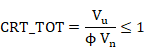
For each element, this shear utilization value is stored in the CivilFEM results file as the parameter CRT_TOT.
In cases where the strength provided by the concrete is null and the
shear reinforcement is not defined in the section, the shear strength , and the criterion is set equal to 2100.
The  value is stored in the CivilFEM results file as the parameter VFI.
11-C.2.2 Torsion Checking
Torsion checking according to ACI 349-01 and ACI 349-06 is described in this section. Units in these equations refer to the US (British) force, length, time units measured in pounds, inches, and seconds.
1) Obtaining material strength properties. These properties are obtained from the material properties associated with each transverse cross section at the active time, (see ~CFMP command).
specified compressive strength of concrete.
specified yield strength of reinforcement.
2) Obtaining geometrical parameters depending on specified code. Geometrical parameters used for torsion calculations must be defined within the CivilFEM database, (see ~SECMDF command). The required data are as follows:
web width or diameter
of circular section, (parameter BW_VY or BW_VZ of ~SECMDF command).
d distance from the extreme compression fiber to the centroid of the longitudinal tensile reinforcement in Y, (for circular sections, this must not be less than the distance from the extreme compression fiber to the centroid of the tensile reinforcement in the opposite half of the member), (parameter D_Y or D_Z of ~SECMDF command).
 Area enclosed by outside perimeter of the concrete cross
section, (parameter ACP of ~SECMDF command).
Area enclosed by outside perimeter of the concrete cross
section, (parameter ACP of ~SECMDF command).
 Outside perimeter of the concrete cross section, (PCP of
~SECMDF command).
Outside perimeter of the concrete cross section, (PCP of
~SECMDF command).
 Area enclosed by the centerline of the outermost closed
transverse torsional reinforcement, (parameter AOH of ~SECMDF
command).
Area enclosed by the centerline of the outermost closed
transverse torsional reinforcement, (parameter AOH of ~SECMDF
command).
 Perimeter of the centerline of the outermost closed
transverse torsional reinforcement, (parameter PH of ~SECMDF
command).
Perimeter of the centerline of the outermost closed
transverse torsional reinforcement, (parameter PH of ~SECMDF
command).
 Gross area enclosed by the shear flow path, (parameter
AO of ~SECMDF command).
Gross area enclosed by the shear flow path, (parameter
AO of ~SECMDF command).
Section 11-A.7 “Previous Considerations to Shear and Torsion Calculation” provides detailed information on how to calculate the required data for each valid section.
3) Obtaining reinforcement data of the section. Data concerning reinforcements of the section must be included within the CivilFEM database, (~RNFDEF and ~RNFMDF commands). Required data are as follows:
Transverse Reinforcement
 area of transverse reinforcement per unit length, (this can
be defined directly using the ASST parameter as part of the ~RNFDEF
and ~RNFMDF commands).
area of transverse reinforcement per unit length, (this can
be defined directly using the ASST parameter as part of the ~RNFDEF
and ~RNFMDF commands).
The reinforcement ratio can alternatively be defined using the following data:
 closed stirrups area for torsion, (parameter AST of ~RNFDEF
and ~RNFMDF commands).
closed stirrups area for torsion, (parameter AST of ~RNFDEF
and ~RNFMDF commands).
s spacing of closed stirrups, (parameter S of ~RNFDEF and ~RNFMDF commands).
Or with the data below:
s spacing of closed stirrups, (parameter S of ~RNFDEF and ~RNFMDF commands).
 diameter of the closed stirrups, (parameter PHIT of ~RNFDEF
and ~RNFMDF commands).
diameter of the closed stirrups, (parameter PHIT of ~RNFDEF
and ~RNFMDF commands).
Longitudinal Reinforcement
 total area of the longitudinal reinforcement, (parameter
ASL of ~RNFDEF and ~RNFMDF commands).
total area of the longitudinal reinforcement, (parameter
ASL of ~RNFDEF and ~RNFMDF commands).
The reinforcement ratio can also be defined using the following data:
 diameter of longitudinal bars, (parameter PHIL of ~RNFDEF
and ~RNFMDF commands).
diameter of longitudinal bars, (parameter PHIL of ~RNFDEF
and ~RNFMDF commands).
N number of longitudinal bars, (parameter N of ~RNFDEF and ~RNFMDF commands).
4) Obtaining section internal forces and moments. The torsional moment that acts on the section is obtained from the CivilFEM results file (.RCV).
Moment Description
 Factored design torsional moment.
5) Checking whether torsion effects will be considered. Torsion effects are only considered if the design torsional moment (Tu) satisfies the following equation:

If the design torsional moment is less than this value, its effects can be neglected and it is considered as null for checking.
6) Checking section dimensions. Section dimensions must satisfy the following requirements:


In hollow sections, if the section wall thickness is less than Aoh/Ph, this value must be substituted with the minimum thickness of the section in the expression above.
The ratio of the two coefficients is stored in the CivilFEM results file at both element ends as the parameter:

7) Calculating the nominal torsional moment strength of the section. The nominal torsional moment strength (Tn) is evaluated with the following expression:

where:
specified yield strength of torsional reinforcement
(not greater than 60000 psi).
This nominal torsional moment strength and its ratio to the design shear force are stored in the CivilFEM results file at both element ends as the parameters:
TN Nominal torsional moment strength.

CRTTN Ratio of the design torsional moment (Tu) to the torsional moment strength Tn .

The needed longitudinal reinforcement area is given by:

The calculated results are stored in the CivilFEM results file at both element ends as the parameters:
ALT Area of torsion longitudinal reinforcement required in accordance to the torsion transverse reinforcement defined.

CRTALT Ratio of the area of torsion longitudinal reinforcement required to the area of torsion longitudinal reinforcement defined.

If longitudinal reinforcement is not
defined, then , and the criterion is set equal to 2100.
8) Obtaining torsion criterion. The section will be valid for torsion if the following condition is satisfied:


f strength reduction factor of the section.
Therefore, the torsion design utilization is defined as follows:

For each element end, this value is stored in the CivilFEM results file.
In cases where the strength provided by concrete is null and the torsion reinforcement is not defined in the section, the criterion will be set to 2100.
The  value is stored in the CivilFEM results file at both element ends
as the parameter TFI.
value is stored in the CivilFEM results file at both element ends
as the parameter TFI.
11-C.2.3 Combined Shear and Torsion Checking
For checking sections subjected to combined shear force and torsional moment, the following steps are taken:
1) Checking if torsion effects must be considered. Torsion effects are only considered if the design torsional moment (Tu) satisfies the condition below:
If the design torsional moment is less than this value its effects can be neglected and it is considered as null for checking.
2) Checking section dimensions. For shear force and associated torsional moment, section dimensions must satisfy the following requirements:
a) Solid sections:

b) Hollow sections:

In hollow
sections if the section wall thickness is lower than  , this value is changed in the previous expression by the section
minimum thickness.
, this value is changed in the previous expression by the section
minimum thickness.
The ratio between these two factors is stored in the CivilFEM results file at both element ends.
a) Solid sections:

b) Hollow sections:

3) Checking for shear force with associated torsional moment. This checking is accomplished following the same steps considered for the checking of elements subjected only to shear force according to ACI 349. The same results as defined in the shear check are calculated.
4) Checking for torsion with shear force. This checking is accomplished following the same steps considered for the checking of elements subjected only to torsion according to ACI 349. The same results as defined in the torsion check are calculated.
5) Obtaining the combined shear and torsion criterion. This criterion determines whether the section is valid or not. The utilization is defined as follows:

For each end, this value is stored in the CivilFEM results file.
A value equals to 2100 for this criterion would indicate one of the following:
h the shear strength provided by concrete is equal to zero and shear reinforcement has not been defined
h the shear strength provided by concrete is equal to zero and transverse torsion reinforcement has not been defined
h the longitudinal torsion reinforcement has not been defined
11-C.2.4 Shear Design
Shear design according to ACI 349-01 and ACI 349-06 is described in this section. Units in these equations refer to the US (British) force, length, time units measured in pounds, inches, and seconds.
1) Obtaining material strength properties. The required material properties associated with each transverse cross section at the active time (see ~CFMP command) are:
specified compressive strength of concrete.
specified yield strength of reinforcement.
2) Obtaining section geometrical data. Section geometrical requirements must be defined within the CivilFEM database, (~CSECDMS command). Required data for shear design:
area of concrete section.
3) Obtaining geometrical parameters depending on specified code. Geometrical parameters used for shear designing must be defined within the CivilFEM database, (see ~SECMDF command). The required data:
web width or diameter
of the circular section, (parameter BW_VY or BW_VZ of ~SECMDF
command).
d distance from the extreme compressed fiber to the centroid of the longitudinal tensile reinforcement in Y, (for circular sections, this must not be less than the distance from the extreme compressed fiber to the centroid of the tensile reinforcement in the opposite half of the member), (parameter D_Y or D_Z of ~SECMDF command).
Section “11-A.7 Previous Considerations to Shear and Torsion Calculation” provides detailed information on how to calculate the required data for each code and valid section.
4) Obtaining reinforcement data of the section. In shear reinforcement designing, it is possible to define the angle a between the reinforcement and the longitudinal axis of the member. This angle must be stored in the shear reinforcement data of each element, (parameter ALPY and ALPZ of ~RNFDEF and ~RNFMDF commands). If this angle is equal to zero or is not defined, a=90º. Other data concerning to reinforcements are ignored.
5) Obtaining forces and moments acting on the section. The shear force that acts on the section as well as the associated axial force are obtained from the CivilFEM results file (.RCV).
Force Description
Factored design shear force.
Factored axial force occurring
simultaneously with the shear force (positive for compression).
6) Calculating the shear strength provided by concrete for nonprestressed members. First, the shear strength provided by the concrete (Vc) is calculated with the following expression:
where:
square root of specified compressive strength of
concrete, in psi (always taken as less than 100 psi).
For sections subject to a compressive axial force:
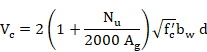
If section is subjected to a tensile force so that the tensile stress is less than 500 psi:

If the section is subjected to a tensile force such that the tensile stress exceeds 500 psi, it is assumed that Vc=0.
The calculated result is stored in the CivilFEM results file at both element ends as the parameter:
VC Shear strength provided by concrete.
7) Calculating the required reinforcement contribution to the shear strength. The section must satisfy the following condition to resist the shear force:
Therefore, the required shear strength of the reinforcement must be:

If the required shear strength of the reinforcement does not satisfy the expression above, the section cannot be designed; consequently, the reinforcement parameter will be defined as 2100. Then:
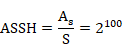
In this case, the element will be labeled as not designed, the program then advances to the following element.
The calculated result at both element ends is stored in the CivilFEM results file as the parameter VS:
VS Shear resistance provided by the transverse reinforcement.

8) Calculating the required reinforcement ratio. Once the shear force that the shear reinforcement must support has been obtained, the reinforcement is obtained from the following expression:

Where:
area of the
cross-section of the shear reinforcement.
s spacing of the stirrups measured along the longitudinal axis.
yield strength of the shear reinforcement (not greater
than 60000 psi). (Parameter FY in ~CFMP command).
The area of the designed reinforcement per unit length is stored in the CivilFEM results file at both element ends:

In this case, the element will be labeled as designed (providing the design process is correct at both element ends).
11-C.2.5 Torsion Design
The design of torsion reinforcements according to ACI 349-01 and ACI 349-06 follows these steps:
1) Obtaining material resistant properties. These properties are obtained from the material properties associated with each transverse cross section and for the active time, (see ~CFMP command).
specified compressive strength of concrete.
specified yield strength of reinforcement.
2) Obtaining geometrical parameters depending on specified code. Geometrical parameters used for torsion designing must be defined within the CivilFEM database, (see ~SECMDF command). The required data is as follows:
web width or diameter
of the circular section, (parameter BW_VY or BW_VZ of ~SECMDF
command).
d distance from the extreme compressed fiber to the centroid of the longitudinal tensile reinforcement in Y, (for circular sections, this should not be less than the distance from the extreme compressed fiber to the centroid of the tensile reinforcement in the opposite half of the member), (parameter D_Y or D_Z of ~SECMDF command).
Area enclosed by outside perimeter of the concrete cross
section, (parameter ACP of ~SECMDF command).
Outside perimeter of the concrete cross section, (PCP of
~SECMDF command).
Area enclosed by the centerline of the outermost closed
transverse torsional reinforcement, (parameter AOH of ~SECMDF
command).
Perimeter of the centerline of the outermost closed
transverse torsional reinforcement, (parameter PH of ~SECMDF
command).
Gross area enclosed by the shear flow path, (parameter
AO of ~SECMDF command).
Section 11-A.7 “Previous Considerations to Shear and Torsion Calculation” provides detailed information on how to calculate the required data for each valid section.
3) Obtaining forces and moments acting on the section. The torsional moment that acts on the section is obtained from the CivilFEM results file (.RCV).
Moment Description
Factored design torsional moment.
4) Checking whether torsion effects will be considered. Torsion effects are only considered if the design torsional moment (Tu) satisfies the condition below:

If the design torsional moment is less than this value, its effects can be neglected and it is consider as null for the design.
5) Checking section dimensions. Section dimensions must satisfy the following requirements:

In hollow sections, if the section’s wall thickness is less than Aoh/Ph, this value will be equal to the minimum thickness of the section in the formula above.
The torsion reinforcement will not be designed if the previous expression is not satisfied, so the parameters where the reinforcement is stored would be marked with 2100. Then:
 for transverse reinforcement
 for longitudinal reinforcement
In this case, the element will be marked as not designed.
The ratio of the two coefficients is stored in the CivilFEM results file at both element ends:

6) Calculating the required transverse reinforcement. In order to resist the torsional moment, the section must satisfy the following condition:

cross-sectional area of one leg of a closed stirrup of
the transverse reinforcement.
s spacing of the stirrups.
Therefore, the required transverse torsion reinforcement is:
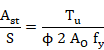
The area of the designed transverse reinforcement per unit length is stored in the CivilFEM results file at both element ends:

7) Determining the longitudinal reinforcement requirement. The longitudinal reinforcement area is given by the following expression:

The area of the designed longitudinal reinforcement is stored in the CivilFEM results file at both element ends:

If both transverse and longitudinal reinforcements are designed at both element ends, this element will be labeled as designed.
11-C.2.6 Combined Shear and Torsion Design
The design of sections subjected to combined shear force and torsional moment, follows the steps below:
1) Checking whether torsion effects will be considered. Torsion effects are only considered if the design torsional moment (Tu) satisfies the condition below:
If the design torsional moment is less than this value, its effects can be neglected and it will be considered as null for designing.
2) Checking section dimensions. For shear force and associated torsional moment, section dimensions must satisfy the following requirements:
a) Solid sections:
b) Hollow sections:

In hollow sections, if the section wall thickness is less than Aoh/Ph, this last value will be equal to the minimum thickness of the section in the equation above.
If the expression above is not satisfied, the torsion reinforcement will not be designed; as a result, the reinforcement parameters will be defined as:
 for transverse reinforcement
 for longitudinal reinforcement
In this case, the element will be labeled as not designed, and the program will then advance to the next element.
The ratio of the two coefficients is stored in the CivilFEM results file at both element ends.
a) Solid sections:
b) Hollow sections:
3) Shear design assuming a null torsional moment. This design is accomplished with the same procedure as for the design of elements subjected to pure shear force according to ACI 349-01 and ACI 349-06.
4) Torsion design considering a null shear force. This design is follows the same procedure as for the design of elements subjected to pure torsion according to ACI 349-01 and ACI 349-06.
11-C.3 Shear and Torsion according to ACI 349-13
Strength reduction factor ϕ is taken as ϕ = 0.75 for shear and torsion according to Chapter 9.3.2 of Code Requirements for Nuclear Safety Related Concrete Structures (ACI 349-13) documents.
11-C.3.1 Shear Checking
Shear checking according to ACI 349-13 is described in this section. Units in these equations refer to the US (British) force, length, time units measured in pounds, inches, and seconds.
10) Obtaining material strength properties. The required material properties associated with each transverse cross section at the active time (see ~CFMP command) are:
specified compressive strength of concrete.
specified yield strength of reinforcement.
 modification factor for lightweight concrete.
11) Obtaining geometrical data of the section. Section geometrical requirements must be defined within the CivilFEM database, (~CSECDMS commands). Required data for shear checking:
area of concrete section.
12) Obtaining geometrical parameters depending on specified code. Geometrical parameters used for shear calculations must be defined within the CivilFEM database, (see ~SECMDF command). The required data:
web width or diameter
of circular section, (parameter BW_VY or BW_VZ of ~SECMDF command).
d distance from the extreme compressed fiber to the centroid of the longitudinal tensile reinforcement in the Y direction, (for circular sections, this must not be less than the distance from the extreme compressed fiber to the centroid of the tensile reinforcement in the opposite half of the member), (parameter D_Y or D_Z of ~SECMDF command).
Section 11-A.7 “Previous Considerations to Shear and Torsion Calculation” provides detailed information on how to calculate the required data for each code and valid section.
13) Obtaining section reinforcement data. Data concerning reinforcements of the section must be included within the CivilFEM database. (See ~RNFDEF and ~RNFMDF commands). Required data includes:
a angle between shear reinforcement and the longitudinal axis of the member section, (parameter ALPHA of ~RNFDEF or ~RNFMDF commands).
area of reinforcement per unit length (reinforcement ratio)
in both the Y and Z directions, (These can be defined directly using the ASSY
and ASSZ parameters as part of the ~RNFDEF or ~RNFMDF
commands).
The reinforcement ratio may also be obtained with the following data:
total area of the reinforcement legs, (parameters ASY
and ASZ of ~RNFDEF or ~RNFMDF commands - both Y and Z directions are available).
s spacing of the stirrups, (parameter S of ~RNFDEF or ~RNFMDF commands).
or with the data below:
s spacing of the stirrups, (parameter S of ~RNFDEF or ~RNFMDF commands).
f diameter of bars, (parameter PHI of ~RNFDEF or ~RNFMDF commands).
N number of reinforcement legs, (parameters NY or NZ of ~RNFDEF or ~RNFMDF commands for Y and Z directions).
14) Obtaining forces acting on the section. The forces that act on the section are obtained from the CivilFEM results file (.RCV).
Force Description
Factored design shear force in the section
Factored axial force occurring
simultaneously to the shear force (positive for compression).
15) Calculating the shear strength provided by concrete for nonprestressed members. First, the shear strength provided by concrete (Vc) is calculated with the following expression:

where:
square root of specified compressive strength of
concrete, in psi (always taken as less than 100 psi).
For sections subject to a compressive axial force:

If the section is subjected to a tensile force such that the tensile stress is less than 500 psi:

If the section
is subjected to a tensile force such that the tensile stress exceeds 500 psi,
it is assumed that .
The calculated result at both element ends is stored in the CivilFEM results file as the parameter VC:
VC Shear strength provided by concrete.
16) Calculating the shear strength provided by the shear reinforcement. The strength provided by the shear reinforcement (Vs) is calculated with the following expression:
where:
yield strength of the shear reinforcement (not greater
than 60,000 psi).
The calculated result at both element ends is stored in the CivilFEM results file as the parameter VS:
VS Shear strength provided by transverse reinforcement.
17) Calculating the nominal shear strength of section. The nominal shear strength (Vn) is the sum of the shear strength provided by the concrete and the shear reinforcement as described in the previous sections:
This nominal shear strength as well as its ratio to the design shear are stored in the CivilFEM results file as the parameters:
VN Nominal shear strength.
CRTVN Ratio of the design shear force (Vu) to the resistance Vn.
If the shear strength provided by the concrete is null and shear
reinforcement is not defined in the section, then , and the criterion is set equal to –1.
18) Obtaining shear criterion. The section will be valid for shear if the following condition is satisfied
f strength reduction factor of the section.
Therefore, the validity of the shear criterion is defined as follows:
For each element, this shear utilization value is stored in the CivilFEM results file as the parameter CRT_TOT.
In cases where the strength provided by the concrete is null and the
shear reinforcement is not defined in the section, the shear strength , and the criterion is set equal to 2100.
The value is stored in the CivilFEM results file as the parameter VFI.
11-C.3.2 Torsion Checking
Torsion checking according to ACI 349-13 is described in this section. Units in these equations refer to the US (British) force, length, time units measured in pounds, inches, and seconds.
9) Obtaining material strength properties. These properties are obtained from the material properties associated with each transverse cross section at the active time, (see ~CFMP command).
specified compressive strength of concrete.
specified yield strength of reinforcement.
modification factor for lightweight concrete.
10) Obtaining geometrical parameters depending on specified code. Geometrical parameters used for torsion calculations must be defined within the CivilFEM database, (see ~SECMDF command). The required data are as follows:
web width or diameter
of circular section, (parameter BW_VY or BW_VZ of ~SECMDF command).
d distance from the extreme compression fiber to the centroid of the longitudinal tensile reinforcement in Y, (for circular sections, this must not be less than the distance from the extreme compression fiber to the centroid of the tensile reinforcement in the opposite half of the member), (parameter D_Y or D_Z of ~SECMDF command).
Area enclosed by outside perimeter of the concrete cross
section, (parameter ACP of ~SECMDF command).
Outside perimeter of the concrete cross section, (PCP of
~SECMDF command).
Area enclosed by the centerline of the outermost closed
transverse torsional reinforcement, (parameter AOH of ~SECMDF
command).
Perimeter of the centerline of the outermost closed
transverse torsional reinforcement, (parameter PH of ~SECMDF
command).
Gross area enclosed by the shear flow path, (parameter
AO of ~SECMDF command).
Section 11-A.7 “Previous Considerations to Shear and Torsion Calculation” provides detailed information on how to calculate the required data for each valid section.
11) Obtaining reinforcement data of the section. Data concerning reinforcements of the section must be included within the CivilFEM database, (~RNFDEF and ~RNFMDF commands). Required data are as follows:
Transverse Reinforcement
area of transverse reinforcement per unit length, (this can
be defined directly using the ASST parameter as part of the ~RNFDEF
and ~RNFMDF commands).
The reinforcement ratio can alternatively be defined using the following data:
closed stirrups area for torsion, (parameter AST of ~RNFDEF
and ~RNFMDF commands).
s spacing of closed stirrups, (parameter S of ~RNFDEF and ~RNFMDF commands).
Or with the data below:
s spacing of closed stirrups, (parameter S of ~RNFDEF and ~RNFMDF commands).
diameter of the closed stirrups, (parameter PHIT of ~RNFDEF
and ~RNFMDF commands).
Longitudinal Reinforcement
total area of the longitudinal reinforcement, (parameter
ASL of ~RNFDEF and ~RNFMDF commands).
The reinforcement ratio can also be defined using the following data:
diameter of longitudinal bars, (parameter PHIL of ~RNFDEF
and ~RNFMDF commands).
N number of longitudinal bars, (parameter N of ~RNFDEF and ~RNFMDF commands).
12) Obtaining section internal forces and moments. The torsional moment that acts on the section is obtained from the CivilFEM results file (.RCV).
Moment Description
Factored design torsional moment.
13) Checking whether torsion effects will be considered. Torsion effects are only considered if the design torsional moment (Tu) satisfies the following equation:

If the design torsional moment is less than this value, its effects can be neglected and it is considered as null for checking.
14) Checking section dimensions. Section dimensions must satisfy the following requirements:
In hollow sections, if the section wall thickness is less than Aoh/Ph, this value must be substituted with the minimum thickness of the section in the expression above.
The ratio of the two coefficients is stored in the CivilFEM results file at both element ends as the parameter:
15) Calculating the nominal torsional moment strength of the section. The nominal torsional moment strength (Tn) is evaluated with the following expression:
where:
specified yield strength of torsional reinforcement
(not greater than 60000 psi).
This nominal torsional moment strength and its ratio to the design shear force are stored in the CivilFEM results file at both element ends as the parameters:
TN Nominal torsional moment strength.
CRTTN Ratio of the design torsional moment (Tu) to the torsional moment strength Tn .
The needed longitudinal reinforcement area is given by:
The calculated results are stored in the CivilFEM results file at both element ends as the parameters:
ALT Area of torsion longitudinal reinforcement required in accordance to the torsion transverse reinforcement defined.
CRTALT Ratio of the area of torsion longitudinal reinforcement required to the area of torsion longitudinal reinforcement defined.
If longitudinal reinforcement is not
defined, then , and the criterion is set equal to 2100.
16) Obtaining torsion criterion. The section will be valid for torsion if the following condition is satisfied:
f strength reduction factor of the section.
Therefore, the torsion design utilization is defined as follows:
For each element end, this value is stored in the CivilFEM results file.
In cases where the strength provided by concrete is null and the torsion reinforcement is not defined in the section, the criterion will be set to 2100.
The value is stored in the CivilFEM results file at both element ends
as the parameter TFI.
11-C.3.3 Combined Shear and Torsion Checking
For checking sections subjected to combined shear force and torsional moment, the following steps are taken:
6) Checking if torsion effects must be considered. Torsion effects are only considered if the design torsional moment (Tu) satisfies the condition below:
If the design torsional moment is less than this value its effects can be neglected and it is considered as null for checking.
7) Checking section dimensions. For shear force and associated torsional moment, section dimensions must satisfy the following requirements:
a) Solid sections:
b) Hollow sections:
In hollow
sections if the section wall thickness is lower than , this value is changed in the previous expression by the section
minimum thickness.
The ratio between these two factors is stored in the CivilFEM results file at both element ends.
a) Solid sections:
b) Hollow sections:
8) Checking for shear force with associated torsional moment. This checking is accomplished following the same steps considered for the checking of elements subjected only to shear force according to ACI 349. The same results as defined in the shear check are calculated.
9) Checking for torsion with shear force. This checking is accomplished following the same steps considered for the checking of elements subjected only to torsion according to ACI 349. The same results as defined in the torsion check are calculated.
10) Obtaining the combined shear and torsion criterion. This criterion determines whether the section is valid or not. The utilization is defined as follows:
For each end, this value is stored in the CivilFEM results file.
A value equals to 2100 for this criterion would indicate one of the following:
h the shear strength provided by concrete is equal to zero and shear reinforcement has not been defined
h the shear strength provided by concrete is equal to zero and transverse torsion reinforcement has not been defined
h the longitudinal torsion reinforcement has not been defined
11-C.3.4 Shear Design
Shear design according to ACI 349-13 is described in this section. Units in these equations refer to the US (British) force, length, time units measured in pounds, inches, and seconds.
1) Obtaining material strength properties. The required material properties associated with each transverse cross section at the active time (see ~CFMP command) are:
specified compressive strength of concrete.
specified yield strength of reinforcement.
2) Obtaining section geometrical data. Section geometrical requirements must be defined within the CivilFEM database, (~CSECDMS command). Required data for shear design:
area of concrete section.
3) Obtaining geometrical parameters depending on specified code. Geometrical parameters used for shear designing must be defined within the CivilFEM database, (see ~SECMDF command). The required data:
web width or diameter
of the circular section, (parameter BW_VY or BW_VZ of ~SECMDF
command).
d distance from the extreme compressed fiber to the centroid of the longitudinal tensile reinforcement in Y, (for circular sections, this must not be less than the distance from the extreme compressed fiber to the centroid of the tensile reinforcement in the opposite half of the member), (parameter D_Y or D_Z of ~SECMDF command).
Section “11-A.7 Previous Considerations to Shear and Torsion Calculation” provides detailed information on how to calculate the required data for each code and valid section.
4) Obtaining reinforcement data of the section. In shear reinforcement designing, it is possible to define the angle a between the reinforcement and the longitudinal axis of the member. This angle must be stored in the shear reinforcement data of each element, (parameter ALPY and ALPZ of ~RNFDEF and ~RNFMDF commands). If this angle is equal to zero or is not defined, a=90º. Other data concerning to reinforcements are ignored.
5) Obtaining forces and moments acting on the section. The shear force that acts on the section as well as the associated axial force are obtained from the CivilFEM results file (.RCV).
Force Description
Factored design shear force.
Factored axial force occurring
simultaneously with the shear force (positive for compression).
6) Calculating the shear strength provided by concrete for nonprestressed members. First, the shear strength provided by the concrete (Vc) is calculated with the following expression:

where:
square root of specified compressive strength of
concrete, in psi (always taken as less than 100 psi).
For sections subject to a compressive axial force:

If section is subjected to a tensile force so that the tensile stress is less than 500 psi:

If the section is subjected to a tensile force such that the tensile stress exceeds 500 psi, it is assumed that Vc=0.
The calculated result is stored in the CivilFEM results file at both element ends as the parameter:
VC Shear strength provided by concrete.
7) Calculating the required reinforcement contribution to the shear strength. The section must satisfy the following condition to resist the shear force:
Therefore, the required shear strength of the reinforcement must be:
If the required shear strength of the reinforcement does not satisfy the expression above, the section cannot be designed; consequently, the reinforcement parameter will be defined as 2100. Then:
In this case, the element will be labeled as not designed, the program then advances to the following element.
The calculated result at both element ends is stored in the CivilFEM results file as the parameter VS:
VS Shear resistance provided by the transverse reinforcement.
8) Calculating the required reinforcement ratio. Once the shear force that the shear reinforcement must support has been obtained, the reinforcement is obtained from the following expression:
Where:
area of the
cross-section of the shear reinforcement.
s spacing of the stirrups measured along the longitudinal axis.
yield strength of the shear reinforcement (not greater
than 60000 psi). (Parameter FY in ~CFMP command).
The area of the designed reinforcement per unit length is stored in the CivilFEM results file at both element ends:
In this case, the element will be labeled as designed (providing the design process is correct at both element ends).
11-C.3.5 Torsion Design
The design of torsion reinforcements according to ACI 349-13 follows these steps:
1) Obtaining material resistant properties. These properties are obtained from the material properties associated with each transverse cross section and for the active time, (see ~CFMP command).
specified compressive strength of concrete.
specified yield strength of reinforcement.
2) Obtaining geometrical parameters depending on specified code. Geometrical parameters used for torsion designing must be defined within the CivilFEM database, (see ~SECMDF command). The required data is as follows:
web width or diameter
of the circular section, (parameter BW_VY or BW_VZ of ~SECMDF
command).
d distance from the extreme compressed fiber to the centroid of the longitudinal tensile reinforcement in Y, (for circular sections, this should not be less than the distance from the extreme compressed fiber to the centroid of the tensile reinforcement in the opposite half of the member), (parameter D_Y or D_Z of ~SECMDF command).
Area enclosed by outside perimeter of the concrete cross
section, (parameter ACP of ~SECMDF command).
Outside perimeter of the concrete cross section, (PCP of
~SECMDF command).
Area enclosed by the centerline of the outermost closed
transverse torsional reinforcement, (parameter AOH of ~SECMDF
command).
Perimeter of the centerline of the outermost closed
transverse torsional reinforcement, (parameter PH of ~SECMDF
command).
Gross area enclosed by the shear flow path, (parameter
AO of ~SECMDF command).
Section 11-A.7 “Previous Considerations to Shear and Torsion Calculation” provides detailed information on how to calculate the required data for each valid section.
3) Obtaining forces and moments acting on the section. The torsional moment that acts on the section is obtained from the CivilFEM results file (.RCV).
Moment Description
Factored design torsional moment.
4) Checking whether torsion effects will be considered. Torsion effects are only considered if the design torsional moment (Tu) satisfies the condition below:

If the design torsional moment is less than this value, its effects can be neglected and it is consider as null for the design.
5) Checking section dimensions. Section dimensions must satisfy the following requirements:
In hollow sections, if the section’s wall thickness is less than Aoh/Ph, this value will be equal to the minimum thickness of the section in the formula above.
The torsion reinforcement will not be designed if the previous expression is not satisfied, so the parameters where the reinforcement is stored would be marked with 2100. Then:
for transverse reinforcement
for longitudinal reinforcement
In this case, the element will be marked as not designed.
The ratio of the two coefficients is stored in the CivilFEM results file at both element ends:
6) Calculating the required transverse reinforcement. In order to resist the torsional moment, the section must satisfy the following condition:
cross-sectional area of one leg of a closed stirrup of
the transverse reinforcement.
s spacing of the stirrups.
Therefore, the required transverse torsion reinforcement is:
The area of the designed transverse reinforcement per unit length is stored in the CivilFEM results file at both element ends:
7) Determining the longitudinal reinforcement requirement. The longitudinal reinforcement area is given by the following expression:
The area of the designed longitudinal reinforcement is stored in the CivilFEM results file at both element ends:
If both transverse and longitudinal reinforcements are designed at both element ends, this element will be labeled as designed.
11-C.3.6 Combined Shear and Torsion Design
The design of sections subjected to combined shear force and torsional moment, follows the steps below:
1) Checking whether torsion effects will be considered. Torsion effects are only considered if the design torsional moment (Tu) satisfies the condition below:
If the design torsional moment is less than this value, its effects can be neglected and it will be considered as null for designing.
2) Checking section dimensions. For shear force and associated torsional moment, section dimensions must satisfy the following requirements:
a) Solid sections:
b) Hollow sections:
In hollow sections, if the section wall thickness is less than Aoh/Ph, this last value will be equal to the minimum thickness of the section in the equation above.
If the expression above is not satisfied, the torsion reinforcement will not be designed; as a result, the reinforcement parameters will be defined as:
for transverse reinforcement
for longitudinal reinforcement
In this case, the element will be labeled as not designed, and the program will then advance to the next element.
The ratio of the two coefficients is stored in the CivilFEM results file at both element ends.
a) Solid sections:
b) Hollow sections:
3) Shear design assuming a null torsional moment. This design is accomplished with the same procedure as for the design of elements subjected to pure shear force according to ACI 349-13.
4) Torsion design considering a null shear force. This design is follows the same procedure as for the design of elements subjected to pure torsion according to ACI 349-13.
11-C.4 Cracking Analysis
In the current version, the cracking check of beam cross sections in CivilFEM is available for the following codes:
- Eurocode 2
- ITER Design Code
- ACI 318-05 and ACI 318-14
- EHE (EHE-98, EHE-08)
11-C.4.1 Code Properties
During the calculation process some cross sectional properties, grouped into the code properties, must be defined. These properties are the following:
Eurocode 2 and ITER Design Code:
PHI Reinforcement bars size (mm)
RHOr Effective reinforcement ratio
ACI 318:
Cc Geometrical cover
EHE:
PHI Reinforcement bars size (mm)
RHOr Effective reinforcement ratio
C Geometrical cover
S Distance between longitudinal bars
These properties are defined for each extreme fiber of the cross section, with respect to its coordinate system:
1: Fiber Y top
2: Fiber Y bottom
3: Fiber Z top
4: Fiber Z bottom
CivilFEM can automatically calculate these properties for the following concrete cross section types defined by dimensions:
- Rectangular section
- Box section
- T section
- I section
The automatic calculation of these properties is possible if the following conditions are met:
- The reinforcement groups are defined over the section’s faces by default when creating the section.
- Each section face has only one associated reinforcement group.
- The reinforcement groups are defined by bars. These should not be defined by linearly distributed reinforcement (condition not needed for ACI 318).
If the program cannot calculate these properties, they can be directly defined and modified through the ~SECMDF command.
If these properties are not defined for a concrete cross section in the direction of the bending moment, the section will not be checked for cracking and will be considered as non-checked.
11-C.5 Cracking Checking according to Eurocode 2 (ENV 1992-1-1:1991)
11-C.5.1 Decompression Checking
This check confirms whether all of the internal cross section points are under compression for the analyzed load state.
11-C.5.2 Cracking Checking
The cracking check is performed by calculating the crack width and checking the following condition:

where:
 Design crack width.
 Maximum crack width (argument of ~CHKCON
command)
Maximum crack width (argument of ~CHKCON
command)
The design crack width is obtained from the following expression (Art. 4.4.2.4):

 Coefficient that
relates the average crack width to the design width (argument of ~CHKCON command)
Coefficient that
relates the average crack width to the design width (argument of ~CHKCON command)
 Average final crack spacing.
 Average reinforcement strain
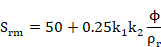

f Reinforcement bar size in mm (cross section code property, see ~SECMDF command).
 Coefficient accounting for the effect of the bond properties
of bar on the crack size (argument of ~CHKCON command).
Coefficient accounting for the effect of the bond properties
of bar on the crack size (argument of ~CHKCON command).
 Coefficient accounting for the influence of the form of the
strain distribution on the crack size:
Coefficient accounting for the influence of the form of the
strain distribution on the crack size:

Where  is the
larger tensile strain and
is the
larger tensile strain and is the
smaller tensile strain at the boundary of the section subjected to eccentric
tension.
is the
smaller tensile strain at the boundary of the section subjected to eccentric
tension.
 Effective reinforcement ratio, where As is the
area of reinforcement contained within the effective tension area. (Cross section
code property, see ~SECMDF command)
Effective reinforcement ratio, where As is the
area of reinforcement contained within the effective tension area. (Cross section
code property, see ~SECMDF command)
 Stress in the tensile reinforcement calculated considering a
cracked section.
Stress in the tensile reinforcement calculated considering a
cracked section.
 Elastic modulus of the longitudinal reinforcement.
 Stress in the tensile reinforcement calculated considering
the load conditions leading to the formation of the first crack.
Stress in the tensile reinforcement calculated considering
the load conditions leading to the formation of the first crack.
 Coefficient accounting for the influence of the bond
properties of the bar on the average strain (argument of ~CHKCON command).
Coefficient accounting for the influence of the bond
properties of the bar on the average strain (argument of ~CHKCON command).
 Coefficient accounting for the influence of the duration of
the loading or of the repetition of the loading on the average strain (argument
of ~CHKCON command).
Coefficient accounting for the influence of the duration of
the loading or of the repetition of the loading on the average strain (argument
of ~CHKCON command).
11-C.5.3 Reinforcement Stress Calculation
During the calculation process, it is necessary to determine the reinforcement stress under service loads (ss) as well as the reinforcement stress for the cracking of concrete (ssr). Both of these stresses assume the section as cracked.
The calculation of the stresses is an iterative process in which the program searches for the plane of deformation that causes a stress state that is in equilibrium with the external loads. The reinforcement stress is then obtained from the plane of deformation and from the reinforcement position.
The design loads are taken as external loads for the serviceability stress calculation. For the stress calculation at the instant the crack appears, the external loads are taken as homothetic to the design loads that cause a stress equivalent to the concrete tensile strength in the fiber with the greatest amount of tension.
If the loads that act on the cross section cause collapse under axial plus bending checking, the cross section and the associated element will be labeled as non-checked.
11-C.5.4 Checking Results
The checking results are stored in the corresponding alternative in the CivilFEM results file (*.RCV).
The following results are available (see ~PLLSCON and ~PRCON commands):
|
CRT_TOT |
Cracking criterion. |
||||||
|
SIGMA |
Maximum tensile stress. |
||||||
|
WK |
Design crack width. (Not valid for decompression checking). |
||||||
|
SRM |
Average final crack spacing. (Not valid for decompression checking). |
||||||
|
ESM |
Mean strain. (Not valid for decompression checking). |
||||||
|
POS |
Cracking position inside the section. (Not valid for decompression checking).
|
||||||
|
ELM_OK |
Plots Ok and not Ok elements. |
For the cracking check (wmax > 0) the total criterion is defined as:
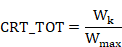
For decompression checking (wmax = 0) the total criterion is defined as:

where
 concrete design compressive strength
 Maximum section stress (positive tension), corresponding to the
SIGMA result. (If CRT_TOT is negative, it is taken as zero)
Maximum section stress (positive tension), corresponding to the
SIGMA result. (If CRT_TOT is negative, it is taken as zero)
Therefore, values for the total criterion greater than one indicate that the section is not valid according to the code.
11-C.6 Cracking Checking according to Eurocode 2 (EN 1992-1-1:2004/AC:2008) and ITER Design Code
11-C.6.1 Decompression Checking
This check verfies whether all of the internal cross section points are under compression for the analyzed load state.
11-C.6.2 Cracking Checking
The cracking check calculates the crack width and checks the following condition:

where:
 Design crack width.
Maximum crack width (argument of ~CHKCON
command)
The design crack width is obtained from the following expression (Art. 7.3.4):

 Maximum spacing between cracks.
Mean strain in the reinforcement.
 Mean strain in the concrete between bars.


f Reinforcement bar size in mm (cross section code property, see ~SECMDF command).
 Effective reinforcement ratio, where Ac,eff is the
effective area of concrete in tension, As is the area of
reinforcement contained within the effective concrete area and Ap’
is the area of pre- or post-tensioned tendons within Ac,eff. (Cross
section code property, see ~SECMDF command).
Effective reinforcement ratio, where Ac,eff is the
effective area of concrete in tension, As is the area of
reinforcement contained within the effective concrete area and Ap’
is the area of pre- or post-tensioned tendons within Ac,eff. (Cross
section code property, see ~SECMDF command).
Coefficient accounting for the influence of the bond
properties of the bonded reinforcement (argument of ~CHKCON
command).
Coefficient accounting for the influence of the form of the
strain distribution:
Where is the
larger tensile strain and is the
smaller tensile strain at the boundary of a section subjected to eccentric
tension.
 Constants defined in the National Annexes (arguments of the ~CHKCON command).
c Cover to the longitudinal reinforcement. (Cross section code property, see ~SECMDF command).
Stress in the tensile reinforcement calculated for a cracked
section.
Elastic modulus of the longitudinal reinforcement.
 Coefficient accounting for the influence of the duration of
the loading (argument of ~CHKCON command).
Coefficient accounting for the influence of the duration of
the loading (argument of ~CHKCON command).
 Ratio between steel-concrete elastic modulus (Es/Ecm).
11-C.6.3 Reinforcement Stress Calculation
During the calculation process, it is necessary to determine the reinforcement stress under service loads (ss) with the assumption the section is cracked.
The calculation of these stresses is an iterative process in which CivilFEM searches for the deformation plane that causes a stress state that is in equilibrium with the external loads. The reinforcement stress is obtained from this deformation plane and from the reinforcement position.
The design loads are taken as external loads for the case of serviceability stress calculation. For the stress calculation at the instant the crack appears, the external loads are taken as homothetic to the design loads that cause a stress equivalent to the concrete tensile strength in the fiber under the greatest amount of tension.
If the loads acting on the cross section cause collapse under axial plus bending checking, the cross section and the associated element are labeled as non-checked.
11-C.6.4 Checking Results
Checking results are stored in the corresponding alternative in the CivilFEM results file (*.RCV).
The following results are available (see ~PLLSCON and ~PRCON commands):
|
CRT_TOT |
Cracking criterion. |
||||||
|
SIGMA |
Maximum tensile stress. |
||||||
|
WK |
Design crack width. (Not valid for decompression checking). |
||||||
|
SRMAX |
Maximum spacing between cracks. (Not valid for decompression checking). |
||||||
|
EM |
Difference between the mean strain in the
reinforcement and the mean strain in concrete |
||||||
|
POS |
Cracking position inside the section. (Not valid for decompression checking).
|
||||||
|
ELM_OK |
Plots Ok and not Ok elements. |

For the cracking check (wmax > 0) the total criterion is defined as:
For decompression checking (wmax = 0) the total criterion is defined as:
where
concrete design compressive strength
Maximum section stress (positive tension). It corresponds to the
SIGMA result. (If CRT_TOT is negative, it’s taken as zero)
Therefore, values for the total criterion larger than one indicate that the section does not pass as valid for this code.
11-C.7 Cracking Checking according to ACI 318-05 and ACI 318-14
11-C.7.1 Decompression Checking
The decompression check determines if all of the internal cross section points are under compression for the analyzed load state.
11-C.7.2 Cracking Checking
Checking of the Cracking Limit State according to ACI 318-05 and ACI 318-14 consists of the following condition:

Where:
 Reinforcement spacing closest to the fiber in tension
(argument of ~CHKCON command)
Reinforcement spacing closest to the fiber in tension
(argument of ~CHKCON command)
S Design reinforcement spacing
CivilFEM checks this condition by applying the general calculation method for the reinforcement spacing (Art. 10.6.4):


where:
 Calculated stress in reinforcement at service loads.
 Geometrical cover (cross section code property, see ~SECMDF command)
11-C.7.3 Reinforcement Stress Calculation
During the calculation process, it’s necessary to determine the reinforcement stress under service loads (fs).
The calculation of the stresses is an iterative process in which the program searches for the deformation plane that causes a stress state that is in equilibrium with the external loads. The reinforcement stress is obtained from this deformation plane and from the reinforcement position.
The design loads are taken as external loads.
If the loads acting on the cross section cause collapse under axial plus bending checking, the cross section and the element to which it belongs are marked as non checked.
11-C.7.4 Checking Results
Checking results are stored in the corresponding alternative in the CivilFEM results file (*.RCV).
The following results are available (see ~PLLSCON and ~PRCON commands):
|
CRT_TOT |
Cracking criterion. |
||||||
|
S |
Design reinforcement spacing. (Not valid for decompression checking). |
||||||
|
FS |
Reinforcement stress. (Not valid for decompression checking). |
||||||
|
SIGMA |
Maximum tensile stress. |
||||||
|
POS |
Cracking position inside the section. (Not valid for decompression checking).
|
||||||
|
ELM_OK |
Plots Ok and not Ok elements. |
For the cracking check (sd > 0) the total criterion is defined as:

For decompression checking (sd = 0) the total criterion is defined as:

where
 concrete design compressive strength.
Maximum section stress (positive tension), corresponding to the
SIGMA result. (If CRT_TOT is negative, it is taken as zero)
Therefore, the values for the total criterion larger than one indicate that the section is not considered valid for this code.
11-C.8 Cracking Checking according to EHE (EHE-98 and EHE-08)
11-C.8.1 Decompression Checking
This check determines whether all of the internal cross section points are under compression for the analyzed load state.
11-C.8.2 Cracking Checking
Checking of the Cracking Limit State according to the EHE code consists of the following condition:
where:
Design crack width
Maximum crack width (argument of ~CHKCON
command)
CivilFEM checks this condition by applying the general calculation method for the crack width (Art. 49.2.5):
where:
Coefficient that
relates the average crack width to the characteristic value (argument of ~CHKCON command)
 Average final crack spacing.
Average reinforcement strain accounting for the collaboration
of the concrete among them.


c Concrete cover (cross section code property, see ~SECMDF command)
s Spacing of the longitudinal bars. If s > 15f, it is taken as s=15f. (cross section code property, see ~SECMDF command).
Coefficient representing the influence of the section
tension diagram on the spacing of the cracks

where is the
larger tensile strain and the
smaller tensile strain at the boundary of the section subjected to eccentric
tension.
f Reinforcement bar size (cross section code property, see ~SECMDF command).
Effective reinforcement ratio where As is the
area of reinforcement contained within the effective tension area (cross
section code property, see ~SECMDF command)
Stress in the tensile reinforcement calculated for a cracked
section
Modulus of the longitudinal strain of the reinforcement.
Stress in the tension reinforcement, calculated for a cracked
section under conditions of loading that leads to the formation of the first
crack.
Coefficient that depends on the type of loading (argument of
~CHKCON command)
11-C.8.3 Reinforcement Stress Calculation
During the calculation process, it is necessary to determine the reinforcement stress under service loads (ss) as well as the reinforcement stress for the cracking of concrete (ssr). Both of these stresses assume the cross section is cracked.
The calculation of these stresses is an iterative process in which the program searches for the deformation plane that causes a stress state that is in equilibrium with the external loads. The reinforcement stress is obtained from this deformation plane and from the reinforcement position.
The design loads are taken as external loads in the case of serviceability stress calculation. For the stress calculation in the instant that the crack appears, the external loads are taken as homothetic to the design loads that cause a stress equivalent to the concrete tensile strength in the fiber with the greatest amount of tension.
If the loads acting on the cross section cause collapse for axial plus bending checking, the cross section and the associated element are labeled as non-checked.
11-C.8.4 Checking Results
The checking results are stored in the corresponding alternative in the CivilFEM results file (*.RCV).
The following results are available (see ~PLLSCON and ~PRCON commands):
|
CRT_TOT |
Cracking criterion. |
||||||
|
SIGMA |
Maximum tensile stress. |
||||||
|
WK |
Design crack width. (Not valid for decompression checking). |
||||||
|
SRM |
Average final crack spacing. (Not valid for decompression checking). |
||||||
|
ESM |
Mean strain. (Not valid for decompression checking). |
||||||
|
POS |
Cracking position inside the section. (Not valid for decompression checking).
|
||||||
|
ELM_OK |
Plots Ok and not Ok elements. |
For the cracking check (wmax > 0) the total criterion is defined as:

For decompression checking (wmax = 0) the total criterion is defined as:

where
 concrete design compressive strength.
 Maximum section stress (positive tension). It corresponds to the
SIGMA result. (If CRT_TOT is negative, it’s taken as zero)
Maximum section stress (positive tension). It corresponds to the
SIGMA result. (If CRT_TOT is negative, it’s taken as zero)
Therefore, the values for the total criterion larger than one indicate that the section is not considered valid for this code.